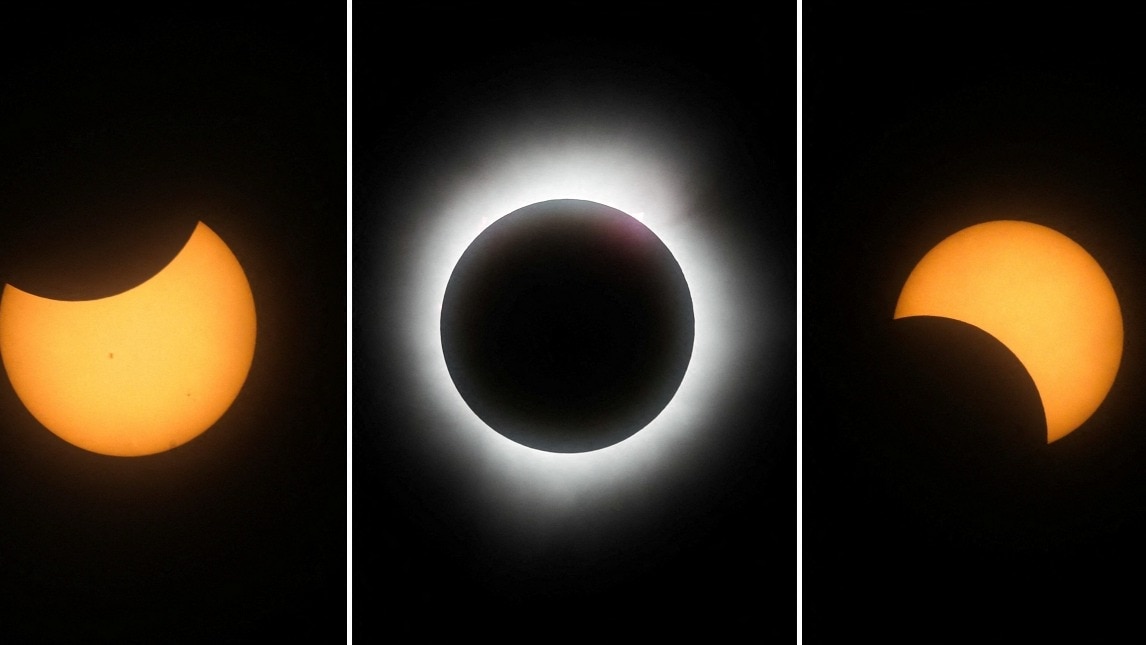
A total solar eclipse will sweep across parts of the world on August 12, 2026, after a 28-month gap. The event matters especially for mainland Europe, which has not seen totality since 1999.A combination of pictures shows the beginning to the end (top to bottom) of a total solar eclipse seen from Mazatlan, Mexico April 8, 2024. (Photo: Reuters)Skywatchers across the world are preparing for one of the most spectacular astronomical events in years as a total solar eclipse returns on August 12, 2026, ending the longest gap between total eclipses in nearly three decades.The eclipse will be the first total solar eclipse visible anywhere on Earth in 28 months, since the April 8, 2024 eclipse that captivated millions across Mexico, the United States and Canada.While total solar eclipses occur somewhere on Earth roughly every 16 months on average, the world has had to wait significantly longer this time. The event is particularly significant for Europe. It will be the first total solar eclipse visible from mainland Europe since August 11, 1999, when the Moon's shadow swept across countries from France to Bulgaria.Since then, Europeans have only been able to witness totality in remote regions such as parts of Russia, Georgia, the Faroe Islands and Norway's Svalbard archipelago. A total solar eclipse occurs when the Moon passes directly between Earth and the Sun, completely blocking the Sun's bright disk for observers along a narrow path known as the path of totality.For a few magical minutes, daylight fades into twilight, temperatures can drop, stars become visible and the Sun's shimmering outer atmosphere, the corona, appears around the dark silhouette of the Moon.The corona is visible only during a total solar eclipse, making the event a once-in-a-lifetime experience for many.The eclipse will also be witnessed by an extraordinary number of people.According to a calculation by timeanddate.com using population estimates from Columbia University's Center for International Earth Science Information Network (CIESIN), around 980 million people will live in regions where at least a partial eclipse will be visible.Of these, about 15.2 million people are located directly within the path of totality, where the Sun will be completely obscured.Astronomers say total solar eclipses are among nature's most awe-inspiring phenomena and provide scientists with valuable opportunities to study the Sun's corona, solar magnetic fields and space weather.For millions fortunate enough to stand beneath the Moon's shadow, the 2026 eclipse promises to be an unforgettable celestial spectacle that won't be repeated in mainland Europe for years to come.- EndsPublished By: Sibu Kumar TripathiPublished On: Aug 4, 2026 12:28 IST
Total solar eclipse coming: Why you should not miss the rare celestial event
Full Article
Original Source
Read the full article at Indiatoday →KhanList aggregates and links to publicly available news content. We do not host full articles from third-party sources. Always verify important information with original sources.