
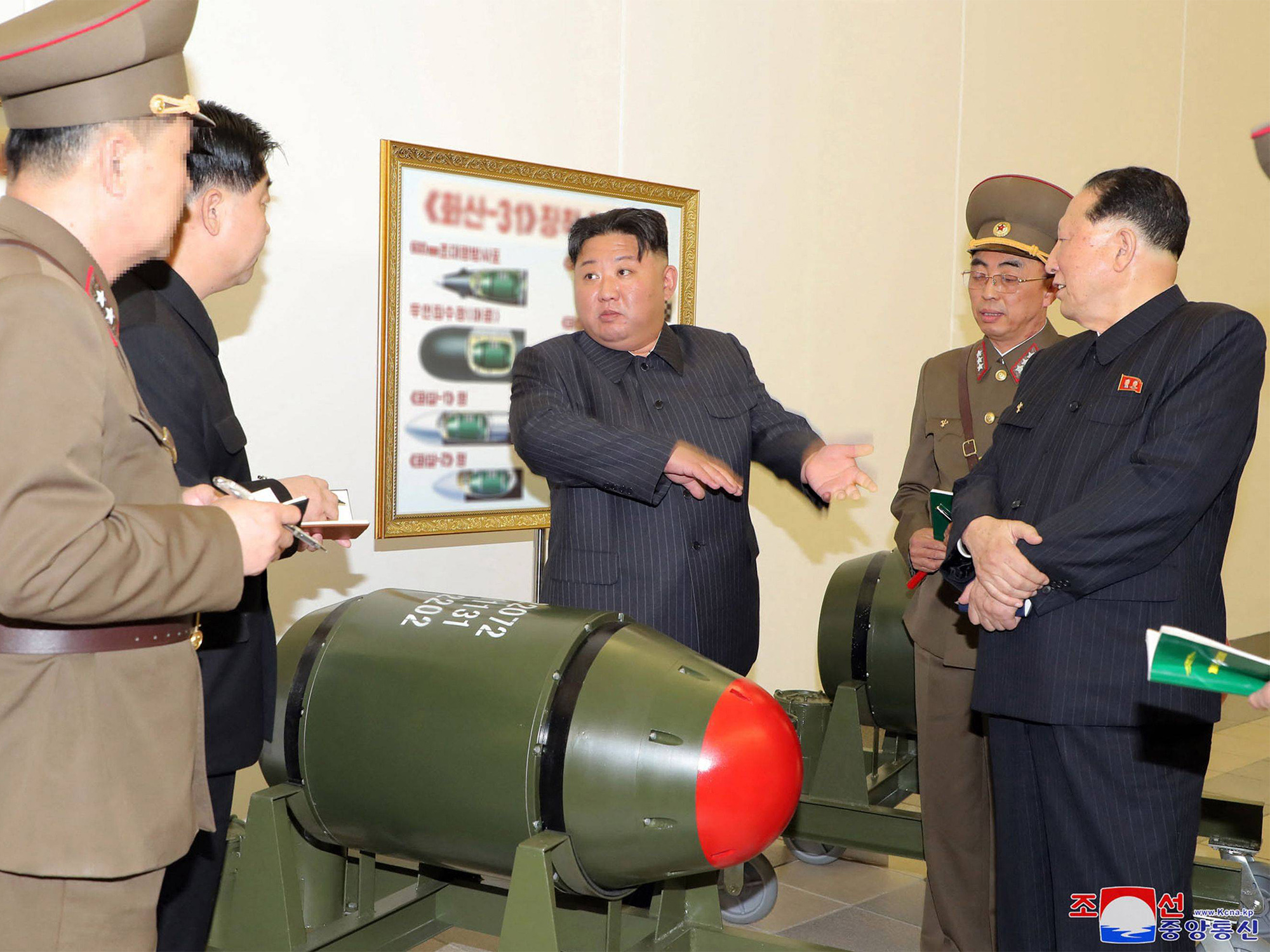
November 19, 2026 • 10:21 am ET Markus Garlauskas, John Park, and Kyoko Imai Top three The United States and its allies need a deeper shared understanding of the threat of limited nuclear attack. Strengthening societal resilience to the psychological effects and aligning senior leaders around a common framework—within the context of conventional-nuclear integration—is essential.Preparation should expand overall resilience, readiness, and deterrence, but requires mitigating constraints that currently limit flexible and credible response options. Worth a thousand words Kim Jong Un inspects a Hwasan-31 (Volcano-31) warhead, also known as the “olive,” in photos released by North Korea in 2023. Open-source analysis suggests the warhead is less than 20 inches in diameter, while North Korea claims it is a “tactical warhead” that can be employed on at least eight different smaller delivery systems. North Korea has a range of warheads and delivery means that could be used for limited nuclear attacks (LNA)—such as the Hwasan-31 warhead pictured above—and these will likely increase in quality, quantity, and diversity in the next five to ten years. North Korea could plausibly develop and field one or more additional warhead types within this timeframe, providing more options for a limited nuclear attack. Limited nuclear attack, for the purposes of the Guardian Tiger III study, is an adversary’s employment of nuclear weapons for lethal, destructive, or electromagnetic effects on US or allied personnel and assets, while remaining limited in effect due to some combination of scope, scale, damage, and targets. The study considered limited nuclear attacks by North Korea such as a detonation at sea or at high altitude and attacks on military bases and military forces in the region. The diagnosis The risk of North Korea launching a limited nuclear attack will likely increase over the coming decade, yet the United States and its allies are insufficiently preparing to deter and prevail in the face of such nuclear strikes. Though few doubt that the risk of a major military conflict in the region is growing, not enough attention is being paid to the risk that such a conflict would escalate into nuclear attacks by North Korea. This insufficiency is rooted, in part, in cognitive and organizational biases against considering such possibilities. For most people and organizations, preparing for nuclear war requires thinking about the unthinkable. The Guardian Tiger III study summarized here was informed by a range of activities, including engagements with more than 150 US and allied government and military stakeholders and outside experts; four virtual workshops with US stakeholder organizations and experts; five international virtual workshops; research trips to the US Strategic Command headquarters and to key locations in East Asia, including South Korea; and a three-day in-person multinational tabletop exercise with more than one hundred participants. The research and tabletop exercise that informed this study focused on North Korea as a case study for the LNA challenge to the United States and its allies because North Korea is particularly likely to employ an LNA in the event of a conflict. Vastly outclassed by the United States and South Korea in non-nuclear military capability and economic power, North Korea relies heavily on the threat of nuclear escalation as part of its coercive diplomacy. In the event of a military conflict, it is even more likely to rely on the threat of nuclear strikes to cause South Korea and the United States to hesitate. The United States, along with its allies and defense partners, must be prepared and resilient to continue operations to meet key military and political objectives even in the aftermath of a limited nuclear attack by North Korea or other adversaries. Ideally, such preparedness will help deter such adversaries from nuclear escalation, or even from initiating aggression at all. The prescription The United States needs to develop a deeper and broader understanding of the risks of LNA—and to effectively communicate those risks to key US and allied personnel. The US government should develop and disseminate tailored products for US and allied decision-makers to enhance their understanding of LNA-related risks, including specific adversaries’ LNA-related capabilities and information about the ability of the United States and its allies to manage these threats. Relevant US military commands should leverage existing training, education, and exercises conducted by US and allied governments and militaries to deepen and broaden the understanding of LNA-related risks by disseminating information about such risks. They should learn from stakeholders to inform future training, education, and exercises through incorporating examples of LNA scenarios. The psychological and political effects of LNA could potentially far exceed the actual damage at the time of the attack and the radiological contamination in the aftermath. Widespread misconceptions about nuclear effects and difficulty with quickly characterizing effects, as well as an “all or nothing” approach to nuclear warfare—exemplified by the US South Korean declaratory policy of “ending the North Korean regime” in the event of any North Korean nuclear attack—complicate efforts to boost resilience. The United States should lead an effort to establish and employ new and restored unclassified education and training curricula on LNA effects for US and allied military and government personnel. US defense and military planners should develop an unclassified booklet (in various languages) and disseminate it for public release to directly inform a broad range of audiences about LNA effects and mitigation. The goal is to gradually increase resilience to psychological and other non-kinetic effects over time, through future crisis and conflict situations, during a nuclear attack, and beyond nuclear employment into recovery phases. LNA should be effectively conceptualized and placed into a larger context of conventional-nuclear integration (CNI) to ensure that US and allied senior leaders come to a shared awareness and understanding, and that they can determine at the time whether an event should be considered an LNA. A strict definition of LNA for use in doctrine could be counterproductive, however, in terms of limiting decision space for policymakers during a crisis or conflict. The US government should sponsor Track 1 (official) and Track 1.5-type (government and non-government participant) convenings, both with and without allied participants, to build a shared conceptualization of LNA. By broadening participation, they can both gain from different perspectives and generate buy-in from those included in the process. US policymakers and analysts should produce a one-page primer that leverages the results of these convenings, explaining adversary capabilities, sample scenarios, and a brief overview of nuclear effects. Translating this material and sharing it with key allies would promote a common understanding regarding a shared conceptualization of LNA and its importance, while placing LNA into a broader context that includes CNI. Preparing for LNA is vital, not a tradeoff. There is a widespread, persistent, and false perception that preparing for an LNA would come with an unacceptable tradeoff, harming more important posture and readiness priorities. The United States should lead a global influence campaign about how to deter LNA. This would ensure execution and integration with proactive communication and influence efforts—across the US government, allies, and partners—aimed at deterring adversaries and shaping adversary perceptions below the regime leadership level. US policymakers should issue broad and unclassified guidance so that LNA scenarios and CNI become a baseline part of US training, force development, engagement with allies, and planning going forward. To counter operational and strategic risks, it is important to understand and mitigate the constraints of the United States and its allies that complicate options for deterring, preparing for, and responding to an LNA. Current alliance politics, declaratory policy, and limitations in the availability of key capabilities suited for countering LNA also constrain these options. The United States should engage potential LNA target countries in East Asia (e.g., South Korea) and enable institutional capacity building to assess and manage both LNA and CNI. In coordination with US allies and defense partners, US military planners should assess and execute posture and capability adjustments to better prepare a resilient and flexible range of military response options to LNA. Acknowledgments A version of the full Guardian Tiger III report was originally written for the US Defense Threat Reduction Agency (DTRA), but it does not necessarily express the views of DTRA or any other US government organization. The principal investigator thanks DTRA, particularly the Strategic Trends team, for the sponsorship, guidance, support, and resources for this study. About the authors Markus Garlauskas is the director of the Indo-Pacific Security Initiative of the Atlantic Council’s Scowcroft Center for Strategy and Security. John Park is a nonresident senior fellow with the Atlantic Council’s Indo-Pacific Security Initiative. Kyoko Imai is the associate director and resident fellow for the Indo-Pacific SecurityInitiative of the Atlantic Council’s Scowcroft Center for Strategy and Security. Watch highlights from the Guardian Tiger III tabletop exercise Related reading Image: North Korean leader Kim Jong-un visits the Institute of Nuclear Weapons in Pyongyang in this photo published by the North Korean Central News Agency (KCNA). Kim urged increasing nuclear production for military purposes and making more powerful weapons. Photo by KCNA via Latin America News Agency/Reuters Connect.
Toplines: Why and how the United States and its allies should prepare for a limited nuclear attack
Full Article
Original Source
Read the full article at Atlanticcouncil →KhanList aggregates and links to publicly available news content. We do not host full articles from third-party sources. Always verify important information with original sources.