
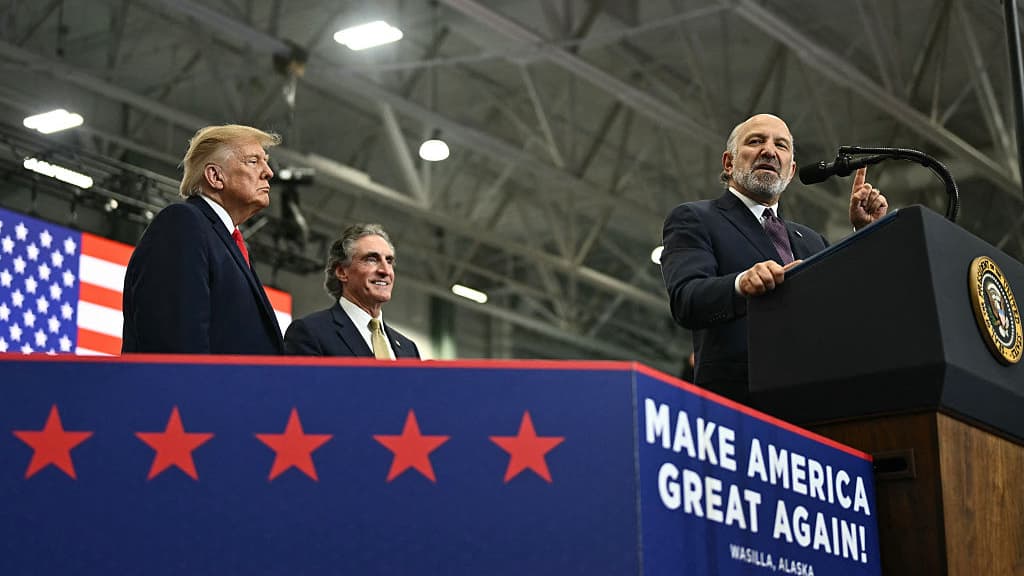
Last month alone, Commerce Secretary Howard Lutnick, Federal Communications Commission Chair Brendan Carr, and Interior Secretary Doug Burgum appeared alongside President Donald Trump to support Republican Sen. Dan Sullivan in his tight reelection fight against Democrat Mary Peltola at a rally in Wasilla, Alaska, on Oct. 13. Defense Secretary Pete Hegseth appeared in Wisconsin alongside GOP Rep. Derrick Van Orden on Oct. 20 to speak to manufacturing workers during a Pentagon tour highlighting U.S. defense production. Last Monday, Vice President JD Vance and Burgum spoke at a rally in Topeka, Kansas. And on Tuesday, Secretary of State Marco Rubio briefly joined Trump on stage, at the President’s urging, during a rally in Corpus Christi, Texas.Cabinet members and other leading Trump officials have been wading into the midterms in these and other ways for months. In August, for instance, Transportation Secretary Sean Duffy endorsed Republican Senate candidate Mike Rogers in Michigan.Legal experts and advocacy groups contend that in making such moves, members of the Administration have violated a decades-old law: the Hatch Act, passed by Congress in 1939, which places restrictions on certain political activities for federal executive branch employees.The Administration has argued that the officials have participated in political events in a strictly personal capacity, which is permitted under the Hatch Act, and that their actions have been cleared by lawyers and ethics officials.But several top Trump aides—including at least nine of his 15 Cabinet secretaries—have been hit with formal complaints that their actions have violated the law.“The number of Hatch Act violation complaints is extreme and abnormal for election time, especially for complaints against senior officials,” Kedric Payne, the head of ethics at the Campaign Legal Center, a legal non-profit that has filed a complaint against the Trump Administration for using taxpayer money to fund political ads, tells TIME. “We are seeing with the Trump Administration why the Hatch Act is so important,” Payne says, “because when it is not enforced quickly, it can be abused.”Here’s what to know about the Hatch Act, and the accusations that Trump officials have violated it.What is the Hatch Act?The Hatch Act is an 87-year-old federal law that prohibits certain government employees from using their “official authority or influence for the purpose of interfering with or affecting the result of an election,” among other limits it imposes on officials’ political activity. It states that such interference applies to “an activity directed toward the success or failure of a political party” or candidate. The law was established to ensure that “federal programs are administered in a nonpartisan fashion, to protect federal employees from political coercion in the workplace, and to ensure that federal employees are advanced based on merit and not based on political affiliation,” according to the Office of Special Counsel (OSC), which enforces it. Many of the Hatch Act complaints against Trump officials on the campaign trail have centered around one specific aspect of the law that says federal employees cannot use or identify with their official title while engaging in political activity. In a handful of such complaints against members of the Administration, legal and press advocacy groups have pointed out that they were introduced at rallies by their Cabinet positions. “Political activity must be conducted purely in your personal capacity, without using your official title, without implying endorsement of the United States government. In your personal time at your own personal expense,” Richard Painter, the former chief White House ethics lawyer under George W. Bush and a professor at the University of Minnesota law school, tells TIME. The Trump Administration has pushed back on the accusations, saying that its members were acting in a personal capacity at the times in question.How Trump Administration officials have been accused of violating the Hatch Act on the campaign trailA number of complaints have been filed against the Trump Administration for violating the Hatch Act in recent months.Two advocacy non-profits, The Democracy Defenders Fund and Reporters Without Borders, filed a complaint in October over the rally in Alaska that featured Trump, Lutnick, Burgum, and Carr. The groups claimed that Carr “impermissibly mixed his official work into his personal remarks” and requested that the OSC open an investigation into each Trump official’s conduct at the rally. In September, the two advocacy groups also filed a complaint against Duffy for his appearance in Michigan and his endorsement of Rogers. Chief Counsel at the Democracy Defenders Fund said in a statement that Duffy’s conduct “crossed the legal and ethical line” and more broadly stated that it was “part of a broader pattern of this administration playing fast and loose with the law.”Spokespeople for the Interior and Transportation departments have denied wrongdoing on the part of their respective leaders to media outlets. The FCC and Commerce Department did not immediately respond to TIME’s request for comment. These complaints are among many more that have been filed over Administration officials’ participation in campaign activities. “We haven't seen since the first Trump Administration this number of complaints against officials, and I've lost track, but I do think it's well over 20 complaints just in recent weeks,” Payne says. In addition to complaints over officials’ appearances at campaign rallies, others have similarly alleged that Trump officials used their official titles in efforts to influence the midterms through social media and television network appearances.CREW, a nonprofit government watchdog organization, has made several such claims. In one complaint from earlier this month, it argued that White House Deputy Chief of Staff Stephen Miller violated the Hatch Act during an interview on Fox News in which he spoke against specific Democratic candidates running for office and urged voters to support a “pro-American Trump agenda.” The group has also filed complaints against Health Secretary Robert F. Kennedy, Jr. and Federal Bureau of Investigation Director Kash Patel for comments made while speaking to Fox.“These accusations are baseless and amount to a manufactured political attack," the Department of Health and Human Services said in a statement. "Secretary Kennedy takes his ethical obligations seriously, follows federal ethics laws, and consults HHS career ethics officials to ensure his activities comply with the standards governing public service.”The Department of Department of Justice, which houses the FBI, did not immediately respond to TIME’s request for comment regarding the accusations against Patel. When asked about the various Hatch Act complaints against Administration officials, White House spokeswoman Lauren Bis tells TIME that “it has long been established that senior administration officials are allowed to discuss current events, policies, and the candidates involved with those policies in order to advance the agenda of the administration.”Complaints allege further Hatch Act violationsTop Trump officials have additionally been accused of violating the Hatch Act through other means than direct statements and appearances in support of—or opposition to—midterm candidates that complaints allege may also affect the outcome of upcoming elections.Payne and his colleagues filed a complaint accusing several Administration officials of using taxpayer money for political ads which the complaint describes as “touting partisan and political rhetoric” to influence the outcome of the midterms. The complaint cites three ads: one that promotes Trump’s actions in Iran, another that decries socialism, and a third that features Trump speaking at Mount Rushmore. The Campaign Legal Center in its complaint quotes parameters set by the OSC that say the Hatch Act is designed “to prevent the use of federal power and taxpayer resources to shape electoral outcomes and to preserve public confidence in the nonpartisan administration of the law.”“Voters deserve to know that elected officials are campaigning using their own money and not taxpayer dollars,” Payne says. “Clearly these advertisements that were paid for by U.S. taxpayer dollars were intended to promote the Republican Party and influence the upcoming election.”The complaint specifically requests an investigation into Trump officials including Office of Management and Budget Director Russell Vought, Department of Homeland Security Secretary Markwayne Mullin, White House Chief of Staff Susie Wiles, and White House Appointments Secretary Natalie Harp for their involvement in putting together the ads.“There’s a statute that prohibits use of government funds for publicity or propaganda, unless expressly permitted by Congress,” Painter says. “Those ads that Trump was paying for with taxpayer dollars that said ‘paid for by the White House,’ that was propaganda. That violated that statute.”Trump has defended the ads by saying he was “only promoting the country,” rather than specific candidates. “That’s an ad for the spirit of our country,” he said when asked about the ads in the Oval Office in September.A Hatch Act complaint was also filed against the Administration by the Democracy Defenders Fund over the raid federal agents conducted at Democratic Rep. Ilhan Omar’s home in Minnesota in October. The raid was reportedly part of an ongoing Department of Justice investigation into potential immigration fraud. Omar has denied all wrongdoing. “The timing of this outrageous action against a long-time target of Trump’s evinces illegal political intent,” Norm Eisen, the co-founder of Democracy Defenders Fund, said in a statement. “Staging a public raid on the home of a sitting member of Congress weeks before a consequential election is an abuse of power.”Trump has maintained that he has “nothing to do” with the investigation, but has continued to levy public attacks against Omar, including calling her “crooked.”The flurry of recent complaints against the Trump Administration are far from the first instances in which the President and his aides have come under fire for alleged Hatch Act violations.An OSC report from 2021, for instance, found that in 2020, at least 13 senior Trump Administration officials violated the Hatch Act. What is the penalty for a Hatch Act violation?Following an investigation by the OSC, disciplinary measures for Hatch Act violations are determined by the Merit Systems Protection Board (MSPB), an independent judicial agency within the Executive branch. For Cabinet or senior officials, OSC refers its findings to the President, who determines disciplinary action.“The potential of those consequences happening under this President are small because it is up to the President usually to hold members of the administration accountable when they violate the Hatch Act,” Payne says, noting that in some cases, officials may be required to only issue a public apology for their violation, or face no consequence at all.Federal officials who have previously been found to have violated the Hatch Act under Trump largely have not faced repercussions because the President either declined to punish them or because the OSC reported the violations after Trump and the officials in question left office. After one OSC report from 2018 found Kellyanne Conway, a former counselor to Trump, had violated the Hatch Act, for example, Trump declined to fire her, telling Fox & Friends at the time that “it looks to me like they’re trying to take away her right of free speech and that’s just not fair.” The OSC itself has meanwhile acknowledged that it was reporting other violations at a point when disciplinary action could not be taken. “Though discipline is no longer possible once subjects leave government service, OSC is issuing this report to fully document the violations, highlight the enforcement challenges that OSC confronted in investigating the violations, and to deter similar violations in the future,” one OSC report from 2021 reads.Federal employees can face several civil penalties if they are found to have violated the Hatch Act, however, including a fine, a suspension, or a letter of reprimand. For a criminal violation, up to three years in prison may be imposed as a penalty if an official is found to have “intimidate[ed], threaten[ed], command[ed], or coerce[ed] … any employee of the Federal Government … to engage in, or not to engage in, any political activity.” “If President Trump or anyone overreaches the point of trying to coerce someone in the government to engage in partisan conduct, that's a violation of the criminal provision of the act, but all the rest of it's civil,” Painter explains.
Top Trump Officials Are Hitting the Campaign Trail Ahead of the Midterms. Are They Allowed To?
Full Article
Original Source
Read the full article at Time →KhanList aggregates and links to publicly available news content. We do not host full articles from third-party sources. Always verify important information with original sources.