
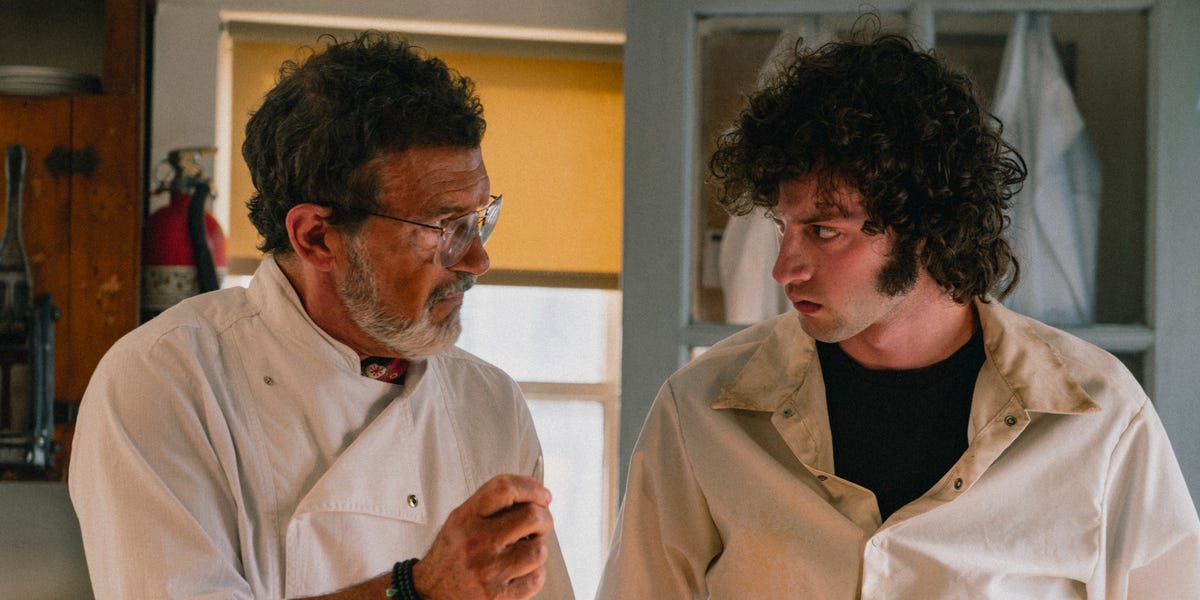
7 min read“I was—to be frank—a spoiled, miserable, narcissistic, self-destructive and thoughtless young lout, badly in need of a good ass-kicking.” That’s how the late Anthony Bourdain described his younger self when he stepped into a real kitchen for the first time. It is also the version of him we meet in Tony, a new biopic directed by Matt Johnson and released by A24. The movie stars Dominic Sessa as a nineteen-year-old Bourdain who, long before he penned the New York Times best-seller Kitchen Confidential and hosted Parts Unknown, had serious growing up to do.Like any buzzy biopic, the movie raises the typical but always worthwhile question: How much of it is true? Luckily, Bourdain himself chronicled his first few years employed in restaurant kitchens in his aforementioned hit book, Kitchen Confidential, a half-memoir, half-industry tell-all published in 2000. Really, there’s no better way to fact-check Tony with than Bourdain’s own memories.In theaters now, Tony takes place in the summer of 1975 in the rustic resort town of Provincetown, Massachusetts. The film follows Bourdain, a Vassar College student and aspiring writer who chases an old crush (Emilia Jones) all the way to Provincetown and winds up working at a ramshackle seafood restaurant. Like any coming-of-age tale, the unlikely environment becomes a transformative cocoon for “Tony” to mature into the first draft of the man we know as Anthony Bourdain.Despite its premise as a biography, the filmmakers of Tony still took creative liberties for the sake of a cohesive narrative. Some of their changes are minuscule—Bourdain worked at multiple joints in Provincetown, not just one—while others are bigger changes for dramatic effect. The Flagship staff didn’t beat up Bourdain before he worked with them. (And if he did, he never mentioned it.) Nor did he burn any restaurant down and save it with a climactic clambake. Though there were clambakes—more on that in a bit.Generally speaking, Tony has plenty of grounding in Anthony Bourdain’s lived reality. But how the filmmakers blur fact from fiction is their way of arriving at a simple truth: That it was all a formative experience in the life of a really great man.(Warning: Spoilers for Tony are below.)Bob GruenAntonio Banderas (left), Dominic Sessa (center), and Leo Woodall (right) star in A24’s Tony, which depicts a pivotal 1975 summer in the life of Anthony Bourdain.Trust that we’re not going to pick apart every detail of Tony, nor run the movie through some arbitrary filter. For starters, only Anthony Bourdain would have the right to do that, and even then, he maybe would have found the practice dull.Secondly, Bourdain didn’t write everything about his time in Provincetown. Bourdain’s accounts of that time period make up about the first forty-eight pages of Kitchen Confidential, the bulk of which includes his stint at the Culinary Institute of America, or CIA. Tony ends at Bourdain’s admissions interview for the CIA.But for those who are keen to know which parts of the man’s experiences are played out on the screen, below is a summary of all the broad strokes.Anthony Bourdain did, in fact, go to Provincetown, Massachusetts during his summers studying at Vassar College. (He’d later drop out.) In Tony, he travels in pursuit of Nancy (played in the film by Emilia Jones), an old high school crush who, in real life, would become his first wife of twenty years. In Bourdain’s book, he alluded to this being true, though he was hesitant to say much about it. “In 1973, unhappily in love, I graduated high school a year early so I could chase the object of my desire to Vassar College—the less said about that part of my life, the better, believe me,” he wrote. His friends also embarked on a “summer share” there. “It was what my friends were doing, and that was enough for me.”The movie’s “Tony” works at a seafood restaurant called the Flagship (which was a real establishment) much like the real Bourdain did. But the movie cranks up the drama dial to have him get piss-drunk at the bar (after a sour encounter with Nancy) and thrown out by the staff, only to be taken in by the Flagship’s owner out of pity. In real life, Bourdain simply needed money. His friends, who also worked there, hooked him up with a job. As Bourdain put it: “Dishwashers ... were the most transient breed in the seasonal restaurant business, so when one goofball failed to show up for work for two days, I was in.”The movie also shows Nancy working at a pizza restaurant. That’s actually true. In his book, Bourdain wrote his unnamed “on-again-off-again girlfriend” at the time “spun pizza for a living” at Spiritus Pizza, where Bourdain slept in the back room in lieu of having a proper place of his own. During the opening weekend of Tony, Spiritus Pizza’s Instagram account confirmed that Bourdain’s nameless girlfriend who worked there was in fact Nancy.Tony, the film, faithfully follows Bourdain’s growth from dishwasher to his first real food prep responsibility of manning the salad station, which he took over from an ex-con and meth dealer named Mike. It was a big moment for Bourdain’s future. Wrote Bourdain: “Mike had gone missing on a meth jag and I had been promoted to the salad station plating shrimp cocktails, cracking oysters and cherrystone clams, mixing canned lobster meat with mayonnaise and filling champagne glasses with strawberries and whipped cream.”Speaking of “Mike,” Bourdain recalled getting close to the cooks of the Flagship (which Bourdain called the “Dreadnaught,” but Flagship was the real name) and idolized them like rock stars. In Bourdain’s eyes they were hedonistic pirate-princes who wielded knives and screwed their way through Provincetown. The movie Tony composites all these devil-may-care cooks into Sal, a brash employee at the Flagship played by Leo Woodall. Sal acts as both a bully and mentor to Tony; Bourdain himself didn’t paint anyone specifically in this light, but rather placed them all on a pedestal.In the movie, Sal hilariously gives a new bride—in the middle of her wedding dinner!—the absolute business in the back of the restaurant. Believe it or not (and you should believe it), this happened. In Bourdain’s book, he said the deed was carried out by Bobby, “a well-toasted, late-thirtyish ex-hippie” who worked as the head chef.But yeah, the bride stuff happened. Wrote Bourdain in vivid detail:“Soon, all of us—Tommy, Lydia, the new dishwasher and I—werepeering through the window, where in full view of his assembled crew, Bobby was noisily rear-ending the bride. She was bent obligingly over a 55-gallon drum, her gown hiked up over her hips. Bobby's apron was up, resting over her back as he pumped away furiously, the young woman's eyes rolled up into her head, mouth whispering, ‘Yess, yess... good... good...’ While her new groom and family chawed happily on their flounder fillets and deep-fried scallops just a few yards away in the Dreadnaught dining room, here was the blushing bride, getting an impromptu send-off from a total stranger.”“And I knew then, dear reader, for the first time: I wanted to be a chef.”Now, Bourdain never burned down any restaurants like he accidentally does in Tony. Nor did he save any from financial ruin with a feel-good fundraising cookout. But clambakes were/are a thing in Provincetown. Howard Mitcham, the owner of the Flagship, is depicted in the film by Antonio Banderas as a nameless chef from Portugal. (Provincetown has a deep Portuguese community.)Bourdain wrote that Howard had an annual clambake that was “a major social event” for locals and those working in the seasonal restaurants. “Howard and friends would dig pits in the beach and drop shiny new trash cans into the holes, then fill them with quahogs, lobsters, codfish, vegetables, potatoes and corn, allowing them to simmer over glowing coals buried deep in the sand while everyone drank themselves silly.”One last, small, but no less important detail: Tony’s blue suit. In the movie, Tony travels to Provincetown in a light blue seersucker suit. Why? Because he’s just that kind of dumb teenager. Well, in Bourdain’s book, the man admitted he really was that dumb kid, but he had his reasons. After his first summer at the Flagship, the restaurant was bought by a new owner who invited the season’s previous staff to audition for new jobs in the kitchen. Feeling cocky after killing it his first year, Bourdain rolled into town in that blue suit to make an impression and get the job he wanted behind the fry station. It didn’t go over well. Wrote Bourdain:“I pulled into town, I remember, wearing—God help me—a spanking-new light blue Pierre Cardin seersucker suit. The shoes, too, were blue. Here I was, hitchhiking into a town that for all intents and purposes was a downscale, informal Portuguese fishing village and artists' colony, a town where people dressed unpretentiously in work clothes ... and in some deranged, early '70s bout of disco-inspired hubris, I chose to make my entrance in gull-wing shouldered Robert Palmer-wear, just itching to show the local yokels how we did it in New York City.”As Bourdain worked the kitchen (again, wearing that blue suit), he grabbed a hot sauté pan and burned himself. Tyrone, the broiler whom Bourdain described as a large and imposing figure with burned hands akin to the “claws of some monstrous science-fiction crustacean,” mocked him and grabbed the same hot pan without a fuss. “I watched, transfixed, as Tyrone—his eyes never leaving mine—reached slowly under the broiler and, with one naked hand, picked up a glowing-hot sizzle-platter, moved it over to the cutting board, and set it down in front of me. He never flinched.”Added Bourdain, “I had been shown up for the loudmouthed, useless little punk that I was. I was, I learned later, a mal carne, meaning ‘bad meat’ in Italian, referred to as ‘Mel’ for weeks after. I had been identified as a pretender, and an obnoxious one at that.”But the experience motivated Bourdain. After that, he resolved to study at the CIA, something the cooks who laughed at him would never do, and that he would “do whatever was necessary to become as good as, or better than” all of them. “I would have hands like Tyrone's and I would break loudmouth punks like myself over the wheel like they'd broken me. I'd show them.”In the end, Bourdain did just that. He just had to get his butt kicked first.
Tony Takes Some (Okay, a Lot) of Liberties With Anthony Bourdain’s Life
Full Article
Original Source
Read the full article at Esquire →KhanList aggregates and links to publicly available news content. We do not host full articles from third-party sources. Always verify important information with original sources.