
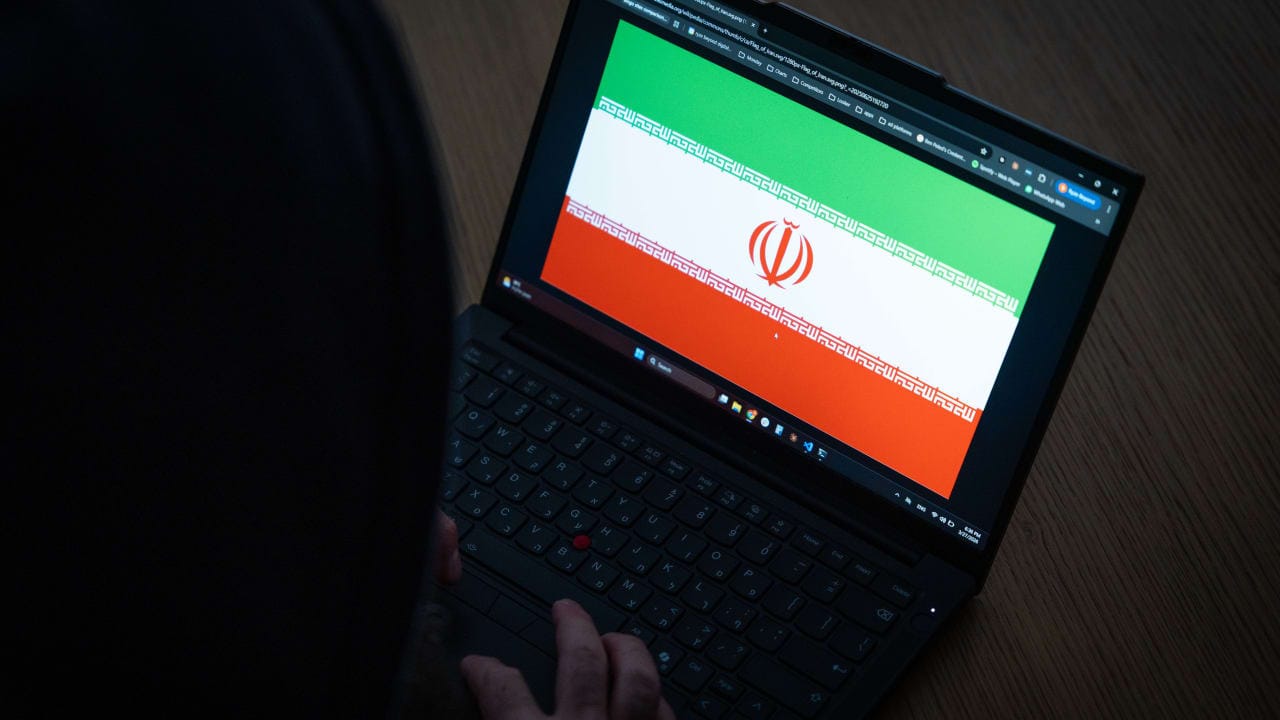
NOVEMBER 22, 2026 09:13Updated: NOVEMBER 22, 2026 10:01There is a sentence that Yossi Karadi repeats to his colleagues every morning: “Friends, in the past 24 hours, the enemy failed to achieve its mission of attacking Israeli cyberspace. Tomorrow, they might succeed.”For Karadi, the director general of the Israel National Cyber Directorate (INCD), It's not just a motivational sentence. “I'm never sleeping peacefully at night,” he said.Since Prime Minister Benjamin Netanyahu appointed him in May 2025, Karadi has been responsible for coordinating Israel's national cyber defense at a time when the country's digital infrastructure has become another front in its confrontation with Iran and other hostile actors.According to Karadi, Israel has faced thousands upon thousands of cyberattack attempts during the current war, targeting citizens, businesses, organizations, and the broader Israeli digital environment.An illustrative photo of a laptop displaying a website in Persian with references to Mossad, representing cyber or intelligence-related activity, March 27, 2026. (credit: NATI SHOHAT/FLASH90)Yet, despite the scale of the campaign, one important distinction remains: Israel's critical national infrastructure has so far avoided a significant cyberattack that would disrupt the country's daily life.“After three years, and particularly during the past year and a half of confrontation with Iran, Israeli citizens have not experienced a cyberattack that significantly affected the Israeli environment,” he said. “Sometimes the attackers came closer, sometimes less so.”Recent attacks targeting seemingly ordinary household appliances in Europe have offered a glimpse into a new dimension of cyber warfare.From smart appliances to critical infrastructure“The supermarket refrigerator attacks are a front that is visible to the public, but it is only the tip of an iceberg underneath,” he said.The issue is not necessarily the refrigerator itself. It is the controllers and connected systems that operate devices across modern society, from household appliances to industrial equipment.“When those controllers are exposed to the internet, any attacker can potentially reach them,” Karadi explained. “You open the door to maintenance personnel, but you have also opened the door to attackers. From there, everything depends on the level of protection you have in place.”Karadi said Israel has also seen attempts to target such controllers during the current war. The concern is that an attacker who can compromise these systems could potentially move beyond stealing information or deleting files and cause physical disruption.For now, Israel's defenses have prevented such an incident from producing a major impact on the country's national infrastructure. But Karadi is careful not to interpret that record as a guarantee of future success.“Imagine rooms full of very tense people in the National Cyber Directorate, working to prevent an attacker from affecting the daily lives of citizens,” he said.The cyber threat is not limited to infrastructure, businesses, or military systems. It also extends to the democratic process.Defending electionsDuring Israel's recent election campaign, the National Cyber Directorate was responsible for protecting the digital systems involved in the electoral process. Karadi said there were efforts to target the election process in its broadest sense, possibly including undermining public confidence.He emphasized that protecting elections means more than securing the central systems used to administer voting. It also involves protecting the entire process, from the systems supporting the election to the mechanisms through which results can be challenged, and ultimately the public's trust in the outcome.Nevertheless, he said that the preparations, which began months before election day, succeeded in preventing any serious compromise.“There was no case throughout the election process in which an attacker was inside a system in a way that caused me serious concern about the integrity of the process,” he said.Karadi distinguished between attempts to compromise critical infrastructure and the attacks that have successfully affected smaller organizations and individual citizens.“The biggest threat, from my perspective as head of the National Cyber Directorate, is an attacker succeeding in damaging critical infrastructure or national infrastructure,” he said. “That is the threat we are managing most closely.”INSIDE THE Israel National Cyber Directorate. (credit: MARC ISRAEL SELLEM)However, attackers have achieved successes elsewhere.Smaller and, in some cases, medium-sized organizations have suffered data deletion and loss of databases. Other campaigns have focused on collecting information, including through the compromise of cameras and systems used by ordinary citizens.Weakest linkThat's one of the important points in Karadi’s eyes. Despite Israel's reputation as a global cyber power, the country's small and medium-sized organizations are not adequately protected.He described a recurring pattern in investigations into successful cyberattacks: organizations that continue to rely on basic usernames and passwords, without implementing even the most fundamental security measures.“Almost every week, when I investigate successful cyberattacks in the Israeli environment, I discover that we are returning to usernames and passwords and basic levels of cyber protection,” he said. “In 2026, particularly in the age of AI, we cannot afford to remain there.”One problem is that many organizations are reluctant to report attacks.A small business that has suffered a cyber incident, he said, may decide the damage is manageable and that reporting it to the authorities would create additional reputational harm. Public knowledge of the attack could undermine customer confidence and affect future business. Karadi said this creates a culture of underreporting.This is one reason he is pushing for legislation that would establish mandatory cybersecurity standards for essential organizations.Israel has been trying to advance a comprehensive cyber law for approximately 11 years. During the past year, the legislation finally passed its first reading in the Knesset.Among its central provisions are the establishment of mandatory cybersecurity standards for essential organizations, requirements to report cyberattacks, and expanded authority for the National Cyber Directorate to act during serious cyber incidents.But the Knesset dispersed before the legislative process could be completed.“We must pass the Cyber Law as quickly as possible,” Karadi said. “Our attackers are less interested in the political situation in Israel.”DEFENDING ISRAEL’S digital frontier: Israel National Cyber Directorate chief Yossi Karadi warns that artificial intelligence is rapidly transforming cyber warfare and expanding the scale and sophistication of attacks against governments, companies, and critical infrastructure. (credit: Israel National Cyber Directorate)Smaller, faster cyberattacksOne development that particularly concerns Karadi is the integration of artificial intelligence into offensive cyber operations.He said Iran is already learning how to use AI capabilities for cyberattacks. The danger, he explained, is not necessarily that AI will create entirely new forms of warfare overnight. Rather, it will make existing offensive capabilities more accessible, more efficient, and easier to scale.“AI creates an ability to scale up cyberattacks,” he said. “If an Iranian attack group previously had a certain level of capability, using AI models could potentially give it significantly greater capabilities.”Karadi said Israel is already encountering examples of AI-assisted attacks, including phishing campaigns.Instead of sending mass generic text messages to thousands of people, an attacker can potentially create highly personalized messages tailored to individual recipients.“Imagine receiving a message that says: ‘Amichai, yesterday you were at such-and-such a place. Here is the link to the cake,’” Karadi said, illustrating how a seemingly familiar message could be used to trick someone into opening a malicious link.Karadi's broader concern is that AI will allow hostile groups to increase the volume and sophistication of their operations faster than organizations can improve their defenses.“The biggest threat is the use of frontier models and open-source models through AI against Israel's cyber defense environment,” he said. “The attackers are improving their capabilities through AI. If our level of protection remains where it is today, we will reach a scale of attacks that will be difficult for us to contain.”Iran remains Israel's primary cyber adversary, but Karadi said the threat landscape is broader. He identified Iran, Hamas, and Hezbollah as direct enemies with varying cyber capabilities.The greater concern, however, is the possibility that Iran could import more advanced capabilities from groups operating in countries with more sophisticated cyber industries.“The threat I have been following throughout the war is the possibility that Iran will begin importing capabilities and cooperating with attack groups from more technologically advanced countries,” he said.International cyber allianceAttribution is also significantly more complicated in these cases. Unlike a missile, whose trajectory can often help identify its origin, a cyberattack can be routed through multiple systems and deliberately disguised.The growing international nature of the threat has also pushed Israel to expand its cyber cooperation with other countries, including states with which it has developed security relationships in recent years.Karadi described cooperation and partnerships with the United States, European countries, and regional partners.For example, one initiative brings together Israel, Greece, and Cyprus in an effort to establish a regional cyber defense framework around the Mediterranean. Israel is also cooperating with the United Arab Emirates and other countries in the region.The cooperation extends beyond exchanging general information. Karadi described intelligence sharing, the exchange of capabilities, and operational cooperation as essential components of an effective defense.He also points to a recent agreement with Germany aimed at developing what he described as a cyber equivalent of the Iron Dome: a protective framework designed to strengthen the country's ability to defend itself against cyber threats.India is another important partner. Karadi said he plans to visit the country with representatives of Israeli cybersecurity companies, seeking to connect the two countries' industries and expand cooperation.“Israel is known and recognized as a global cyber power,” he said. “We have the best people, the companies, the start-ups, and the cybersecurity industry. Each contributes its own added value to this system.”Karadi remains optimistic about the future of Israel's cybersecurity industry.He rejected the suggestion that the sector has already passed its peak. On the contrary, he believes the combination of Israel's established cyber expertise and the rapid development of artificial intelligence could produce an entirely new wave of innovation.“I see incredible things in the Israeli cyber market,” he said. “Every day I meet start-ups and Israeli cybersecurity companies bringing tremendous innovation to the world through the combination of cyber and AI.”During meetings with foreign governments and international investors, he said, he is repeatedly asked to recommend Israeli start-ups and companies they can invest in.“I don't think we are at the peak. I think we are constantly approaching a new high,” he said.Israel has managed to maintain that standard against attacks on its most critical infrastructure throughout an exceptionally intense period of warfare. But Karadi knows that cyber defense is a contest without a final victory, and that yesterday's success offers no guarantee about tomorrow.“Today, after a year and a half of intense war, we have accomplished the mission,” he said. “Tomorrow? I don't know.”Follow us on Google
‘Tomorrow, they might succeed’: Israel’s cyber chief on the war nobody can afford to lose
Full Article
Original Source
Read the full article at Jpost →KhanList aggregates and links to publicly available news content. We do not host full articles from third-party sources. Always verify important information with original sources.