
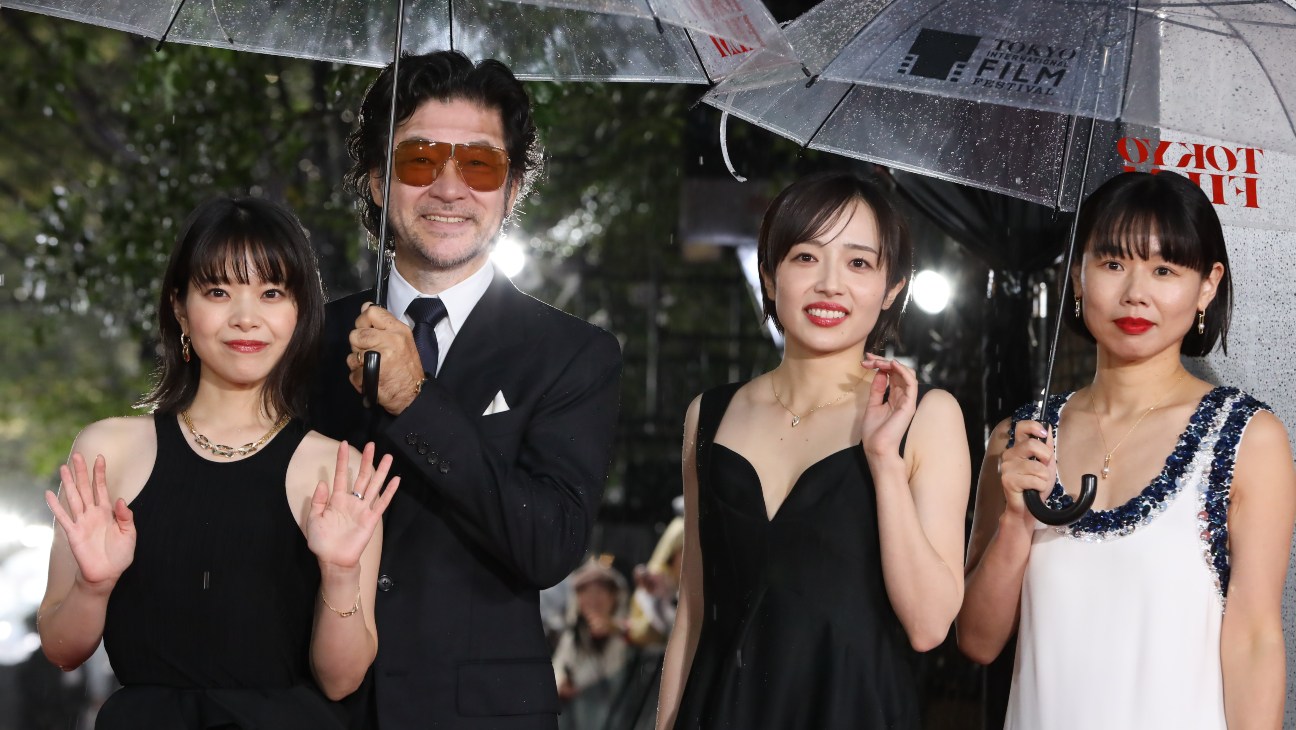
A chilly autumn rain did little to dampen the enthusiasm of the scores of fans gathered in Tokyo’s Hibiya district Monday evening, as the Tokyo International Film Festival kicked off with a starry — albeit soggy — red carpet featuring Shōgun actor Tadanobu Asano, Last Samurai Standing leading man Junichi Okada, singer-actor Kento Nakajima, actress Mei Nagano and Yu Yu Hakusho lead Takumi Kitamura. Umbrellas were ubiquitous on the carpet, with stars and filmmakers doing their best to make the most of the downpour. Macedonian director Milcho Manchevski, attending with the cast and producers of his competition film Sister Brother Manhole Cover, managed to both plug his movie and find an ad-hoc solution, wielding a replica manhole cover to shield himself from the rain. Asked about the significance of the prop, he explained: “Manhole covers keep the dirt of society hidden, and they are what our heroes steal in the film.” The star power at the festival’s opening leaned heavily on local talent, although Academy of Motion Picture Arts and Sciences CEO Bill Kramer was also on hand, walking the carpet alongside the organization’s chief membership, impact and industry officer Meredith Shea. Asked for his message to Japanese film fans, Kramer kept it simple: “Go and support your filmmakers. Go to the cinema.” Oscar winner Cate Blanchett is expected at the festival later in the week, while Kramer is scheduled to participate in an array of events, including a public conversation with Toho CEO Hiro Matsuoka. The legendary Japanese studio has also thrown its weight behind this year’s edition of Japan’s leading cinema event, with the latest blockbuster featuring its best-known movie monster — Godzilla Minus Zero — set for a high-profile screening as the festival’s centerpiece film on Nov. 1. The 39th Tokyo International Film Festival runs Oct. 26-Nov. 4, with an expanded program of 204 films from 112 countries and regions, including 35 world premieres. Screenings are concentrated around the Ginza district of central Tokyo, while the accompanying content market, TIFFCOM, will be held Oct. 28-30 at the Tokyo Metropolitan Industrial Trade Center in nearby Hamamatsucho. Monday’s opening ceremony took place inside Hulic Hall Tokyo, with pop star turned actor Kento Nakajima serving as the evening’s host and the festival’s official “navigator.” The ceremony also marked the return of Japanese industry veteran Takeo Hisamatsu as festival director, following the departure of former chairman Hiroyasu Ando earlier this year. “I’ve been in the film industry for nearly 50 years — involved in live-action, anime, documentaries; in Japan, the U.S., Africa and Asia, across multiple genres,” Hisamatsu said as he took the stage at the ceremony. “Looking back, I feel that this has been such a wonderful and enjoyable ride — and with that, I would like to declare the 39th Tokyo International Film Festival open.” The evening also featured a video message from Japanese Prime Minister Sanae Takaichi, who emphasized cinema’s role in bringing people together across national and cultural boundaries. “Film has the power to connect people across countries and cultures,” she said, adding that such exchanges create new opportunities for dialogue. The prime minister also highlighted her government’s ambitions for Japan’s booming entertainment and intellectual property sectors, pledging to accelerate public-private investment with a goal of expanding the country’s overseas content sales to 20 trillion yen ($130 billion) by 2033. Japan’s minister of economy, trade and industry, Ryosei Akazawa, similarly pointed to the growing international appeal of Japanese entertainment, singling out Godzilla Minus Zero as an example of the kind of homegrown intellectual property — alongside the country’s globally popular manga and character-driven content — that has become an increasingly important cultural and commercial export. Australian filmmaker Rolf de Heer, who heads Tokyo’s main competition jury this year, paid tribute to the enduring influence of Japanese cinema on international filmmakers. “An actor, a colorist, a producer, a director: we’re all filmmakers,” de Heer said of his fellow jury members. “And as filmmakers, we’ve all been influenced by the Japanese masters.” Recalling a shot from a Yasujiro Ozu film that had stayed with him for more than half a century, de Heer added: “It’s a privilege for us to work as a jury in the land of those masters.” The evening’s opening film was Sukiyaki, director Takahisa Zeze’s music biopic about the creation of the Japanese pop song “Ue o Muite Arukō,” which became an unlikely international sensation under the title “Sukiyaki,” topping the U.S. Billboard Hot 100 chart for three consecutive weeks in 1963. The film stars Okada as composer Hachidai Nakamura, Tori Matsuzaka as lyricist Rokusuke Ei and Taiga Nakano as singer Kyu Sakamoto, telling the story behind the creative partnership that produced one of Japan’s most beloved musical exports. The Sukiyaki team was on hand Monday night to walk the red carpet in support of the film’s first screening in Asia. Okada, whose portrayal of Nakamura required extensive musical preparation, told the hosts along the red carpet that he had practiced piano for three months before filming began. Tokyo’s 2026 competition jury will assess 15 films from around the world for the Tokyo Grand Prix and other honors. Joining de Heer on the five-member panel are Korean producer Oh Jungwan (A Tale of Two Sisters, A Bittersweet Life); producer Alex Lo, whose credits include Jim Jarmusch’s recent Venice Golden Lion winner Father Mother Sister Brother; Japanese actress Makiko Watanabe (Still the Water, While the Women Are Sleeping); and international film colorist Yov Moor (Richard Linklater’s Nouvelle Vague). Highlights from this year’s competition include Iranian-Kurdish director Bahman Ghobadi’s psychological thriller Trees Are Watching, starring Eva Green; Venice Golden Lion-winning filmmaker Manchevski’s Sister Brother Manhole Cover; Indonesian veteran Garin Nugroho’s historical drama Red Before Dawn; and Chinese director Qiu Jiongjiong’s Fuxi: Four Tales of Feasting. The three Japanese films competing this edition are Akira Ikeda’s The Canary’s Lullaby, Yukiko Mishima’s Two Cigarettes, Three Nights and Akira Yamamoto’s The Intertwining. Hisamatsu, who previously served as festival director from 2017 to 2021, has said he hopes to bring a stronger entertainment focus and more celebratory atmosphere to the festival while maintaining its commitment to independent and international cinema. Among Hisamatsu’s initiatives this year is the introduction of competitive awards for Nippon Cinema Now, the festival’s showcase of contemporary Japanese filmmaking, intended to give greater international visibility to emerging and established local directors. Tokyo is also launching CROSSCUT ASIA+, a program organized with the Japan Foundation to spotlight cinema from Southeast Asia. The festival will also present its annual Kurosawa Akira Awards to Iranian filmmaker Mohammad Rasoulof and Japanese director Mipo O. Rasoulof, whose politically charged filmmaking has jeopardized his freedom in Iran, won Berlin’s Golden Bear for There Is No Evil and earned an Oscar nomination for The Seed of the Sacred Fig. O, meanwhile, is known for acclaimed dramas including The Light Shines Only There and Living in Two Worlds. TIFF is also adding one more new honor in 2026: the Kashiko Kawakita Award, recognizing women who have made significant contributions to film culture. Its inaugural recipient is Japanese film critic and international cinema advocate Sahoko Hata, whose career helped introduce landmark European films to Japanese audiences. Blanchett’s visit will center on the Japanese premieres of five short films supported by the Displacement Film Fund, an initiative she co-founded to support filmmakers exploring the experiences of displaced communities. She is scheduled to participate in a public discussion on Oct. 30 with Rasoulof and Afghan filmmaker Shahrbanoo Sadat. The two-time Oscar winner is also receiving Japan’s prestigious Praemium Imperiale award during her visit to Tokyo. The Academy’s presence at the festival will be similarly high-profile. Along with Kramer and Shea, Academy president Lynette Howell Taylor will take part in an Oct. 28 panel examining the Oscars’ growing international activities and the state of global cinema. Other programming highlights include a masterclass with Hong Kong-born filmmaker Wayne Wang, a retrospective spotlighting German auteur Ulrike Ottinger and special screenings honoring Japanese master Kenji Mizoguchi and Egyptian filmmaker Youssef Chahine. The festival’s gala slate also features high-profile international titles including Martin McDonagh’s Wild Horse Nine and this year’s Cannes Palme d’Or winner Fjord, from Romanian filmmaker Cristian Mungiu. The 39th edition of the Tokyo festival closes on Nov. 4 with Korean filmmaker Yeon Sang-ho’s latest outbreak thriller Colony.
Tokyo Film Festival Kicks Off With Rain-Soaked Red Carpet, Japanese Stars and ‘Godzilla 2’ Anticipation
Full Article
Original Source
Read the full article at Hollywoodreporter →KhanList aggregates and links to publicly available news content. We do not host full articles from third-party sources. Always verify important information with original sources.