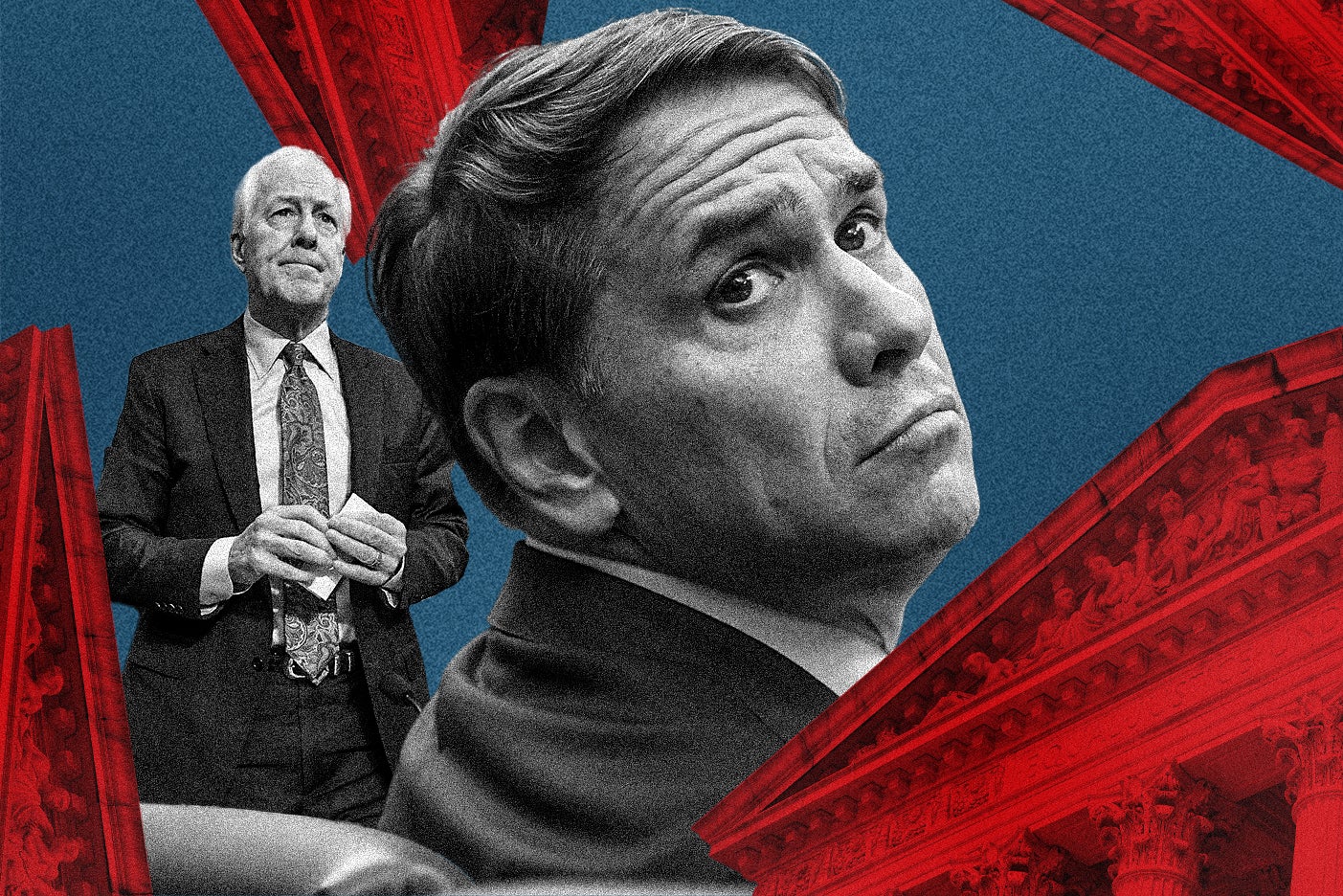
Jurisprudence By Enter your email to receive alerts for this author. Sign in or create an account to better manage your email preferences. Unsubscribe from email alerts Are you sure you want to unsubscribe from email alerts for Shirin Ali? Aug 06, 20265:45 AM Photo illustration by Slate. Photos by Win McNamee/Getty Images. This is Executive Dysfunction, a newsletter that highlights one under-the-radar story about how Trump is changing the law—or how the law is pushing back—and keeps you posted on the latest from Slate’s Jurisprudence team. Click here to receive it in your inbox each week. Todd Blanche is one step closer to becoming the next attorney general of the United States. A contentious confirmation hearing with the Senate Judiciary Committee three weeks ago initially failed to convince enough Republican legislators, specifically Texas’ John Cornyn and North Carolina’s Thom Tillis, that he was fit for the job. These two outgoing lawmakers—whose departures are the result of Donald Trump’s endorsement of opponents—had been the key holdup on Blanche’s promotion over the president’s misbegotten “anti-weaponization fund.” After another two weeks of private meetings and discussions, as well as a threat by Trump to temporarily pull the nomination rather than give in on the slush fund, the acting AG came up with a solution. Blanche committed in writing that the Justice Department would rescind the settlement agreement reached in Trump’s $10 billion lawsuit against the IRS that would have established that $1.7 billion fund. Blanche also made minor tweaks to who in the Trump family would be granted protection from tax audits. Now, at first glance, this might seem like a significant concession on behalf of the administration. The anti-weaponization fund would have handed out billions of taxpayer dollars to the president’s supporters and associates who claimed they were targets of political prosecution. The even bigger benefit was that Trump, his family, and his business would be shielded from past IRS audits, estimated at over $100 million. Blanche’s negotiation with Republican senators purportedly guts the fund, while limiting IRS review to Trump, two of his sons, and the Trump Organization. Both Tillis and Cornyn put out statements confirming their satisfaction with Blanche’s written commitment, and on Tuesday the committee voted 12–10 along party lines to send his nomination to the full Senate for consideration. However, upon further inspection, it’s not clear that any of this is legally binding, and Blanche himself admitted as much during his hearing last month. Trump’s attorneys “could try to enforce the contract,” he said. “They can’t force the Department of Justice to move forward with the weaponization fund. They could potentially say, I suppose, that we breached [the contract] by not moving forward.” When Trump filed the IRS lawsuit, Blanche, who was representing the federal government against his boss, came up with the controversial settlement agreement—it prompted a judge to reopen the case, litigation for which is still ongoing. Both parties agreed to it. But now Blanche has simply committed the DOJ to rescinding the settlement, without the plaintiff’s sign-off. Harry Litman, a former U.S. attorney and deputy assistant AG, notes this critical distinction in his Talking Feds Substack: “Walking back the agreement requires Trump’s okay. Blanche cannot just unilaterally declare the Department’s obligations are extinguished.” To clarify where exactly he stands on this development, Trump took to Truth Social 24 hours before Blanche unveiled his written statement on the settlement to declare that he would “push hard” to get the anti-weaponization fund established via legislation. “It will immediately be back on the table, and I will get it done,” the president proclaimed. Safe to say, then, that the plaintiff has not agreed to the DOJ’s settlement changes. Maryland Rep. Jamie Raskin and New York Rep. Grace Meng also emphasized Blanche’s empty commitment. “Yes, two Republican Senators forced Mr. Blanche to sign a memo rescinding the fund. But the underlying lawsuit is still active, the President never signed off, and he’s already said he’d revive the fund the moment the pressure lets up,” Meng said in a statement. “The IRS protections for his family remain untouched. Nothing about the deal that matters most to the President has actually changed.” Nevertheless, Cornyn and Tillis can tell themselves they notched a win on their way out of Washington, and Blanche can retain loopholes to try to smooth things over with his boss if and when he makes it out of confirmation. On Wednesday, embattled Maine Sen. Susan Collins threw a wrench into things when she announced she would be voting against Blanche’s nomination. Similarly, Louisiana Sen. Bill Cassidy said he hadn’t yet decided how he was going to vote, and Alaska Sen. Lisa Murkowski said she was “still deliberating” on her decision. If all three oppose the nomination, Blanche could be toast, given that 84-year-old Sen. Mitch McConnell has been missing in action for almost two months for medical issues, with no sign of a pending return. Meanwhile, Blanche threw another obstacle at senators after details of a call he had with the anti-abortion group Intercessors for America were released this week. Blanche promised that a DOJ under his control would prioritize restrictions on medication abortion. “If states have said ‘We are going to protect the unborn, and we’re going to protect every life from the moment of conception,’ we’re putting practices and policies in place so that other states and other organizations can’t attack that,” he said. Without providing more specifics on the practices and policies under consideration, the deputy AG proclaimed, “Victory will be soon, and victory will be permanent.” We hope you learned a thing or two from this edition of Executive Dysfunction. If you enjoyed reading it, please consider supporting our legal journalism by becoming a Slate Plus member! Elsewhere in Jurisprudence In this week’s Amicus, Dahlia Lithwick continues the “By the People” series, in which she discusses the landmark 2015 marriage-equality decision Obergefell with co-host Mark Joseph Stern and gay rights advocate Marc Solomon. The group grapples with the idea that public pressure can produce not just positive Supreme Court decisions but negative ones and that, at the end of the day, no constitutional win is ever truly permanent.In the Amicus bonus episode, Dahlia and Mark focus on the Trump administration’s emergency request to limit mail voting right in time for the midterms. They also unpack Blanche’s performance in Part 1 of his Senate Judiciary Committee confirmation hearing.Friend of Slate Richard L. Revesz, professor and dean emeritus at New York University School of Law, explains how the White House has been quietly making America’s air quality worse. The newest strategy from Environmental Protection Agency officials is to state that the benefits of reducing air pollution are too uncertain to have value in regulatory decisionmaking.It may be hard to remember, but there was a time not that long ago when SCOTUS justices believed that the Second Amendment did not establish a personal right to possess firearms. Mark explores the evolution of America’s gun rights debate and the court’s D.C. v. Heller decision, which fundamentally changed the country’s understanding of the amendment. Evan Wolfson founded and led the successful Freedom to Marry campaign for same-sex couples in the U.S., and he writes in Slate about how his experience offers lessons for saving American liberal democracy. The first lesson: “We didn’t take the Supreme Court’s no for a final answer.” Despite adverse court decisions, Wolfson continued to engage people, politicians, opinion leaders, influencers, state legislatures, courts, and more until he got SCOTUS to answer the constitutional question correctly.As the Trump administration has taken an unlawful and inhumane approach to U.S. immigration policy, now is the time to demand that Congress do something. Elora Mukherjee, a clinical professor of law at Columbia Law School and director of the Immigrants’ Rights Clinic, writes in Slate about how Americans can ask their elected officials to pass the bipartisan American Dream and Promise Act. The bill would offer pathways to permanent status for Dreamers, those with temporary protected status, and other lawful immigrants. Thank you for reading Executive Dysfunction! We’re thrilled to be in your feeds and will be back with more dysfunction analysis next week. Sign up for Executive Dysfunction Delivered every Thursday morning. Department of Justice Donald Trump Jurisprudence Capitol Riot Executive Dysfunction
Todd Blanche’s Latest Promise Is Worse Than Useless
Full Article
Original Source
Read the full article at Slate →KhanList aggregates and links to publicly available news content. We do not host full articles from third-party sources. Always verify important information with original sources.