
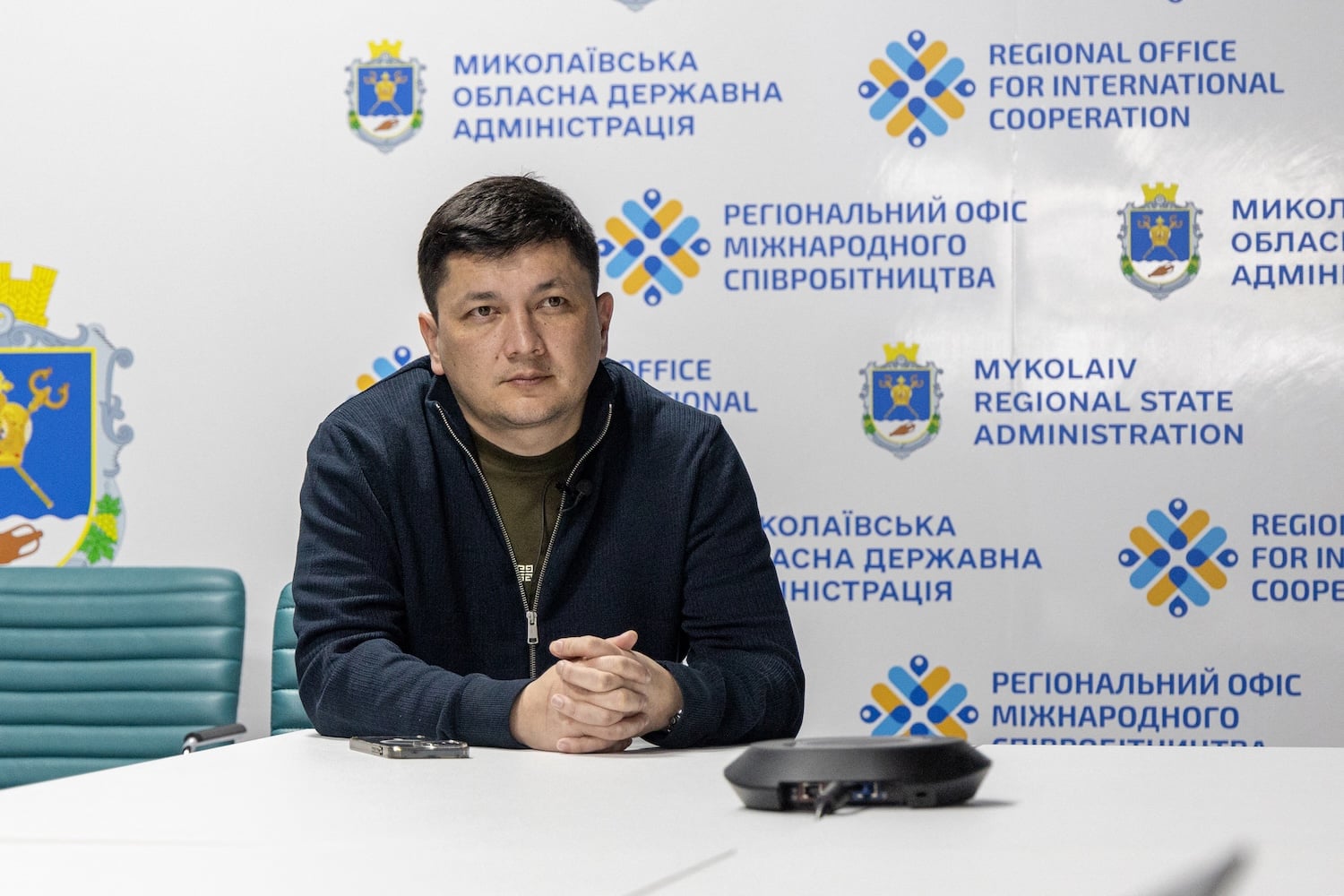
Ukraine must “build the engine while it’s driving the car,” said Vitalii Kim, the country’s new veterans’ affairs minister. Vitalii Kim sits at a table in front of a backdrop featuring the logo of the Mykolaiv Regional Military Administration. Vitalii Kim, then head of the Mykolaiv Regional Military Administration, during an interview in Mykolaiv, Ukraine, on Feb. 14, 2024. Oleksandr Gimanov/AFP via Getty Images Military Economics Russia Ukraine September 21, 2026, 6:00 AM Vitalii Kim, Ukraine’s newly appointed minister for veterans’ affairs, has a job few would envy: helping Ukraine’s over 1 million veterans while operating on a shoestring budget, in a war where the shooting is far from over. Ukraine has to “build the engine while it’s driving the car,” he told Foreign Policy last week while visiting the United States to speak with U.S. officials and nongovernmental organizations. Vitalii Kim, Ukraine’s newly appointed minister for veterans’ affairs, has a job few would envy: helping Ukraine’s over 1 million veterans while operating on a shoestring budget, in a war where the shooting is far from over. Ukraine has to “build the engine while it’s driving the car,” he told Foreign Policy last week while visiting the United States to speak with U.S. officials and nongovernmental organizations. The problem is vast. After over four years of war, Ukraine has over 1 million veterans, many of whom suffer from psychological trauma as well as physical injuries, including tens of thousands with missing limbs. The number of veterans following the war’s end could hit 3 million, out of a prewar population of 44 million that has shrunk to under 36 million over the course of the war. But unlike in the United States, where veterans can return home to a society largely unaffected by war, Ukrainian veterans are living in a war-torn country. Continued Russian attacks are slowing the country’s economic growth while posing a threat to the lives of soldiers who once served on the front line. The stakes are existential for Ukraine’s economy. “With their families, [veterans] account for 30 percent of the labor force,” Kim said. “We cannot lose them.” But that challenge could also help solve some of the country’s economic problems, he said, with many of its service members now proven leaders. “We have people with unique skills—we will use these skills in our economy,” Kim said. Besides traditional problems, such as medical care, there are unique challenges borne from the fact that many soldiers were civilians up until 2022. In some cases, this may help Ukraine—many soldiers had a civilian career they could possibly return to. However, soldiers in combat roles can also earn thousands of dollars in pay per month, versus an average salary of less than $1,000 per month in Ukraine. “This is a problem; we need to adjust the situation,” Kim said. “We are preparing programs that will stimulate business to pay [veterans] more.” Kim’s ministry also needs to address social problems associated with veterans adapting to civilian life—including high rates of divorce and a plummeting birth rate. “Nobody talks about sex at all,” said Kim. “But this is a problem. We need our [population numbers] to rise.” Ukraine’s high number of veterans, many of them skilled in fighting, is also fueling a concern in countries bordering Ukraine about the possibility of veterans leaving the war-torn country and contributing to an increase in crime after the end of the war. Kim declined to comment directly on the potential issue but noted that a thriving Ukraine would attract its citizens back. “Our policy is to create conditions for our veterans so they can work inside the country. And I hope that after the war stops, our citizens will come back and work in the economy of Ukraine,” Kim said. Kim is not short on ideas for solving the wide array of problems. Among Kim’s wants are special hospitals for veteran care—as exist in the United States—as well as programs for using veterans to speak to other veterans during moments of mental health crises. Kim also floated the idea of giving veterans flexible resources that could be used for a variety of goals, from education to business grants, as well as measures to decrease the chances of divorce. But Ukraine’s cash-strapped government can spare relatively little for the needs of veterans. Under a proposed budget for next year, Ukraine would devote two-thirds of its spending to the military, even as the country’s taxable businesses suffer under Russian strikes. In the new budget, spending for veterans would increase by 17 percent, but that amounts to just over $450 million. Kim said he’s searching for foreign financial support, but he’s also working on projects that can be done with little expenditure and have an impact, like reducing the paperwork load for veterans. “You can do everything with money. My task is to do it without the money and earn money for our budgets,” Kim said. Military Economics Russia Ukraine Sam Skove is a staff writer at Foreign Policy. X: @samuelskove Read More Ukrainian President Volodymyr Zelensky arrives for a meeting with senators at the U.S. Capitol in Washington, D.C. Lindsey Graham’s Parting Gift to Ukraine The late senator’s long-stalled Russia sanctions bill is on its way to becoming law. A woman with dark hair stands in profile, looking out over a cemetery filled with graves decorated with blue and yellow Ukrainian flags and colorful floral wreaths. Ukraine’s War Widows Are Fighting for Money Their husbands died defending the country—and now their families are struggling for compensation. European Commissioner for Defence and Space Andrius Kubilius speaks during a press conference in Poland, June 25, 2026. Europe Must Learn From Ukraine’s Example, Top EU Defense Official Says “We were looking at how to support Ukraine—now we are looking at how Ukraine can support us.” OTHER SUBSCRIPTION OPTIONS Stories Readers Liked Go to slide 1 Go to slide 2 Go to slide 3 Go to slide 4 Go to slide 5 Go to slide 6 Go to slide 7 Go to slide 8 Go to slide 9 Go to slide 10 A statue of a seated, bearded man with a bare torso and draped cloth around his waist, holding a scroll in one hand, positioned in front of a row of large classical columns. An illustration of Donald Trump in a blue suit and long red tie gesturing with open hands in front of a grid patterned background with jagged red, blue, and black line graphs diving downward. Five people sit in folding chairs pushed up against a wall, all of them on their phones and several looking board. Text on the wall behind them says "AI for Real" with images of robotic arms and household appliances printed around it. An illustration depicting a man submerged up to his nose in water. The wavy water is divided horizontally into three color bands that mimic a flag: white foam at the very top peaks, a deep blue middle section filled with bubbles, and a red lower section covering his neck and suit jacket. His blue eyes look upward with a wide, strained expression. As the Tide Turns Against Putin, Beware the Drowning Man By Peter Frankopan Negotiators from the United States, Canada, and five European countries converse after finishing the draft of the North Atlantic Treaty in Washington on March 18, 1949. Trans-Atlanticism Isn’t Dead—It’s Being Renegotiated By Alexandra de Hoop Scheffer A woman crosses a road in front of a mural depicting Russian President Vladimir Putin in Kashira, Russia, southeast of Moscow, on Oct. 16, 2017. The Western Myth of Russian Greatness By Christian Caryl An illustration of a vintage-style map featuring North America and parts of Europe and Africa. Overlaid on the map are 3D red brick walls shaped exactly like the borders of the contiguous United States and Alaska, casting long shadows to the right. America, the Once Global Nation By Odd Arne Westad A creative illustration against a pale yellow background showing a garden planter containing a dense green hedge. Five human arms emerge from the hedge, with four of the hands holding small flags of China, Russia, the United States, and the European Union, while the fifth hand holds the flag of India. An illustration showing a pair of hands tightly wringing out an American flag. Water droplets shaped like missiles squeeze out of the twisted fabric and fall toward a puddle shaped like the map of Iran on a red background. An aerial photo shows Doha in the booming petrostate of Qatar.
To Win the Peace, Ukraine Must Cope With Vast Numbers of Veterans
Full Article
Original Source
Read the full article at Foreignpolicy →KhanList aggregates and links to publicly available news content. We do not host full articles from third-party sources. Always verify important information with original sources.