
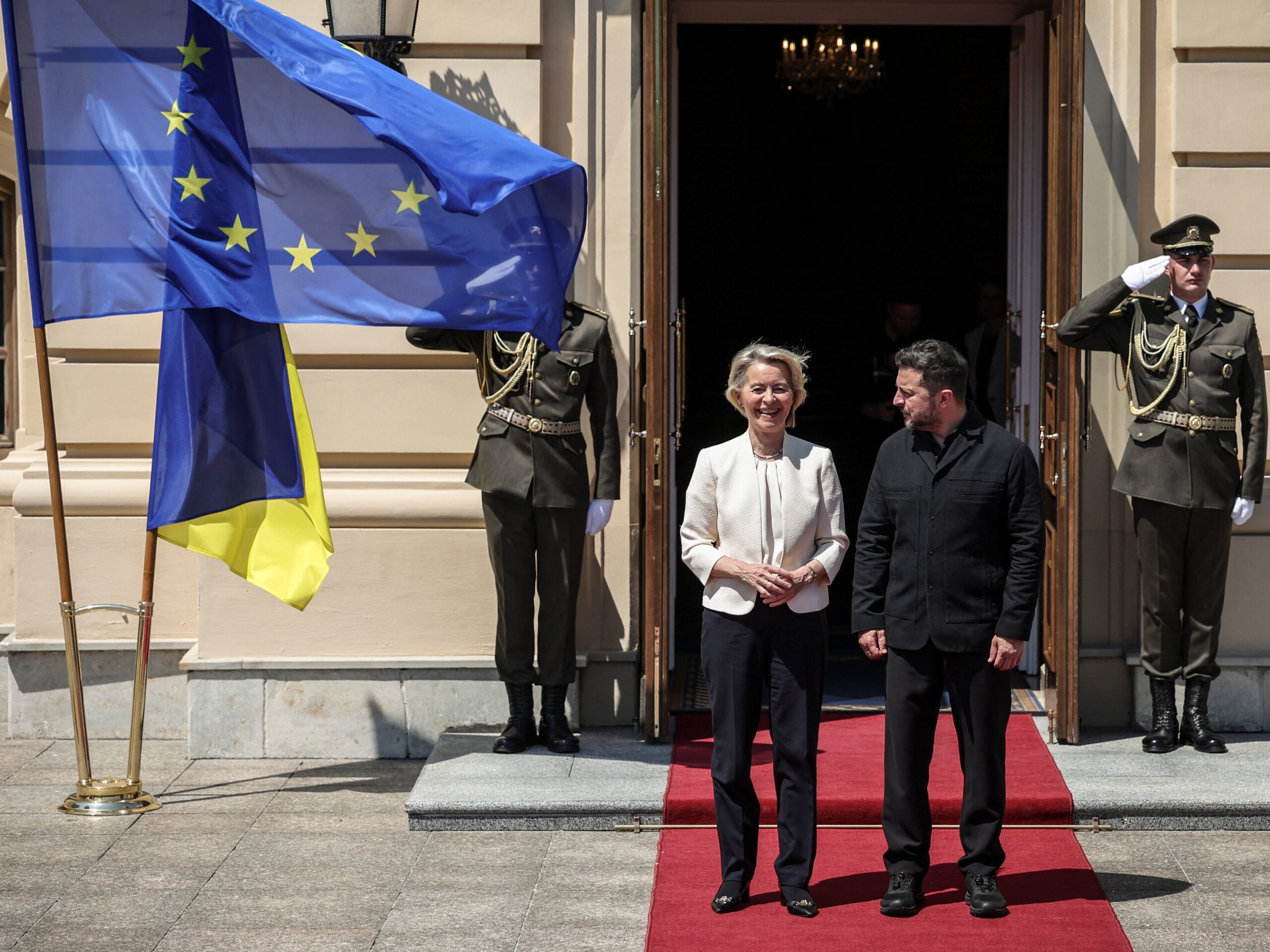
Bottom lines up front A durable settlement to the Russian war on Ukraine must include EU membership for Ukraine.The EU supports Ukraine’s membership, but member states fear a financial hit from the bloc’s expansion and farmers’ anger over new competition.Washington can and should offer a grand bargain—you could even call it a deal—to break the impasse. The Trump administration’s efforts to end the Russian war on Ukraine have been cyclical. In 2025, the White House first offered diplomatic engagement to both sides, pressured Ukraine to relinquish territory, then offered gifts to Russia. The administration returned to negotiations and then only belatedly pressed Moscow with sticks. In November 2026—in the wake of the Starlink-Starshield debacle and US plan to purchase Russian diesel—we are somewhere between “gifts to Russia” and “a return to earnest negotiations,” as the administration initiates another hurried push to reopen peace talks. But there may be a way off this merry-go-round that ends the fighting, sets up Ukraine’s European future, and reestablishes US credibility. The White House’s latest effort comes as relations between the US and Ukraine—and the US and Europe—may be at their lowest ebb in recent times. New negotiations should be an opportunity for Washington to strengthen its relations with Europe and put Ukraine on a durable path to peace that not only ends the fighting but deters future Russian belligerence by providing a realistic path toward Ukraine’s European future, including with membership in the European Union (EU). The absence of such a path—leaving Ukraine in a neutral gray zone—would invite future Russian attempts to subsume Ukraine. Fortunately, the United States, Europe, and Ukraine share a range of mutual interests, some of which should be advanced in a “grand deal” between Washington, Brussels, and Kyiv. The prospects for such a deal may seem dim, but the logic behind the idea may not be so farfetched: Overlapping interests provide a strong basis for a pragmatic framework that gives each party a way to secure existing strategic priorities, all with a view to a sustainable end to the war. An opportunity to build a “grand deal” Negotiations would not start from scratch, and the Trump administration has already tied Ukraine’s admission to the EU to its previous peace proposals. This is the one underappreciated element of the Trump team’s otherwise immensely flawed proposals to end the war. Even amid recent news, membership in the bloc appears to still be on the table in a settlement. Ukraine’s EU membership should continue to be part of peace plans, and the United States should be more involved in advancing it. Washington should offer a grand bargain to Europe—in which it commits to supporting Ukraine’s EU bid by pushing Kyiv to make EU-required reforms in exchange for advantageous commercial and security arrangements when Kyiv joins the bloc, while Europe gets a greater role in peace talks and Washington’s support in smoothing over otherwise fraught accession plans for Ukraine. Such an arrangement would benefit all parties. Kyiv would get a more realistic path toward membership. Europe would receive recognition of its role in Ukraine peace talks. The United States would get additional leverage to end the war and a more “balanced” partnership with Europe, one of its top strategic objectives vis-à-vis the Continent. With US-European and US-Ukrainian ties as frayed as they’ve ever been, pulling off a grand bargain to end the war in Ukraine—by securing Ukraine’s future in the European Union—won’t be easy. But the interests align and with the right diplomatic touch, Washington can help make it happen. This initiative would require a significant shift from Washington. A grand bargain cannot rest on its diktats. To get what it wants, the White House should act as a constructive third party interested in securing tangible benefits for Kyiv, Brussels, and Washington—and catalyze Ukraine’s EU bid. Schrödinger’s EU membership The inclusion of EU membership for Ukraine in previous peace plans was just about their only positive. Point eleven of the fatally flawed twenty-eight-point plan authored in November 2025 by US special envoys Jared Kushner and Steve Witkoff—with significant input from Russia—stated, “Ukraine is eligible for EU membership and will receive short-term preferential access to the European market while this issue is being considered.” The revised twenty-point plan from December 2025—with input from Ukrainian President Volodymyr Zelenskyy—pushed more forward-leaning language: “Ukraine will become a member of the EU within a specifically defined period of time, and Ukraine will receive short-term privileged access to the European market.” As with much in the proposals, details are scarce. Left unexplored is exactly how Ukraine will become a member of the bloc. Nevertheless, that both proposals mention Ukraine’s EU membership acknowledges the role that EU membership will play in the country’s postwar future. EU membership for Ukraine is squarely in the US national interest. In many ways, Ukraine already enjoys privileged access to the EU. Brussels and Kyiv have applied a Deep and Comprehensive Free Trade Area, which goes further than a standard free-trade agreement, since 2016, and it provides Ukraine significant economic integration and market access to the EU. After the full-scale invasion in 2022, the bloc enacted further trade liberalization measures with Kyiv. Today, EU policies seek to integrate Ukraine’s defense industrial base with the bloc’s own. Ukrainian refugees have the right to live and work inside the EU. In January, the EU integrated Ukraine into its mobile roaming scheme. Brussels keen, member states reluctant But access remains in flux. In July, Brussels decreased tariff-free quota allowances for Ukrainian steel by 59 percent. The EU has tightened some liberalizing trade measures and included more safeguards on agricultural products. Furthermore, setting a date for Ukraine to join the Union is difficult. EU accession depends on how quickly a candidate country makes the changes needed to align with EU rules and completes the thousands of time-consuming technical reforms Brussels demands. In attempting to fulfill them Kyiv is not helped by needing to dedicate most of its resources to fighting a war, or Russia occupying roughly 20 percent of the country. Ukraine has made admirable progress, but it still faces entrenched interests in government and the private sector that would like to slow the governance and transparency initiatives membership requires. The EU’s 2026 Communication on enlargement policy notes Ukraine’s good progress overall but hints at the need to speed some reforms, particularly in rule of law. There are arguably more obstacles to setting a date on the EU’s side. Because enlargement happens by consensus, any member state can halt a candidate’s progress for any reason along the serpentine enlargement process. There are more than 150 instances in which unanimity is required. With twenty-seven members, that’s more than 4,000 potential veto opportunities. It only takes one country or leader to upend things, as Hungary’s former Prime Minister Viktor Orban did repeatedly. Even with Orban’s departure, Ukraine still faces obstinate EU members. The current Hungarian government held up negotiations for months over concerns about Hungarian minority rights in Ukraine. World War II-era grievances between Poland and Ukraine are another ongoing flashpoint. Right-wing firebrands like France’s Marine Le Pen might soon find themselves in power and could pick up where Orban left off. Unrelated to Ukraine, but emblematic of the capricious nature of the EU’s enlargement process, Spain has threatened to halt all enlargement proceedings until Catalan, Basque, and Galician become official EU languages. Ukraine stands to be more prosperous with EU membership—and a bigger trading partner for Washington. More responsible leaders also have reasons to push back on Ukraine’s rapid accession to membership. As the rules stand, Ukraine’s entry would alter the math behind the funding the EU doles out in regional development assistance, agricultural subsidies, and cohesion funds. By some estimates, members could see a net cost of €136 billion in the short term if Ukraine joins—though the same estimates stress Ukraine’s entry would not itself be the main reason for the reduction of EU payments to most recipients. Ukraine’s agricultural sector would also likely outcompete EU farmers. European politicians remain broadly supportive of Ukraine’s EU membership while it remains abstract. But if all politics is local, it stands to reason that Europe’s politicians might think twice before embracing a move that translates to less EU money and angrier farmers at home. Enlargement is also tied to debates about how the EU should function overall. The current rules are untenable. Many ideas to address these obstacles have been floated: staged accession or associate membership models, delaying Ukraine’s access to EU agriculture subsidies, and proposals for EU reform. None has taken off. The European Commission has been more forward-leaning, but member states are dragging their feet. Member states rejected a “reversed” membership concept the European Commission presented in March, under which Ukraine would first become an EU member, and then gradually gain access to the full benefits of membership. The commission again proposed creative institutional layouts and safeguards for future members in early October. Member states may be generally supportive of accession and institutional EU reforms, but some will likely continue to push back and, crucially for Ukraine, the process for EU reform will not be quick. In short, little seems likely to change in the near term. This reality points to a stubbornly wide gulf between Europe’s stated aspirations to embrace Ukraine on the one hand and the political will to meaningfully address the difficult questions about EU reform and enlargement on the other. This reality risks leaving Ukraine’s European future in limbo, with EU membership being litigated in fast-changing peace talks, while the actual process for membership remains stuck in the hellishly long EU decision-making process. Deus ex America Enter Washington. The Trump administration can and should play a role to avoid sentencing Ukraine to enlargement purgatory. Transatlantic difficulties make such cooperation difficult. Valid concerns over the United States withholding the intelligence and military aid Kyiv relies on, SpaceX throttling Ukrainian armed forces’ satellite-network access, and special envoys’ uncomfortable backslapping with Vladimir Putin make it difficult to believe that Washington could be a value-add at first glance. The current administration has not said much about Ukraine’s EU membership prospects beyond stipulating in its two peace plans that it should happen. The administration has, however, a lot to say about the EU. Washington’s national security strategy is riddled with objections to the logic behind the EU’s model of pooled sovereignty. Administration officials and the president himself have bashed the bloc. The administration has also made common cause with those in extreme corners of European politics that speak of the EU’s demise. Yet there are still people who hold competing views within the administration, some of whom could be open to cooperation with Brussels—especially if they make the case that EU membership for Ukraine is squarely in the US national interest. With so much at stake and so many shared interests, a US-Europe-Ukraine grand deal may not be so crazy. Consider the economics. Ukraine stands to be more prosperous with EU membership—and a bigger trading partner for Washington. For the ten countries that joined the EU in 2004, gross domestic product per capita almost doubled in the subsequent fifteen years. As these countries got richer, US commerce with them grew. US exports of goods to Poland rose tenfold between 2004 and 2024. It is for this reason that Washington supported earlier rounds of EU enlargement. The EU’s rules may be targets for gripes about overregulation, but the financial stability and standards EU membership provides would make US businesses, traders, and investors take notice—especially in a country like Ukraine, which has well-documented sectors ripe for investment including drone manufacturing, critical raw materials, information technology, and agriculture. The US administration’s signature Ukraine initiative—the US-Ukraine Reconstruction Investment Fund (URIF), which grew out of the 2025 minerals deal—already focuses on strategic equity investments in the Ukrainian economy. The value of those stakes, and the deals for US companies that URIF capital facilitates, would jump immediately if Ukraine becomes an EU member. Membership also cements Europe’s responsibility for Ukraine. Granting Ukraine membership would provide the clearest signal that Europe is mobilizing significant resources for Ukraine’s support and recovery, a frequent Trump administration request. Even so, EU membership is not a panacea. It will not give Ukraine security guarantees like those offered by NATO. But given that NATO membership for Ukraine—no matter how deserved or strategically relevant—remains unlikely in the near term, further integration into Europe’s funding and nascent defense architectures will augment both Ukraine and Europe’s defense and security capabilities, another demand from Washington. Pushing for Ukraine’s EU accession serves existing Trump administration priorities in both Kyiv and Europe. Leaning further forward can multiply these dividends into a strategic windfall for Washington. Europe, of course, gets the final say. And there are serious pitfalls to Washington involving itself in accession proceedings. Enlargement is an EU affair, and the Trump administration has little in the way of political capital or goodwill in Europe after nearly two years of browbeating. A blunt US approach, such as demanding Ukraine join the EU immediately, would likely doom the effort. US involvement in enlargement proceedings has backfired before. The George W. Bush administration overplayed its hand when it pushed for Turkey’s EU bid. President Barack Obama’s endorsement of Turkey’s EU bid was likewise opposed by France and Germany, though it was welcomed by the then-European Commission president. Yet there is recent precedent for transatlantic action. European leaders reportedly raised Orban’s veto of Ukrainian accession with Trump at their August 2025 White House meeting and urged him to pressure Orban. In November 2025, Zelenskyy said Trump agreed to “do everything in his power” to help navigate around Orban’s veto of Ukraine’s accession negotiations. Trump never meaningfully followed through. Nevertheless, that it came up in transatlantic talks is a useful detail that could lay the ground for more willingness to pressure member states to drop obstructive vetoes. The White House might sound like an unlikely champion for Ukraine’s EU prospects but, counterintuitively, the United States might be also an ideal partner. A nuanced US approach to facilitating Ukraine’s accession can form the basis for a grand bargain with Europe, lay the groundwork for speedier reforms in Ukraine, act as a catalyst for diplomatic action, and deter political gamesmanship. The start of the deal Washington’s involvement would fall into three buckets: political pressure, concessional financing, and technical support. In return for its financial and political capital, the United States would get an additional sweetener in negotiations with Kyiv and meet its strategic objectives vis-à-vis Europe. What Washington should do Give Europe a seat at the table Politically, Washington should start by offering to involve Europe more in peace talks. US envoy Steve Witkoff and Jared Kushner have been meeting with European allies in recent weeks, prior to talks in Moscow, and recently met with allies around the talks between Washington, Kyiv, and Moscow in Abu Dhabi. On November 6, Kushner wrote, as part of larger post, that the United States “will consult closely with our European partners on the sidelines [of upcoming negotiations in Abu Dhabi] and, if progress is made, aim to move toward a broader multilateral format with their direct participation.” If done properly, that could be a good start, but Europe is still largely out of the picture in direct negotiations. Establishing a European presence at talks is a major preoccupation on the Continent—toward which end Finnish President Alexander Stubb and Norwegian Prime Minister Jonas Gahr Støre recently spoke to Vladimir Putin, generating some controversy. It is clear Europe will have to be more involved in the future. Additionally, sidelining Europe in future talks, as in 2025, will dampen any US effort to support Ukraine’s EU future. Involving Europe, or at least leaders from the EU and key member states, will help generate buy-in. Get Kyiv moving on rule-of-law reforms As part of those discussions, Washington should seek to outline with the EU the fundamentals of reforms that the United States can support, particularly on issues that will be important to Washington’s future relations with Kyiv: business environment reforms, transparency, anti-corruption efforts, and even sectoral reforms such as in the defense tech or energy fields. In discussions with Kyiv, the administration should insist on more robust commitments to reforms the EU has laid out, most recently in the EU’s Enlargement Policy published November 4, many of which are proceeding too slowly for Ukraine’s hopes of near-term accession. Washington should work closely with the EU to coordinate messaging on this point to Kyiv. Sort out the politicking around agriculture Washington’s political signaling should focus on EU member states as well. In return for working more closely in peace talks, the administration should make it clear to the EU and member states that it expects good-faith efforts to advance the necessary changes to enlargement proceedings and other reforms. It should push European capitals to reject politicking around Ukraine’s EU bid. Here the Trump administration’s unpredictability and penchant for connecting disparate policy decisions could be a tactical benefit. A signal that Washington expects its European allies to deliver on their part in peace talks could be a deterrent against future political grandstanding. Washington should keep in mind that its role would be a supporting one. It need not dictate how enlargement works or how the EU should reform itself, but the administration can put pressure on both Europe and Ukraine to speed up enlargement processes and play a positive role in addressing some difficult realities of accession. Washington could also offer mutually beneficial solutions as part of a deal. If Ukraine and EU members cannot agree on trade rules for Ukrainian agriculture, for example, Washington could offer to buy fixed levels of Ukrainian agricultural products to keep them out of the EU market and take a cut of the profits. For a lighter touch, the administration could guarantee a price floor for US traders to buy a certain percentage of Ukrainian grain or other products to be sold outside of the EU. This or a similar arrangement could be underwritten by the US Development Finance Corporation, which already operates URIF, to help US trading firms buy down commercial risk and increase their trading share of the Ukrainian agricultural market. The EU is unlikely to get a better offer to help address one of the thorniest politico-economic issues of Ukraine’s accession. Make loans with real leverage Washington could also provide financial assistance to advance Ukraine’s EU reform efforts. The US Congress could allocate financial support conditioned on Ukraine completing the reforms the EU lays out. The EU has already done much of the work on this front by conditioning the provision of its main assistance package, the €50 billion Ukraine Facility, on specific reforms. The incoming Democratic Congress could design a financial assistance package or build financial support in future State and Foreign Operations and Related Programs Bills, built around grants or low-interest loans that disburse funding upon the completion of reforms in priority policy areas. A better-armed Europe more able to provide for its own defense would be a major positive for Trump, who has staked significant diplomatic capital on pushing European allies to do more for their own security. Additional funding for Ukraine might seem unlikely from this administration or members of Congress disinclined to boost foreign aid, but loans with conditions for reform and built-in EU oversight on areas this administration cares about could be palatable and bipartisan, especially as the next Congress looks likely to have more appetite for shaping Ukraine policy. But assistance in the form of investment is another story. Bringing Ukraine into the EU would also mean adding the continent’s most technologically advanced military into the bloc. In nearly five years of full-scale war, Ukraine has built a modern fighting force that has halted Europe’s largest army. It has done so through the development and deployment of cutting-edge unmanned aerial vehicles, long-range strike capabilities, maritime drones, and electronic warfare, often powered by artificial intelligence and improved in cheap, short feedback loops. As Europe scrambles to reindustrialize—for its own economic and security reasons and under pressure from the Trump administration—Ukraine’s array of cheap, modular technology would be a boon to the European defense ecosystem. The upshot would be a better-armed Europe more able to provide for its own defense, a major positive for Trump, who has staked significant diplomatic capital on pushing European allies to do more for their own security. A big ask Overall, such a deal provides upsides to both the United States and Europe. Facilitating Ukraine’s EU accession at Washington’s urging gives Brussels a card to play in its tense relationship with the Trump administration. Washington could also be a force multiplier on European demands for reform that Ukraine is slow-walking. The United States could help to address economic concerns inside European countries that stem from the realities of Ukraine’s EU integration. Washington could also use leverage to help cut through political brinkmanship along the lines of Orban’s repeated vetoes of enlargement proceedings. This deal would require a change from the Trump administration—a big one. To be taken seriously in Europe, US support of EU membership for Ukraine will require different rhetoric and a more nuanced approach from Washington. It will require public messaging from US leadership that acknowledges the role EU membership plays in Ukraine’s post-war future and sets expectations for constructive engagement. It will also require sustained attention, as even the most accelerated membership talks will take time. Even with US support, Ukraine’s EU accession is not guaranteed. It will still rely, first and foremost, on Ukraine and on EU member states embracing the necessary changes to allow Ukraine’s membership. But the payoff from such a tactical shift could be substantial. It would increase US credibility in the flagging Ukraine-Russia peace process while simultaneously getting Europe to take further responsibility for its own security and economic future, while advancing commercial diplomacy priorities in Ukraine. For the EU, this is safe ground on which to engage the Trump administration: The bloc can leverage American interest to advance accession-related reforms in Ukraine and swat obstructionist efforts away to speed up a sluggish membership process that it was planning to complete anyway. Ukraine gets EU membership at the price of tough love from its partners and expeditiously enacted reforms necessary for accession. The difficulties associated with such a deal are not going to be easy to surmount, but they are not immutable. The United States and Europe have their differences in the current political moment, but that shouldn’t stop them from working together to advance Ukraine’s EU accession. In fact, an active US role in the accession process can improve discrete aspects of the US–EU relationship and produce strategic wins for Washington, Brussels, and Kyiv. The results of the US midterm elections provide an opening for the Trump administration to change course, for Congress to press for a different policy and Ukraine appropriations palatable to Trump, or for US support for Ukraine’s EU accession to become central policy in any future administration. With so much at stake and so many shared interests, a US-Europe-Ukraine grand deal may not be so crazy after all. About the authors James Batchik is deputy director at the Atlantic Council’s Europe Center, where he leads the center’s programming and strategy on the European Union and US-EU relations. Andrew D’Anieri is associate director of the Atlantic Council’s Eurasia Center, where he facilitates the center’s work on Ukraine and Russia. Explore the program The Europe Center promotes leadership, strategies, and analysis to ensure a strong, ambitious, and forward-looking transatlantic relationship. Image: Ukraine's President Volodymyr Zelenskiy and European Commission President Ursula von der Leyen pose for a photo before a joint press conference as they visit the Ukraine Southeast Europe Summit with other European leaders, amid Russia's attack on Ukraine, in Kyiv, Ukraine, July 15, 2026. REUTERS/Alina Smutko
To settle Russia’s Ukraine war, Europe needs to let Kyiv in. Trump can help (really).
Full Article
Original Source
Read the full article at Atlanticcouncil →KhanList aggregates and links to publicly available news content. We do not host full articles from third-party sources. Always verify important information with original sources.