
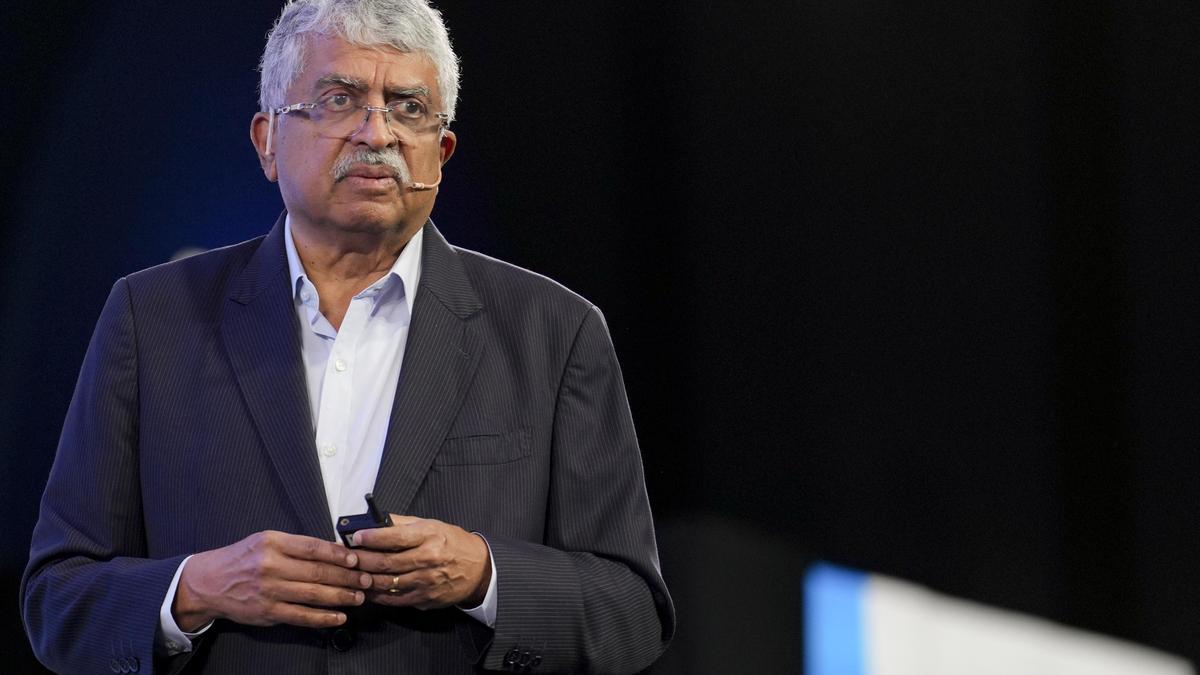
Co-founder and Non-Executive Chairman of Infosys Nandan Nilekani. File. | Photo Credit: PTI Challenged with stemming the slew of question paper leaks that have threatened the credibility of India’s examination system, Infosys co-founder Nandan Nilekani has suggested a solution: create “a massive bank of questions”, and only generate the final paper at the last minute. He added that artificial intelligence could also be used to generate the question paper on the day of the examination itself. For any of this to work, of course, examinations will have to be held in computer-based test mode, abandoning the traditional pen-and-paper format.Mr. Nilekani is the chairman of a six-member high-powered task force on exam reforms set up by the Union government in July.‘Remove economic incentive to leak papers’He was responding to a question on the security issues and weaknesses of the exam system observed by the task force, posed at the Bloomberg New Economy Forum 2026 on Tuesday. “The issue that led to this committee is that of question paper leaks. Why do we need to have something called ‘a question paper’? Because that creates an economic incentive for it to be sold. One way to look at how to solve it is to have a massive bank of questions, and only at the last minute generate the question paper for the day,” Mr. Nilekani said. Task force mandateThe task force, comprising a multidisciplinary group of domain experts, was announced by Prime Minister Narendra Modi on July 26, a day after Union Minister of Education Dharmendra Pradhan tendered his resignation following widespread student protests related to the NEET-UG 2026 paper leak. The mandate of the task force is to help revamp the beleaguered National Testing Agency, especially from a technology perspective, and to bring about structural reforms in the system. The other members are former ISRO chairman S. Somnath, former Intelligence Bureau director Tapan Deka, IIT Chennai director V. Kamakoti, former Education Secretary Anita Karwal, and logistics expert Amrit Lal Meena. At the time of its formation, the task force was given three months to submit on its report.Challenges of shifting to CBTThe panel is studying the feasibility of conducting all exams using CBT, Mr. Nilekani said. NEET-UG 2026, which was attempted by almost 22 lakh candidates, was conducted in a pen and paper format. “The committee is looking at how to make sure all exams are done on CBT. That requires a network of locations. We have 1,50,000 locations where young candidates can take a test and that needs to be expanded,” Mr. Nilekani emphasised. The NTA has sought help from the All India Council of Technical Education (AICTE) to map the available IT infrastructure and vacant spaces in government institutions to establish standard testing centres where exams can be taken in CBT mode. The government is not keen to engage private institutes such as exam centres as they could be more prone to paper leaks due to weak security. “These are some of the systemic issues we will address in our committee and the PM is very keen to implement our suggestions,” Mr. Nilekani said. The AI optionAsked whether artificial intelligence could be used to spontaneously create a question paper on the day of the exam, Mr. Nilekani responded saying, “Yeah sure.” He added: “If you look at it systematically, go to the root cause of why it is happening and use technology to solve it they are solvable issues.”The task force has held 18 meetings of its members, along with 40 consultative meetings. It has received over 50,000 suggestions from students, parents, and doctors’ associations, as well as from exam conducting bodies such as the National Recruitment Agency, Staff Selection Commission, and the Railway Recruitment Board. Published - October 13, 2026 08:05 pm IST
To prevent leaks, generate exam papers at the last minute from a massive question bank: Nilekani
Full Article
Original Source
Read the full article at Thehindu →KhanList aggregates and links to publicly available news content. We do not host full articles from third-party sources. Always verify important information with original sources.