
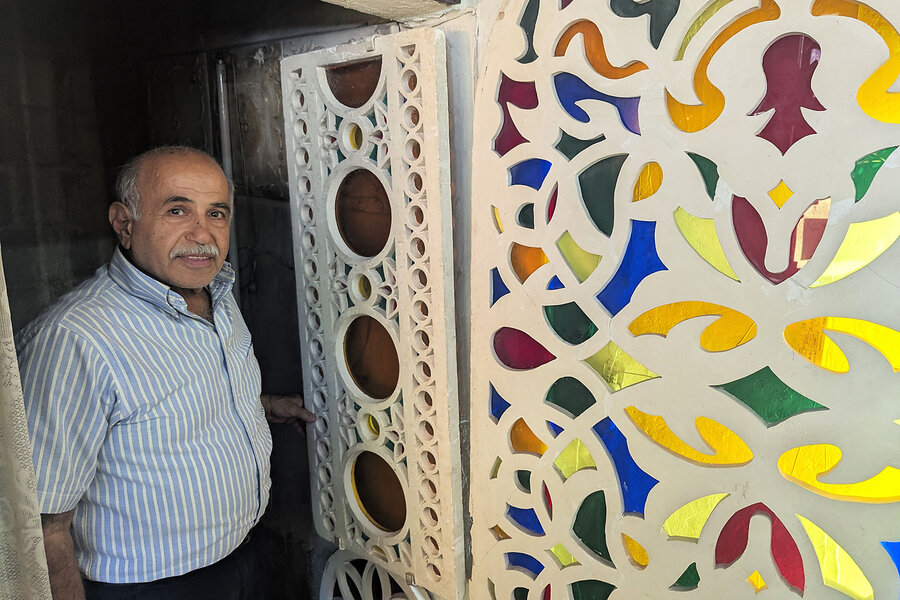
Damascus | Oct. 20, 2026, 3:38 p.m. ET | 4 min read As Syrians pick up the pieces of their war-ravaged country, Fayez Talmasani is opening a window to one of the Middle East’s oldest art forms for the first time in half a century.And as Damascus slowly rebuilds, he hopes that sharing his secrets will meet a rising demand to rely on a legacy of Syria’s past to make the city’s future physically brighter.For Mr. Talmasani, up until recently, was the last person in Syria skilled in producing muashaq, or stained-glass windows, a Damascene art for 2,000 years. Muashaq has long been a symbol of Damascus architecture, with stained glass an art form in the city dating back to the first century. Intricate mosaic-like stained glass windows were commonly placed in Damascus homes and places of worship, filtering in a kaleidoscope of colors in vibrant geometric forms. Taylor LuckA finished stained-glass artwork hangs at the Damascene Dream Institute workshop, in Damascus, Syria, Sept. 23, 2026. Today, these stained-glass windows adorn the Umayyed Mosque, as well as great houses of Damascus; one piece hanging in Mr. Talmasani’s tiny shop was made more than 500 years ago.Damascene stained glass was so famous for its delicacy and intricacy that it gave rise to a 700-year-old Arabic saying, “as thin as Damascus glass.”“Heavenly” inspirationMr. Talmasani’s journey into one of Syria’s oldest art forms began at the Damascus Art Institute in 1966 when, as a 16-year-old sculpture student, he wandered into a stained-glass class and was immediately captivated.He dropped bronze-sculpting and took on window-making full-time. Inspired by the “heavenly” windows in the Old City’s mosques, he locked himself away at home. After two years of experimenting and “a lot of wasted glass and plaster,” he rediscovered the ancient way of producing Damascene stained glass in a single, intricately designed piece. Taylor LuckArtisan Fayez Talmasani watches over a student as she carefully carves and files geometric shapes into a sheet of plaster in preparation for creating a traditional stained-glass window, at the Damascene Dream Institute workshop, Sept. 23, 2026. “It was a lot of hard work,” he says. “I had no teacher or instructor but the beautiful windowpanes I walked by in the Old City.”Like his predecessors centuries ago, Mr. Talmasani meticulously carves out detailed patterns onto stucco gypsum panels. One wrong move and it cracks.He then hand-cuts colored glass pieces that are carefully fitted into carved openings into the plaster without using a single drop of adhesive.Some panels are small – 12 inches by 12 inches. Other windows are 6 feet tall and 4 feet wide.Some Syrian artisans produce glass in the spirit of the Damascene windows, but use adhesives and digitally guided machine cutters for glass and plaster and double panes of glass to create the illusion the window is a single piece. Mr. Talmasani uses traditional Damascene stained-glass colors, each with its own meaning. Among them are red – often at the center of windows – for love, strength, fire, and the sun; and green for life, bountifulness, and giving. Taylor LuckStudent Mariam Ismael carefully drills floral shapes into a plaster pane that will soon become a stained-glass window. During Syria’s civil war, several factors pushed muashaq nearly to the point of extinction as a craft: hyperinflation, difficulty in sourcing materials, the rise of cheaper machine-made glass, and constant bombings.Few Syrians were willing to devote time or money to the arts, let alone to commission stained-glass windows, amid car bombs, barrel bombs, and fuel shortages.Knowledge transferredAs a precaution, for “the art to survive,” Mr. Talmasani recorded all his techniques, secrets, and designs onto a CD in case he and his son were killed.“This art is my inheritance, I am only its keeper,” he says. “I wanted to ensure it survived.”Today, he has fulfilled that promise.In late September, at the Damascene Dream Institute, a Syrian nonprofit at the entrance to Damascus’ Old City devoted to preserving traditional crafts, Mr. Talmasani finished teaching a free two-month muashaq course to 18 young Syrians. Most were young women, including doctors, engineers, and artists. Taylor LuckExamples of Fayez Talmasani’s work hang around his classroom at the Damascene Dream Institute workshop. “I have opened all my files and given away all my secrets,” he says, beaming, while overseeing his students’ final windows in late September. “My students came because they actually love the art, not because they want to make money. They are ready to carry on the craft themselves,” he says, his eyes twinkling, “and work with me.” Mariam Ismael, an accountant in her 30s and a soon-to-be employee at Mr. Talmasani’s workshop, says she learned of the art through Instagram reels highlighting his recent exhibition.“Stained glass is a central part of Syrian heritage that has disappeared from daily life,” Ms. Ismael says, her apron covered in stone dust.“It is beautiful to breathe life into an old craft,” she says. “No one else in the world knows how to do this. It is a wonderful feeling.”Role in rebuildingThe art’s rejuvenation comes amid an increased demand from Syrians to use the glass as they rebuild homes, mosques, businesses, and cultural centers. Taylor LuckStained glass waits to be used in projects produced by students of master glassmaker Fayez Talmasani. “People are more settled now and thinking about the future and rebuilding,” Mr. Talmasani says, noting he has been inundated with dozens of orders since the December 2024 downfall of President Bashar al-Assad.“When people feel there is stability, they are willing to spend money and invest in beauty. And everyone wants a form of beauty that is part of our identity and heritage.”Quietly, these windows are becoming a symbol of the postwar Damascus: ancient and new, hopeful but fragile.Hiba Abdulrahman, a muashaq student who is also working toward a graduate degree in architecture and hopes to assist in Syria’s reconstruction, is already incorporating the windows into her architectural designs. “I feel that we can develop stained glass to make it live longer in this new age,” she says. “With all of the reconstruction and rebuilding, we have a chance to link Syria’s past with the present.” Deepen your worldviewwith Monitor Highlights.Politics with respectGet political stories with respectful analysis.There‘s a world of new ideas in everyBooks newsletter.There‘s more to life, enrich yours withCulture & Learning weekly.Follow humanity‘s discoveries withScience & Nature stories in your inbox.Gain a spiritual perspectivefrom the stories in your inbox.Want to understand the deeper impact of critical events? Learn the Monitor‘s insight.Already a subscriber? Log in to hide ads. “We will carry on this heritage and spread it to rebuild our Syria with this glass and colors,” Ms. Ismael adds. “Our future will be bright and colorful, like our past.”Walaa Buaidani in Damascus supported reporting for this article. ALREADY A SUBSCRIBER? LoginReal news can be honest, hopeful, credible, constructive.The Christian Science Monitor was founded in 1908 to lift the standard of journalism and uplift humanity. We aim to “speak the truth in love.” Our goal is not to tell you what to think, but to give you the essential knowledge and understanding to come to your own intelligent conclusions. Join us in this mission by subscribing.
To light Damascus’ future, an artisan draws on its stained-glass past
Full Article
Original Source
Read the full article at Csmonitor →KhanList aggregates and links to publicly available news content. We do not host full articles from third-party sources. Always verify important information with original sources.