
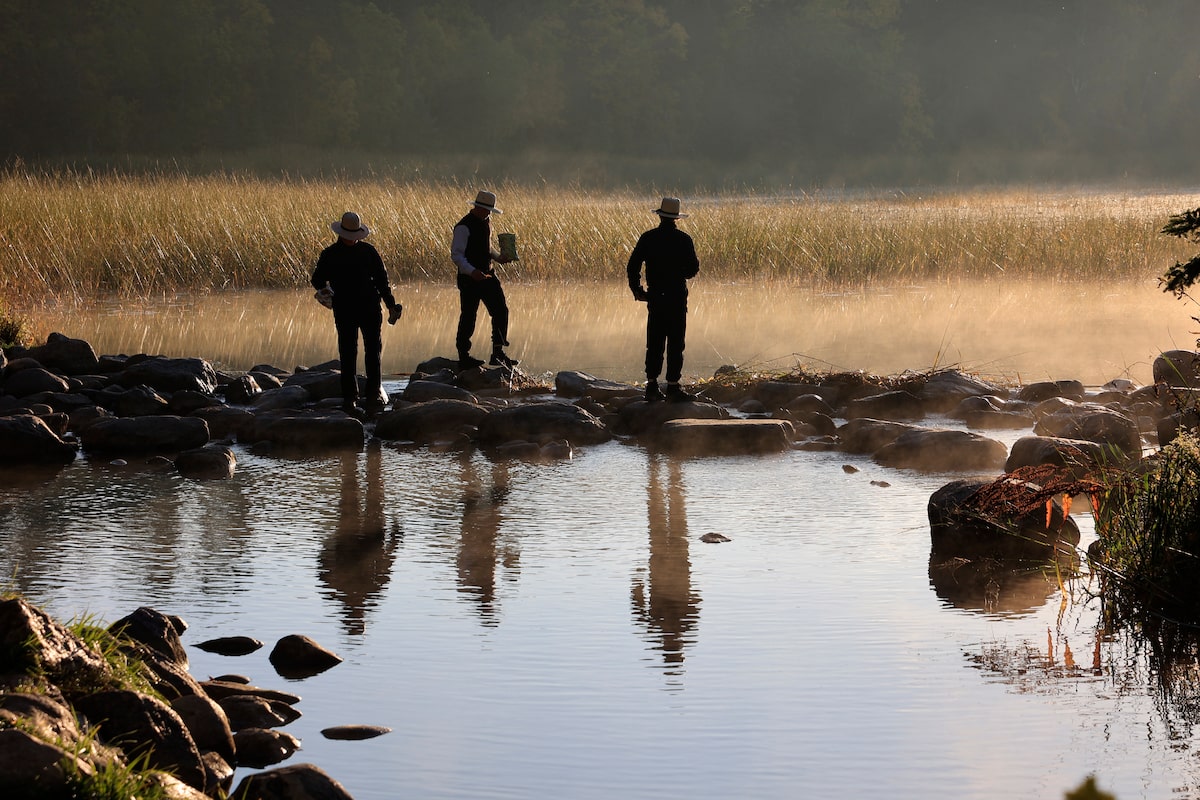
Two years ago, Donald Trump painted the heart of the United States in Republican red. Ten states touch the Mississippi, that great waterway that has given life to the country from its earliest days. Only two voted against Mr. Trump’s MAGA vision. The river is the country’s most important geographic artery. It is also an essential political vein, its ever-shifting currents a constant test for campaigns. In 1996, Bill Clinton won every one of the river’s states save Mississippi itself. Just 20 years later, Mr. Trump swept through with a dramatic political reversal. The father of rivers, as it has been called for centuries, is “the body of the Nation,” Harper’s Magazine declared in 1863. Here, the foundations of U.S. economic might were built: timber, flour, cotton. Jazz was born on the river. So was Mark Twain, scrivener of “the majestic, the magnificent Mississippi, rolling its mile-wide tide along, shining in the sun.”The course of time has altered it in countless ways. Steamboats have been replaced by towboats pushing assemblies of barges. The waters’ annual fluctuations have been tamed by dozens of dams that safeguard the movement of American commodities. Its economic centrality has been eclipsed by other parts of the country.Open this photo in gallery:Lock and Dam No. 1, also called the Ford dam, regulates the flow of the Mississippi between Minneapolis and Saint Paul.Yasmin Yassin/The Globe and MailBut this restless river remains a fundamental filament of American life.The Mississippi touches the Midwest and the South, the sweep of rural American farmlands and the music-inflected urban byways of Memphis and New Orleans. It is a destination for recreation and a backbone of industry. It is a corridor for international trade, a wellspring of culture and, sometimes, a battleground. George Floyd was killed not far from the river’s banks. So were Renée Good and Alex Pretti, shot dead by immigration agents. Winning over that clash of interests has always proven difficult, especially for Democrats. Barack Obama won only four of the Mississippi states; Joe Biden, just three.Yet as the U.S. casts ballots at the midpoint of Mr. Trump’s second time in office, voters have fresh reason to reconsider old allegiances. The midterms arrive at a time of raucous politics and trying economic circumstances – war in the Middle East, questions about humanity’s future in an age of artificial intelligence, instability in the global order. How Americans mark ballots in the coming weeks could reshape their country – and a broader world already thrown into uncertainty by the Trump administration. The Nov. 3 election will determine the balance of power in Congress, and with it, the relative strength of legislative power in Washington to check or accelerate Mr. Trump’s agenda. States along the Mississippi stand on the shores of change – if voters so choose. The 10 river states will elect six governors, 74 people to the House of Representatives and eight U.S. Senators – nearly a quarter of the Senate seats up for election this year.Ahead of the vote, The Globe and Mail is travelling from the headwaters to the delta, traversing the length of the river to probe an electorate on the precipice of what could prove to be a pivotal moment. If the Mississippi is the body of America, it also holds a reflection of its body politic. And that body, too, is restless.Down along the Mississippi, The Globe will examine the people and priorities that will give shape to this election. It begins, like the river, in Minnesota.Thirty per cent of the Mississippi loops through this state. Its opening stretches pass through a broader region progressives now call the “deep north,” places where, like elsewhere in the country, Republicans have won over union members and farmers. As it swells from a canoe creek to a commodities thoroughfare, the river reaches Minneapolis-Saint Paul, the metro area that dominates the state’s left-leaning politics. Further downstream, a panorama of agricultural fields has been a stage for pitched political battles. Elections this year will determine the successor to Tim Walz, the Democrat who failed in his vice-presidential bid two years ago, as well as the state’s U.S. Senate seats, both occupied by Democrats. They will also decide the makeup of the state legislature, whose lawmakers have no power to halt foreign wars, tear down tariffs, change immigration policy or otherwise alter the course of the White House and its principal occupant.But Mr. Trump himself has urged Americans to “pretend that I’m on the ballot,” and the Minnesota communities along the Mississippi offer a glimpse into a country hurtling toward midterm elections with its mind trained on one thing: the sitting president, for better or for worse. Open this photo in gallery:Open this photo in gallery:France once claimed the Mississippi drainage basin as ‘Louisiana,’ which includes but is much larger than the modern state of that name. The United States bought it in 1803.1755 atlas of Georges-Louis Le Rouge, via U.S. Library of CongressThe Ojibwe and the French both named the oddly shaped lake in northern Minnesota after the elk that frequented its shores, calling it Omushkos, then Lac La Biche. In 1832, Henry Rowe Schoolcraft, the 19th-century American geographer who explored the upper reaches of the Mississippi, arrived with a new name, Lake Itasca. It was an invention drawn from the letters of veritas caput, his Latin translation of “true head.”It is a modest place, its shores lined with thickets of wild rice. But no other body can call itself the source of the Mississippi River.From here, a trickle swells into a flowing muscle. A drop of Itasca water slips 3,730 kilometres down the Mississippi in a 90-day journey to the Gulf of Mexico, where its final stretches wind through a “delta as broad and exuberant as the Nile,” Mr. Schoolcraft wrote.Open this photo in gallery:Minnesota holds a sizeable share of the Mississippi. It eventually exits to the Gulf of Mexico.Yasmin Yassin/The Globe and MailBefore the river begins, though, it is a lake, a place where a small group of Minnesotans can launch their bass boats on a Sunday for a year-end fishing tournament. In the still of morning, life offers fewer reasons for complaint.Alone on his bass boat, Bradly Rousu, 22, casts into the wild rice and reflects on the coming elections as he reels in his lure, a Texas rig with a craw-tube. Mr. Rousu, who leans conservative, is married with a young daughter. An auto mechanic, he keeps three freezers to hold the bounty he brings in from the outdoors: fish, deer, occasionally a bear. He operates a truck, a four-wheeler and his boat. Keeping their tanks full “really racks up,” he says.“I’d say probably the cost of living is the biggest thing,” he adds. “Just being able to live a good life with a child and not have to worry about if we run out of money.”Still, in this part of Minnesota, US$300,000 can buy a decent house – steep for a young couple, but not unattainable. Why change a good thing? Mr. Trump – alongside the Republicans he leads – is probably “better than the alternative,” Mr. Rousu says.Open this photo in gallery:Bradly Rousu, fishing on Lake Itasca, says he's concerned about the increasing cost of living.Nathan VanderKlippe/The Globe and MailFar better, argues John Pearson, 77, who speaks from not far down the river in St. Cloud, where the upper Mississippi carves through fertile farmland. The president is “a true patriot. And he’s trying to save this country,” says Mr. Pearson, a businessman, skydiver and retired Minnesota Army National Guard colonel. Look at the borders, he says, fortified by the Trump administration against illegal immigration. Look at the war in Iran, which he sees as an effort to shield Israel from nuclear annihilation. “I’m a Christian, and I’m going to tell you something: We have to save the Jews in Israel,” he says. And look at Mr. Trump himself, he says, a man whose relentless confidence Mr. Pearson finds warmly familiar. A half-century ago, he founded Pleasureland, now a major RV dealer, during the 1970s oil crisis. He recalls handing wary customers wooden buttons labelled FART: “Fight Against Recession Talk.” If people would just keep spending, they could keep the economy humming. It’s the kind of strategy, he says, that works.“Act with optimism,” Mr. Pearson says – in business and in the presidency. If Republicans lose in November, he adds, “God help us.”In Minnesota, Mr. Trump did lose two years ago. But he secured the highest vote percentage for a Republican presidential candidate in the state since George W. Bush in 2004. Even with Mr. Walz, the Minnesotan, on the Democratic ballot, Mr. Trump grew his vote share in all but three of the state’s counties.In Stearns County, within driving distance of the river’s source, nearly two-thirds of the vote went to Mr. Trump.Abdi Daisane, a 38-year-old Somali immigrant who runs a child-care business and is running as a local Democrat for the state legislature, senses a new drift in the political waters. In primary voting this year, he won an appreciably greater number of ballots than his Republican opponent. Across Minnesota, Democratic primary participation rose by nearly 60 per cent from four years ago, considerably outstripping Republican gains. “There’s a lot of Democrats, a lot of independents, even some Republicans that are coming out and saying they are sick of Trump,” he says. Few would give Mr. Daisane much chance of victory. He lost by nearly 13 points in 2024. And yet, when he knocked on doors one recent morning, one woman told him she was sick of Mr. Trump’s “nonsense.” She will vote Democrat. Another said she would boot him from her lawn if he was a Republican. “There are a lot of reassessments that are happening,” Mr. Daisane says.Open this photo in gallery:Abdi Daisane knocks on doors around St. Cloud, Minn., where he hopes to be elected to the state legislature.Nathan VanderKlippe/The Globe and MailMr. Trump, though, is not the only figure looming over voters.For 30 years, Collin Peterson kept the Democratic flame alive over Minnesota’s seventh Congressional district, which sprawls across the northwestern corner of the state. He was among the original Blue Dog Democrats, conservatively minded liberals who staked a claim to the political middle ground. Then, in 2020, he lost to a Republican who shared many of his policy views, but who had been endorsed by Mr. Trump. The district Mr. Peterson once represented is now ranked the most conservative in the state.Six years later, he faults Mr. Walz, the outgoing governor and a fellow Democrat, for so badly hurting the party’s image that, he says, even voters angry at Mr. Trump would pause before altering their vote. Under Mr. Walz, Minnesota has whittled away a considerable state budget surplus. When he became governor, nearly 60 per cent of the state’s students achieved expectations for reading and writing; today, fewer than half meet that mark. Fraudulent expenditures on social service programs, meanwhile, have brought unflattering national attention to Minnesota, after a series of issues related to spending on daycares and school meals – even if other states, too, have struggled to contend with fraud.Open this photo in gallery:Alleged fraud at Feeding Our Future, a Minnesota food charity raided by the FBI in 2022, is just one facet of a public spending scandal that Mr. Walz and the Democrats have had to contend with.Shari L. Gross/The Associated PressIt all means that “there’s a very good chance the Democrats might lose the legislature” in the state, Mr. Peterson says. They might even lose a crucial U.S. Senate race, one they need to win if they want to gain power in Congress, he says.“The Democratic Party, I think, is so damaged in Minnesota that they’re going to almost have to start over,” he says.Local issues, after all, matter.“Anybody with a brain in their head can see the decline in Minnesota. The test scores. The crime. The fraud. The budget,” says Marty Seifert, a retired state legislator who spent more than a decade in the Minnesota House, where he was one of the most senior Republicans.“Democrats I think, have felt pretty confident because of Trump’s unpopularity. But just saying, ‘I’m against Trump’ – that isn’t enough for people any more.”For many, though, it has proven difficult not to heed Mr. Trump’s own advice, to conjure his name on this year’s ballots. Sept. 18 was the first day of early voting in Minnesota. From now until Nov. 3, midterm day, Americans will decide who to elect to the House of Representatives, 35 Senate seats and assorted state legislatures. Ellen Schmidt/The Associated Press Politics does not normally deliver problems to the doorstep of Schroeder’s Home Center. The appliance store does business in Brainerd, a small city along the banks of the Mississippi best known for hosting a winter festival billed as the world’s largest charity ice fishing tournament. Every year, throngs descend to drop lines through more than 10,000 holes in a frozen lake. This year’s winner snagged a 5.63-pound walleye and drove away in a Ford pickup. Inside Schroeder’s showroom, though, the rows of stoves, fridges and laundry machines have put on display the changes wrought by Mr. Trump. Foreign brands sit side by side with domestic makes. Mr. Trump’s tariffs have struck them all – new levies on imports, but also taxes on the steel and aluminum used by U.S. manufacturers. The price hikes have been modest in comparison to what happened during the COVID-19 pandemic, and Schroeder’s co-owner Mike Kuck likes the idea of bolstering American manufacturing. With the broader American economy growing, too, buyer confidence “seems like it’s coming back – around here, at least,” Mr. Kuck says. On a recent weekday, the store was so busy that he struggled to find enough salespeople to attend to all of the customers.“We’re actually having one of the best years we’ve had yet,” he says.Open this photo in gallery:Mike Kuck is co-owner of Schroeder’s Home Center in Brainerd, Minn., which sells washing machines and other appliances.Nathan VanderKlippe/The Globe and MailYet Mr. Kuck has watched the direction of the country with concern. He is a community-minded entrepreneur who has overseen the ice fishing extravaganza. He tries to live independently and frugally. Politics, he says, should be about coming together to solve problems. Why, then, launch a war in Iran? Why, he asks, “can’t we get along with our neighbours to the north?” “It’s a little extreme on how far some of the stuff is going.”He voted three times for Mr. Trump. “I don’t know if I would do it again.”“Look for bacon,” Jadah Green says, as she looks out on the array of flowers and mementoes that make up the streetside memorial to Alex Pretti, the nurse killed by immigration officers in January. Most mornings at 7, Ms. Green comes to Nicollet Avenue in Minneapolis to bring order to the place where he died. The site in the state’s biggest city, south of Brainerd and across the river from its capital of Saint Paul, has been regularly vandalized. Of late, someone has taken to tucking raw bacon into the flower-flecked ring of green boughs that surrounds a space filled with poems, letters and statements of defiance. Was it to attract rodents? Was it because a local business is Muslim? All Ms. Green knows is that she is determined to remove it, to keep the memory of Mr. Pretti as an unsullied place for reflection, for grief, for anger.Something ugly happened here. But “when a place is beautiful like this, it allows you to come and have whatever emotional process you need to have, because you’re not distracted by chaos or things being disorganized,” she says. “You can come and be here and bring whatever grief you need to.”Ms. Green looks at the flowers, sweeps and takes a photo, at least one each day, capturing the messages that have lingered.A T-shirt: “Immigrants make America great.”A note penned in Sharpie: “Alex – you inspired millions, by your selfless act of Love. You will not be forgotten.“A sign: “We’re Under Reacting.” Jadah Green keeps track of the messages at Alex Pretti’s memorial, and the periodic vandalism. Yasmin Yassin/The Globe and Mail Often, coming here is a routine act of practical service. But sometimes, she will “stand here and cry.”Ms. Green’s relationship to this memorial is intimate, a daily connection with the events that thrust Minneapolis into the national spotlight during the violence of Operation Metro Surge, an immigration crackdown. For her, memories of the past winter remain raw: city streets billowing with tear gas, neighbourhoods sprayed with bullets. She cannot know whether those events will weigh as heavily on others as they vote in November.But “God, I hope it does. I hope it matters,” she says. “Normal doesn’t exist any more. You can’t go back.”Open this photo in gallery:Open this photo in gallery:This Jan. 11 immigration raid in Minneapolis was one of many in the city during Operation Metro Surge.John Locher/The Associated PressIn many ways, things have gone back. Metro Surge ended in February, a political lifetime ago. Public attention has been diverted to property tax increases and stagnating student test scores. Republicans have campaigned against suffocating regulations and what they call diminishing prospects for young people.Yet across the Twin Cities, a metropolitan area of 3.7 million people, the accumulated sting of recent years has been slow to fade. In 2017, Lutheran pastor Angela Denker moved back to the Twin Cities, where she grew up, after years spent elsewhere. The year she returned, a local police officer fatally shot a woman near her home. In 2020, police murdered George Floyd a few miles away. Last year, Democratic former House Speaker Melissa Hortman and her husband, Mark, were assassinated not far from where Ms. Denker’s parents live. Her son’s basketball coach was at Annunciation Catholic School when a shooter killed two children last August. Then came Metro Surge. People she knows came under FBI surveillance. She had completed her chaplaincy at the hospital where Mr. Pretti worked.It has all felt profoundly close.“You have all these things that shatter the sense of security,” Ms. Denker says. “It shakes you.”Yet as midterms loom, she feels hope in defiance and in the theology of the cross: “The worse things are going for you, the closer you are to God. That is sort of the Minnesotan ethic,” she says. South of the Twin Cities, in the great agricultural band that extends out from the Mississippi, Gerald Woodley dedicated many of his years as a retired teacher to politics. He chaired the local Republican Party in two Minnesota counties. He worked as a local staffer for Norm Coleman, a Minnesota Republican who served in the U.S. Senator from 2003 to 2009. He chaired campaigns for Brad Finstad, who was first elected to the state legislature and then, in 2022, won a seat in the federal House of Representatives. Mr. Finstad carried the Republican banner in a district once represented by Mr. Walz, the Democrat. Over the course of two decades, Mr. Finstad and Mr. Woodley became good friends. No longer.“I’m ditching him,” Mr. Woodley says. He lost faith after watching Mr. Finstad march in close step with Mr. Trump, voting to maintain tariffs favoured by the president even as local farmers felt the brunt of rising prices and export difficulties. “The tariffs hurt a lot,” he says. But “Brad was supporting more of Trump’s policies than he was the people in his district.”He has now installed two signs on his front lawn in a quiet residential neighbourhood: one for a local Republican candidate, another for Jake Johnson, the Democrat running against Mr. Finstad. Mr. Woodley says he is not the one who changed – it is the party he once supported. A handful of neighbours and other fellow conservatives in southern parts of the state have told him they, too, are changing their vote.“They’re moving away from the Republican Party because of Trump, and because Trump has changed the values of the party.”Open this photo in gallery:Gerald Woodley, a long-time Minnesota Republican, has thought carefully where to cast his vote this time.Nathan VanderKlippe/The Globe and MailSecond thoughts have travelled like driftwood down the Mississippi.It was only two years ago that Salman Fiqy counted among the exuberant converts to the MAGA cause. A Somali immigrant and practicing Muslim, he already leaned conservative. But his anger over American support for Israel tipped the balance. He had voted for Mr. Biden in 2020. In 2024, he could not imagine supporting the Democrats, not when Mr. Trump promised to stop wars.So Mr. Fiqy, an insurance broker and professional translator, joined with dozens of other Somalis to stump for Mr. Trump. He knocked on doors. He conducted interviews. He spoke at rallies. “And we succeeded,” he says.In 2024, the Democratic vote fell by double digits in some Somali areas of Minnesota. The state is home to roughly 100,000 Somalians, and Mr. Fiqy grew convinced that Muslim communities across the country were on the precipice of a lasting transition to the Republican Party. Then Mr. Trump took office. War in the Middle East did not end, it expanded. The U.S. continued arming Israel with potent munitions. Mr. Trump called Somalis “garbage,” immigrants stained by a home country he described as ”filthy, dirty, disgusting, ridden with crime.” Open this photo in gallery:Salman Fiqy is a former Republican operative who now regrets his success in 2024.Yasmin Yassin/The Globe and MailWhen Mr. Fiqy heard those comments, he decided he could tolerate it no more. He called local Republican leadership in hopes they would offer some public support to the Somali community he had, just a year earlier, rallied to their cause.He was told there was nothing the Republicans could do.“I was like, that’s the end,” Mr. Fiqy says in an interview from his office in Bloomington, a southern suburb of Minneapolis. “They turned out to be cowards.”His views on Mr. Trump, too, hardened.“No shadow of a doubt. He is racist,” Mr. Fiqy says. He remains a conservative, but has cut ties with the GOP. Open this photo in gallery:'What we want is people to think about their pocketbook, the crime levels, education,' says Mohamed Ahmed from Republican People of Color, stumping for one of the party's Senate candidate in Wayzata, Minn.Yasmin Yassin/The Globe and MailThe White House calls it “Trump Derangement Syndrome,” an ostensible condition in which hatred for Mr. Trump drives opponents into an absurd frenzy against the U.S. president.Mohamed Ahmed is more worried about something else. “What has happened is it has successfully been transferred to Republican Derangement Syndrome,” he says. Antipathy toward Mr. Trump is metastasizing into a dislike of all Republicans.“And we don’t want that to be an issue in Minnesota.”Mr. Ahmed is a Republican stalwart, a Somali American whose group, Republican People of Color, has remained loyal despite the president’s insults. They have developed training materials to distribute across Minnesota’s 87 counties, designed to bolster the fortunes of Republican candidates by sticking to fundamentals: “Keep it simple, stupid. We talk about local issues. Keep it local, stupid.”He could add a second: Don’t talk about Mr. Trump.“What we want is people to think about their pocketbook, the crime levels, education.”Do that, he says, and Republicans could win a state-wide office for the first time since 2006. “We have a shot this time,” he says. But Mr. Trump has cast a shadow his party has found difficult to escape. In southeastern Minnesota, Aaron Repinski is a businessman, towboat captain and master hypnotist who also runs a Mississippi tour boat that celebrates the history and eccentricities of Winona, his hometown. He is the affable face of a new wave of Republicans in the state. In 2024, he won a state seat occupied for 38 years by a Democrat. That same year, Winona County was one of four in Minnesota that flipped to support Mr. Trump. On one recent evening, Mr. Repinski piloted his tour boat along a smooth river, pointing out bald eagles perched in trees as he scrolled through a playlist of classics. Proud Mary. Fishin’ in the Dark. Peaceful Easy Feeling.But the campaign trail this year has not matched the river’s calm. Some people grow hostile when they open their door to find him there.“As soon as they hear I’m Republican, they go, ‘Trump, Trump, Trump.’ And I’m like, ‘wait, I’m not Trump.’”But, he says, “it is kind of hard to to fight that mentality.”Open this photo in gallery:‘I’m hoping that what we see is just a complete rejection of what has happened,’ John Anfinson says of the coming election.Yasmin Yassin/The Globe and MailFor decades, the states along the Mississippi have crept toward the Republican Party.Yet the history of the river itself has shown how things can change. River historian John Anfinson is a regular visitor to the gorge where the Mississippi cuts through the Twin Cities. It was once the wildest section of the river, careening over boulders and rapids at speeds fast enough to topple a person wading.As the cities developed, the river became a sewer, flushed with a quarter of a billion litres of daily effluent. The construction of dams stymied its flow in service of navigation and hydro-electricity. Now, Mr. Anfinson is advocating a new chapter, removal of the dams to set the river wild again.He hopes the coming elections mark a similar inflection point, a break from politics in the age of Donald Trump. “This is a fundamental referendum on what direction do you want America to go,” he says.Weeks from the vote, he hesitates to describe his own feeling as excitement – not after Mr. Trump’s win crushed his hopes two years ago.To him, though, this time feels different. “I don’t know of any point in my life where the choice was clearer.”
To gauge the U.S.’s political currents, start in Minnesota and follow the Mississippi
Full Article
Original Source
Read the full article at Theglobeandmail →KhanList aggregates and links to publicly available news content. We do not host full articles from third-party sources. Always verify important information with original sources.