
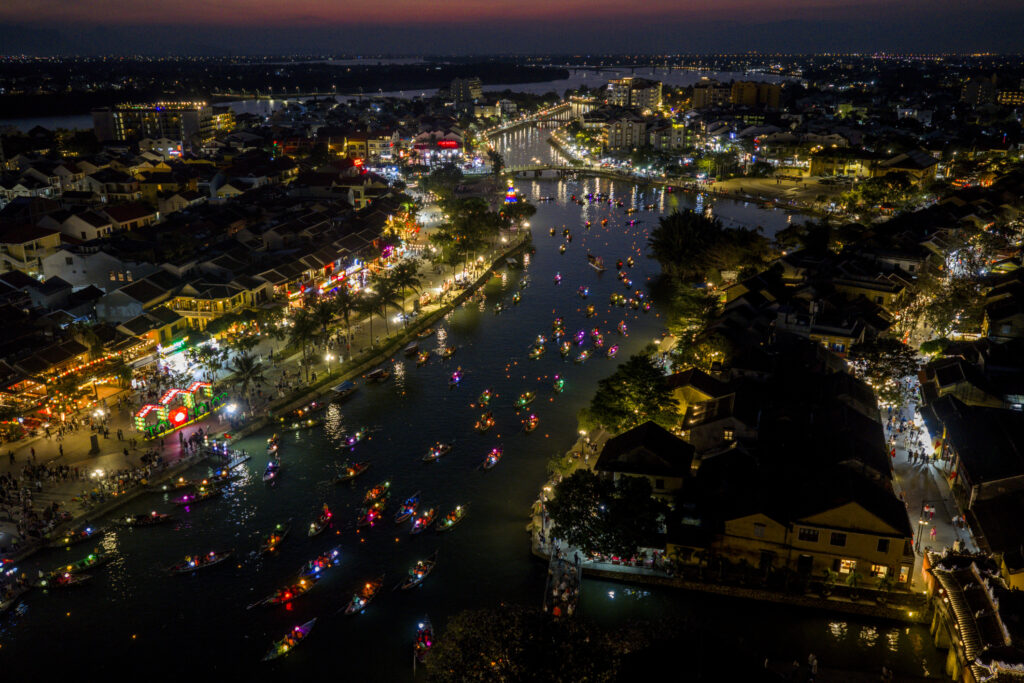
September 22, 2026 • 1:42 pm ET Amin Mohseni-Cheraghlou Few emerging economies have transformed as rapidly as Vietnam. Since 2000, the country’s economy has grown nearly fivefold, turning a relatively poor, agriculture-dependent economy into an upper-middle-income country and one of Asia’s most important manufacturing and export hubs. Merchandise exports reached $475 billion in 2025, almost four times their level in 2010, with manufactured goods accounting for nearly 89 percent. Similarly, foreign direct investment (FDI) disbursements hit a record $27.6 billion, nearly 10 percent higher than in 2024, underscoring continued investor confidence in the country. Yet the same model that powered Vietnam’s rise as a manufacturing powerhouse is now creating a new challenge: too much of the value generated by its export machine remains outside domestic firms. If Hanoi is to build on the successes of the past three decades, this will need to change. Foreign investment is booming. Domestic firms aren’t. Foreign-invested companies still account for the lion’s share of Vietnam’s exports, making up 77 percent of merchandise exports in 2025. Even more strikingly, exports by domestic firms fell 6.1 percent, while those of foreign-invested firms surged 26.1 percent. Productivity among domestic firms remains far below that of these enterprises, while linkages between the two remain relatively weak. The World Bank estimates that value added per worker in domestic private firms is only around one-fifth of that in foreign-invested firms. The challenge facing Hanoi is therefore no longer simply how to attract more FDI. It is how to turn FDI into higher productivity at home—by strengthening domestic suppliers, expanding technology and skills transfer, and capturing more value within the Vietnamese economy. This becomes increasingly important as Vietnam pursues its ambition of becoming a high-income economy by 2045. According to the World Bank, reaching that goal will require Hanoi to shift toward a new growth model built on higher productivity, greater innovation, stronger domestic firms, human capital, and better institutions. Demographics make that transition more urgent. For decades, Vietnam benefited from a young and expanding workforce. But now its population is aging and future growth will increasingly depend on raising output per worker rather than simply expanding the labor force. The International Monetary Fund (IMF) expects demographic change to weigh on potential growth over the medium term. Tensions between Washington and Beijing leave Hanoi in a bind Like other emerging and developing economies in ASEAN, Vietnam has benefited significantly from the restructuring of global supply chains since US-China trade tensions began escalating in 2018. Multinational companies (MNCs) seeking production capacity outside China have poured investment into Southeast Asia, making Hanoi one of the principal beneficiaries of the “China plus one” strategy. But that success has created a new vulnerability. Vietnam’s economy is deeply tied to both the United States and China. Beijing supplies enormous quantities of machinery, components, and intermediate goods to Vietnamese factories, while Washington buys an increasingly large share of what those factories produce. In 2025, the United States was Vietnam’s largest export market, purchasing $153.2 billion in goods, or roughly one-third of total exports. The IMF estimates that value added embedded in exports ultimately destined for the United States was equivalent to 10 percent of Vietnam’s GDP, one of the highest exposures in Asia. China, meanwhile, was its largest source of imports, supplying $186 billion. Vietnam therefore sits in the middle of a production chain in which Chinese and other Asian inputs frequently enter Vietnamese factories before finished products—mainly consumer electronics and other goods—move onward to the United States, the European Union (EU), and other advanced economies. That arrangement worked particularly well when Washington encouraged supply-chain diversification away from China. However, it becomes considerably more complicated as US trade policy focuses not only on where a product is assembled, but also on its Chinese content and rules of origin. On the flip side, continued diversification away from China could bring additional FDI in electronics, semiconductors, machinery, and other advanced manufacturing. But Hanoi cannot assume that simply providing an alternative location for final assembly will be sustainable over the long run. From “China plus one” to “Vietnam plus value” To limit the risks of continued US-China trade tensions, Hanoi will need to increase Vietnamese content in exports, strengthen domestic suppliers, and diversify both its export markets, including into the EU, and its sources of critical inputs. Several areas offer particularly strong opportunities for this next phase of growth: Electronics and semiconductors: Vietnam already occupies an important position in global electronic supply chains. The next step is to move beyond assembly into semiconductor packaging and testing, components, engineering, chip design, and eventually research and development. Domestic suppliers: The biggest economic payoff from future FDI may come not from attracting another MNC, but from connecting Vietnamese companies to the MNCs already investing there. Stronger supplier development, financing, technology transfer, workforce training, and competition can help domestic companies capture more of the value generated by exports. Digital economy and artificial intelligence: Vietnam’s large, increasingly connected population and growing technology workforce provide a base for expansion in software, digital services, data centers, fintech, and artificial intelligence. The challenge will be developing the digital infrastructure and highly skilled workforce necessary to complement its manufacturing base rather than simply creating another foreign-dominated enclave. Green manufacturing and energy: Rapid industrialization is driving up electricity demand as Vietnam seeks to reduce its carbon intensity and reach net-zero emissions by 2050. The country has substantial renewable-energy resources, with its updated power strategy targeting between 6 and 16 gigawatts (GW) of offshore wind by 2035 and up to 139 GW by 2050. Expanding reliable, low-carbon electricity could strengthen energy security and make Vietnam’s manufacturing sector more competitive as global supply chains decarbonize. This is increasingly important because in just a decade, Vietnam has shifted from being a net energy exporter to relying on imports, which now account for more than one-third of its energy needs. Together, these opportunities could allow Vietnam to shift from being primarily a highly competitive manufacturing location to becoming a source of technology, skilled labor, domestic suppliers, and intellectual capital in ASEAN, reducing its exposure to trade wars and global energy-market volatility. The goal is not to retreat from FDI-led development, which has served Vietnam exceptionally well, but to capture more of the value it generates at home. Building Vietnam’s next growth model These priorities will be particularly relevant at the 2026 IMF-World Bank Annual Meetings in Bangkok, where Hanoi can seek the investment, financing, and partnerships needed to support the next phase of its development. Vietnam’s trade balance has deteriorated sharply in the first half of 2026, with the deficit estimated at $15 billion, compared with a $7.6 billion surplus during the same period last year. Surging fuel prices amid the Iran war drove much of the reversal. Hanoi should use the meetings to advance three key objectives: attract investment that brings technology, strengthens domestic supply chains, and develops Vietnamese private firms; mobilize capital for domestic energy production, logistics, and digital infrastructure; and build partnerships that raise total factor productivity through human capital, advanced technical skills, and innovation. Vietnam’s economic rise has been one of Asia’s major development successes. But the global environment that enabled it is changing. US-China strategic competition, tariffs, tighter rules of origin, technological restrictions, volatile energy markets, and fragmented supply chains mean Vietnam can no longer rely indefinitely on its role as an alternative manufacturing base to China. The next stage will be harder. Vietnam must turn factories into capabilities, FDI into technology transfer, exports into greater domestic value added, and industrialization into sustained gains in productivity and innovation. Maintaining strong economic ties with China and the United States while deepening relationships with the EU and emerging markets across the Middle East and Latin America could help Vietnam turn global fragmentation from a source of vulnerability into an opportunity for long-term economic upgrading. If successful, this strategy could put Vietnam on track to become a high-income economy by 2045, the centenary of its founding. Amin Mohseni-Cheraghlou is a macroeconomist with the Atlantic Council’s GeoEconomics Center, a senior lecturer in economics at American University, and a faculty affiliate at Columbia University. Image: The historic streets of Hoi An Ancient Town illuminated at night. Source: iStock.
To achieve its next economic leap, Vietnam needs to move beyond the factory floor
Full Article
Original Source
Read the full article at Atlanticcouncil →KhanList aggregates and links to publicly available news content. We do not host full articles from third-party sources. Always verify important information with original sources.