
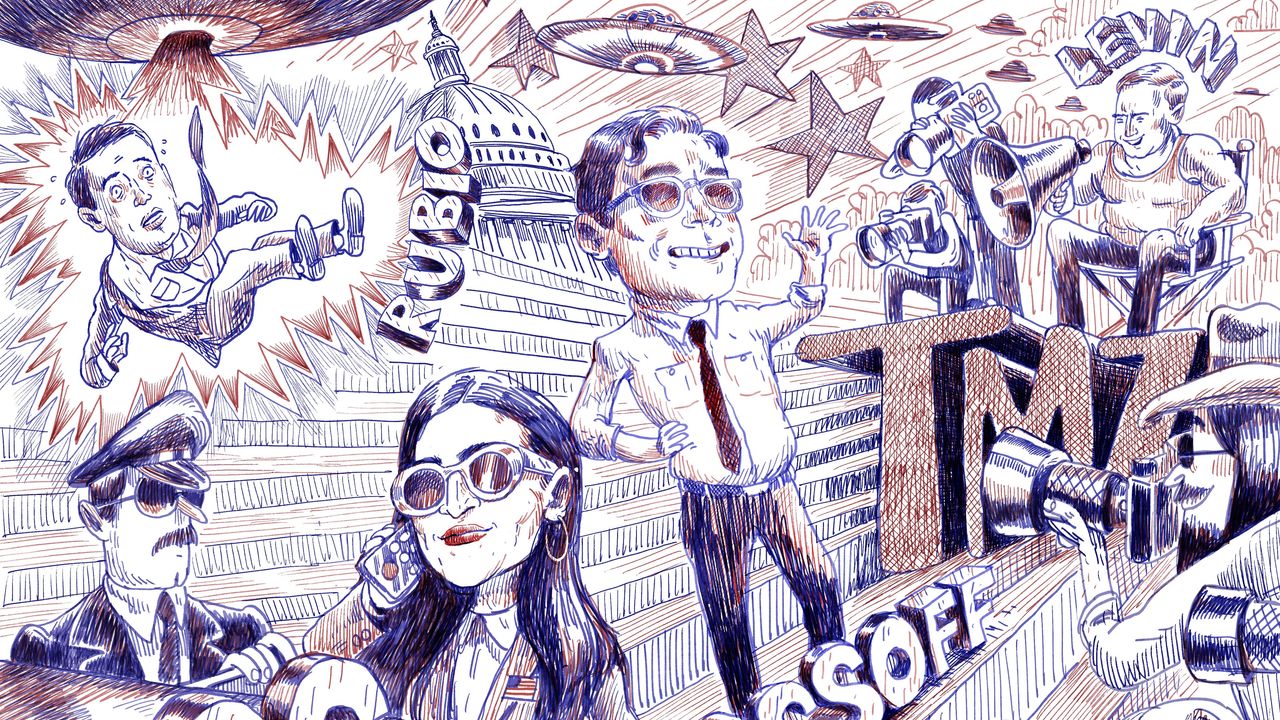
Late on the evening of July 21, as Michigan congresswoman Haley Stevens walked through the Capitol Building in Washington, DC, a reporter from the celebrity news site TMZ rushed toward her. “Jacob with TMZ,” he shouted, his phone camera filming. Stevens is a middle-of-the-road Democrat and had been campaigning in a heated primary for a Senate seat against Abdul El-Sayed, a public health official running to her left. Like other centrists from her party, she criticized Donald Trump and played up her working-class bona fides. In one video making the rounds on social media, Stevens said she would be “workin’ on our behalf” and “doing it with a little bit of joy, a little bit of enthusiasm…and a little bit of stick it to ’em.”Jacob Wasserman started the interview by saying he wanted to applaud Stevens. “I saw that video, which was legendary,” the TMZ reporter told her. “I think it’s widely considered, like, a legendary video.” He asked about her choice to clip the legendary “stick it to ’em” and stick it in a campaign video. TMZ published the interview the next day, marking its first foray into congressional campaign reporting. Since April, when Wasserman and an Australian transplant named Charlie Cotton had moved to DC to cover politics for TMZ, they’d mostly published inconsequential takes from politicians like Representative Suhas Subramanyam, who said it’s okay for Democrats to own Teslas, and Representative Chuck Edwards, who explained why he’d given young female staffers guns as gifts.The result, for the political news consumer, has been a flood of strange soundbites, try-hard bits, and bizarre banter, like when Cotton asked Georgia senator Jon Ossoff if he has big-dick energy. But with midterm campaigns underway, and eyeballs up for grabs, TMZ’s approach to politics raises a defining question of the Trump era: How seriously should we take any of this?Three days after the Stevens interview went online, TMZ promoted it on the social media platform X in a second video titled: “Rep. Haley Stevens’ viral ‘stick it to ’em’ clip could have hurt her campaign, but instead gave it a boost.”Zohar LazarWho would have expected kindhearted cheerleading from TMZ? The vulturous celebrity-scoop machine established itself by breaking some of this century’s biggest Hollywood scandals, including Mel Gibson’s 2006 DUI arrest and antisemitic rant; Chris Brown’s 2009 domestic abuse of Rihanna; and the untimely drug-related deaths of Michael Jackson, Prince, Matthew Perry, and One Direction’s Liam Payne. Since its founding by AOL and a subsidiary of Warner Bros. in 2005, the site has been led by Harvey Levin, a 76-year-old lawyer whose willingness to go after some of the world’s most powerful celebrities made him as influential as any talent agency or manager in Hollywood. TMZ’s modus operandi and its voice—ruthless, chiding, immature—are a reflection of Levin’s own priorities and sensibilities, and once TMZ arrived in Washington, it appeared that Stevens might be an unlikely beneficiary.Levin, who declined my requests for an interview, first attempted to open a TMZ bureau in Washington, DC, in the spring of 2007. “He loved the idea that he was changing Hollywood,” said Gillian Sheldon, who served as Levin’s number two in the early years. “And he’d always been fascinated with politics.” Sheldon was sent to DC to look for office space and journalistic talent and attended the White House Correspondents’ Dinner. Then she was suddenly called back to Los Angeles without explanation. Alan Citron, TMZ’s first general manager, presented the idea to the board with Levin. “I remember being at the board meeting and one of the AOL board members saying: ‘Are you out of your mind? That’s not going to happen!’ ” Citron recalled. “From that moment on, I sort of got it that someone had put the kibosh on it.”In 2009, AOL was divested from the partnership, and since 2021, TMZ has been owned by Fox. But Levin did not revisit the idea of a TMZ DC bureau until this March, when Congress went on recess in the midst of a government shutdown and he put out an impassioned plea for crowdsourced photos of lawmakers vacationing while over a million federal workers were furloughed or went unpaid. Amateur paparazzi responded enthusiastically. Soon, TMZ had a gallery of candid shots of politicians like Republican senator Lindsey Graham, who was pictured standing alone at Disney World with a bewildered look on his face and a Little Mermaid toy in his hand. When TMZ actively publicized some early DC coverage, the journalist Daniel Boguslaw summed up its market potential in a post on X celebrating the idea of political coverage done by “sicko, unhinged paparazzi who believe in nothing.”In LA, TMZ’s merciless approach to celebrity news created a new standard, raising—or lowering—the bar for what readers expect from the Hollywood rumor mill. In the course of redefining America’s relationship with celebrity news, it gained a reputation for pushing the boundaries of journalistic practices in service of breaking big stories, rarely getting them wrong, and attracting huge audiences. If it is to do the same with its DC bureau, TMZ might need to destroy one of the last vestiges of decorum in Trump’s DC, where the press corps has mostly managed to stick to a decades-old playbook. Will Levin and his staff usher in a new golden age of political muckraking? Or simply drag us all kicking and screaming into the mire?Since a reality TV star ran for president, TMZ has occasionally waded into politics. But until 2016, most of the two-dozen former TMZ employees and Levin associates I spoke with, in some cases anonymously, said they had always assumed he was politically liberal. That assumption was based largely on the fact that Levin is gay and Jewish and has worked for decades in an industry in which conservatives tended not to advertise themselves. Yet, during Trump’s first presidential campaign, one former staffer recalled being told by Levin to publish a story that claimed election officials were worried about voter fraud—a popular MAGA narrative at the time. (Two of the three election officials quoted in the story later told ProPublica that they were not, in fact, worried about fraud and that view had been wrongly ascribed to them.) In a letter sent to GQ in response to fact-checking questions, an attorney representing Levin stated that TMZ DC is nonpartisan, and any “insinuation that Mr. Levin criticizes or platforms certain elected officials based on his political beliefs is unfounded and untrue.”Zohar LazarLevin often hires new employees straight out of college and trains them on the job. Perhaps because the TMZ staff skews young, several took notice of Levin’s own politics: During the pandemic, they claimed, he was critical of masking and work-from-home policies. Levin also publicly talked about his dislike for cancel culture, which he said was being driven by “the extremes.” “He’s very anti-woke,” said one former employee. “He thinks he’s Bill Maher, who is his good buddy.”Then came the October 7 attacks. Employees noticed that Levin was focused on the escalating conflict, and some I spoke to were offended when, they said, he repeated contested claims about the attacks. (Levin’s attorney noted that Levin has only ever referred to “documented conduct by Hamas, as various media outlets have reported.”) Early in 2025, Donald Trump announced a plan to turn Gaza into the “Riviera of the Middle East.” On the August 1, 2025, episode of TMZ Live, Levin referenced the plan—as part of a segment that also mentioned an investor purchasing Jeffrey Epstein’s island and announcing intentions to turn it into a resort—and asked the chat if they would vacation in Gaza. A former TMZ employee said he was struck, while watching from the outside, by Levin’s growing interest in global affairs. He wondered what lane TMZ wanted to be in. “You can’t talk about Ben Affleck and JLo and then jump into a war happening in another country and speak so insensitively about it as if it’s celebrity gossip,” he said.TMZ’s DC bureau is led by Wasserman as well as Charlie Cotton, who moved to LA from Australia and started working for Levin in 2013. Cotton started as a guide for TMZ’s celebrity bus tours, then got a job staking out Hollywood stars with his video camera at LAX. “He’s very, very, very likable, and funny,” said Miguel Melendez, a former TMZ news writer. “What he’s going to do is really befriend a lot of these politicians and their staff members. And then he’s going to, I don’t want to say weasel, but he’s going to find his way into their inner circle, and that’s when he finds these other storylines that politicians probably don’t want being platformed.”Zohar LazarWasserman told me TMZ emphasizes “personality” in its reporting, which aligns with something Ben Smith, the editor in chief of Semafor, told me in an email: “Political journalism—and politics—have always mixed high-stakes, life-and-death decisions and silly gossip!” So far the two reporters have focused on the sort of walk-and-talk video interviews Cotton spent years perfecting at LAX. The most successful of these came in May, when Senator Ted Cruz grew visibly agitated after Cotton grilled him on the prospect of pardoned January 6 rioters receiving taxpayer--funded payouts from a “slush fund” controlled by Trump. By summer the tone of these conversations grew more playful: In mid-July, Cotton asked Alexandria Ocasio-Cortez what she thought of the looksmaxxing influencer known as Clavicular; a few days later, Wasserman asked Chuck Schumer whether he had farted on the floor of the Senate.“I would bet my paycheck that it was a specific question Harvey asked Jacob and Charlie to get of Senator Schumer,” said a former longtime TMZ employee.This lined up with something I heard again and again from former TMZ staffers, which is that the site’s coverage often reflects Levin’s interests and editorial judgment, sometimes in a way that is inscrutable to others. According to Evan Rosenblum, who worked at TMZ for 15 years, Levin had newsworthy material edited out of an infamous 2018 interview in which Kanye West suggested slavery was a choice. “Earlier in that interview, Kanye went off about Hitler and the Nazis and started talking about his love for Hitler and how Hitler was misunderstood,” said Rosenblum. “This was years before his other antisemitic controversies, but after the show finished taping, Harvey came up and told me he’d had all that stuff cut out. It was crazy. I mean, ‘Kanye West goes to bat for Hitler’ does not hit the cutting-room floor at any serious newsroom.”TMZ’s approach to material like this has at times allowed it to report on famous or powerful people and preserve access to them. In 2011, Levin reportedly paid $80,000 to acquire a video of a young Justin Bieber using a racial slur. Instead of immediately publishing the video, Levin shelved it. A former employee who was there at the time thought Levin did so because he believed it was the ethical thing to do. Eventually the video’s contents were reported elsewhere, and TMZ then published it, writing that Bieber wanted “to own what he did.” By then, Bieber had given an interview to TMZ Live on his 18th birthday. More recently, in January 2023, TMZ acquired footage of Ultimate Fighting Championship CEO Dana White getting into a physical altercation with his wife. The video arrived alongside a sit-down interview between Levin and White. TMZ still gets UFC exclusives.Cotton said the DC bureau is “largely autonomous, but Harvey’s definitely guiding us and giving us ideas and telling us what’s trending in the office.” When I asked him about TMZ’s reputation of paying for scoops, he echoed an explanation Levin has used for years. “We don’t pay for information,” Cotton told me. “We pay for photos and we pay for videos, the very same way that if a cable news organization wants to have a photo of something, they’ll pay for it.” But TMZ pays well, buys controversial material, and has been known to pay these fees in cash-filled envelopes.In Hollywood, Levin perfected the art of using walk-and-talk interviews with celebrities as material for crafting what amounts to his own reality show. This August, TMZ found the first DC test case for this kind of celebrity lore building when AOC revealed her separation from fiancé Riley Roberts. Clavicular responded to the news with an X post saying “I can fix her,” and TMZ began crafting a narrative. First the site announced Clavicular was “shooting his shot” with AOC, then Levin interviewed the influencer on TMZ Live. Instead of some big scoop, Clavicular told Levin’s viewers what the internet already knew: He did it for the engagement.Many former TMZ staffers believed that, more than anything else, Levin’s quest for eyeballs will drive the direction of political coverage. Wasserman seemed to lose interest in Stevens long before she lost her primary to El-Sayed—and, as of this writing, TMZ hasn’t covered El-Sayed’s general election campaign. Plus, neither of the videos covering Stevens’s campaign gained much traction.“We were cutting-edge for so long, the tip of the spear in terms of changing how news was reported and delivered,” said one of the former TMZ employees. A tech upheaval changed both the news business and the nature of celebrity—scandals now break first on social media platforms, power couples hard-launch relationships on Instagram, and movie stars have cut media gatekeepers out of the loop by using podcasts to speak directly to their fans. Through it all, TMZ has stuck to its once-revolutionary formula, even as the world moved on. And while the launch of TMZ DC could simply be chalked up to Levin expanding into new territory as a hedge against shrinking online audiences, at least one former employee has a different theory for his pivot to politics: “Harvey is doing TMZ DC because he’s trying to cement a legacy.” ★
TMZ’s New DC Outpost Brings Chaos to the Capitol
Full Article
Original Source
Read the full article at Gq →KhanList aggregates and links to publicly available news content. We do not host full articles from third-party sources. Always verify important information with original sources.