
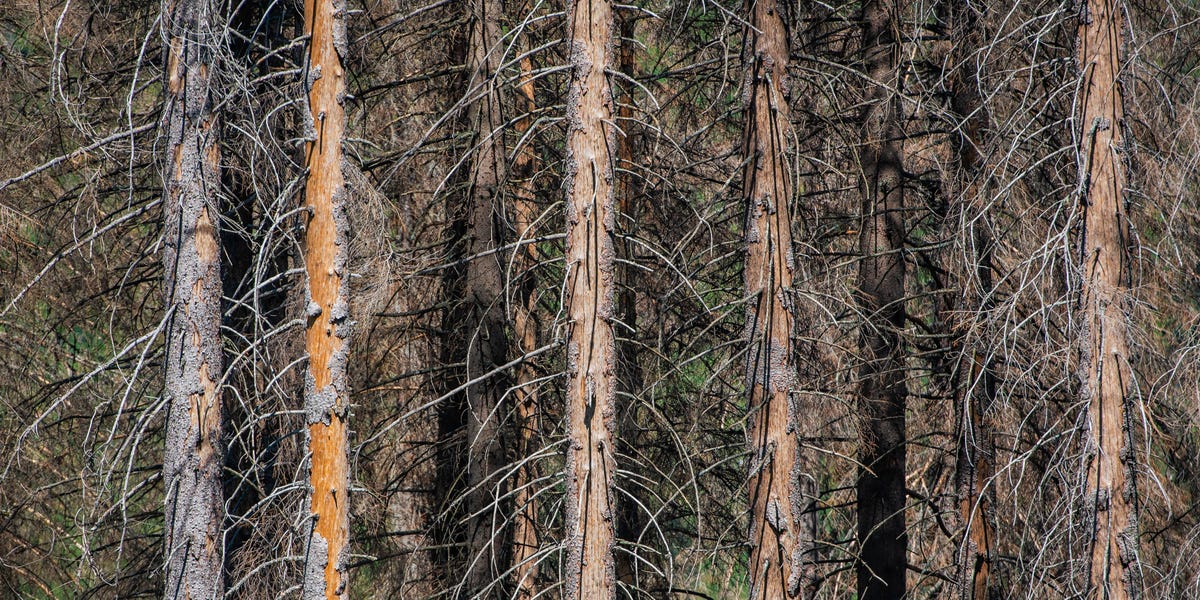
3 min readHere’s what you’ll learn when you read this story:Many trees—both evergreen and deciduous—face increased pressures from insects due to climate change. A new study finds that the majority of trees in wet, colder regions of the U.S. and Canada will see a 30 percent increase in insect pressure by 2050. Winters are no longer cold enough to kill off invasive beetles, and reduced moisture hinders the growth of fungi that keep invasive moths at bay.Trees are among humanity’s greatest allies in the fight against climate change—in more ways than one. The branching immensity of a towering pine or the large boughs of a stately oak provide crucial shade for an increasingly warming world. Trees are also natural carbon dioxide sponges, soaking up and storing the perilous greenhouse gas in their tissues while filtering runoff before it can foul nearby rivers. Simply put, the planet has no better friend than a tree, but like all living things, trees are also susceptible to how quickly the world is changing.A new study published in the journal Nature Ecology & Evolution analyzed records related to one million trees spread across the U.S. and parts of Canada and found that 60 percent of them will experience a 30 percent increase in insect pressure by 2050. Warmer temperatures and milder winters means insects can survive longer or reproduce faster. While this is bad for trees in colder and wetter parts of the continent, insect-induced tree mortality could decrease or even reverse in warm, arid climates.“The forests that exist today aren’t going to be ones existing in 2040,” University of British Columbia’s senior author Jonathan Davies said in a press statement. “The process is happening already. I think we’ve got to put everything on the table because the status quo is no longer tenable.”The study highlights how certain pests, which have already plagued North America for more than a century, will only become a bigger headache as climate change progresses from bad to worse. First introduced from Asia in the 1920s, the woolly adelgid (Adelges tsugae) attacks hemlock and spruce trees as it feeds on its sap. While kept in check by predators and parasites in Asia, in the eastern U.S. the one-millimeter, aphid-like pest decimates forests unchecked. Sub-zero winter temperatures typically kill off the adelgid, but milder winters mean higher survival rates, increasing insect pressure on an already ravaged ecosystem. The balsam woolly adelgid (Adelges piceae) will also make life difficult for more northern and mountain-growing trees, such as the subalpine fir (Abies lasiocarpa).Insect threats don’t even need to be invasive to become a growing threat. In Alaska and western Canada, the spruce beetle (Dendroctonus rufipennis)—whose populations are similarly supercharged by mild winters brought on by climate change—attack spruce trees relentlessly, leaving ghostly, dead Black spruce across vast expanses of the taiga biome. Unlike the adelgid, the spruce beetle is native to the ecosystem, and when in healthy balance, the beetle clears sick and old trees to make way for emerging saplings.But as Alaska’s interior becomes warmer and drier, the beetle completes its life cycle faster, while surviving winters at higher rates. This excess arboreal death also means more fuel for wildfires, which are only increasing in the region as well.Members of the family Pinaceae aren’t the only trees on the menu. The spongy moth (Lymantria dispar) damages hardwood trees across the eastern and midwestern U.S., but the study says their impact will expand as the world warms. Another study, published in the journal Nature Climate Change by researchers from the University of Chicago and the Argonne National Laboratory in 2025, came to the same conclusion, finding that hotter, drier climates will limit the growth of a fungus that typically keeps the moth’s spread in check.“Forests are a fundamental part of our lives, but climate change is reshaping these ecosystems,” Davies said in a press statement. “This research is another early warning sign of how we’re altering the climate system and the impact it’s going to have.”This new perspective on the fate of American forests isn’t just more doom-and-gloom. The researchers hope that these maps can serve as a guide to help governments and forest managers erect pest barriers or locate regions where hardier trees may need to be planted. Because, since time immemorial, trees have kept the planet healthy so humans could eventually rise as the world’s dominant species. Now it’s time to return the favor.Darren lives in Portland, has a cat, and writes/edits about sci-fi and how our world works. You can find his previous stuff at Gizmodo and Paste if you look hard enough.
Tiny Invaders Are Ravaging Our Forests. The Trees May Be Gone by 2040.
Full Article
Original Source
Read the full article at Popularmechanics →KhanList aggregates and links to publicly available news content. We do not host full articles from third-party sources. Always verify important information with original sources.