
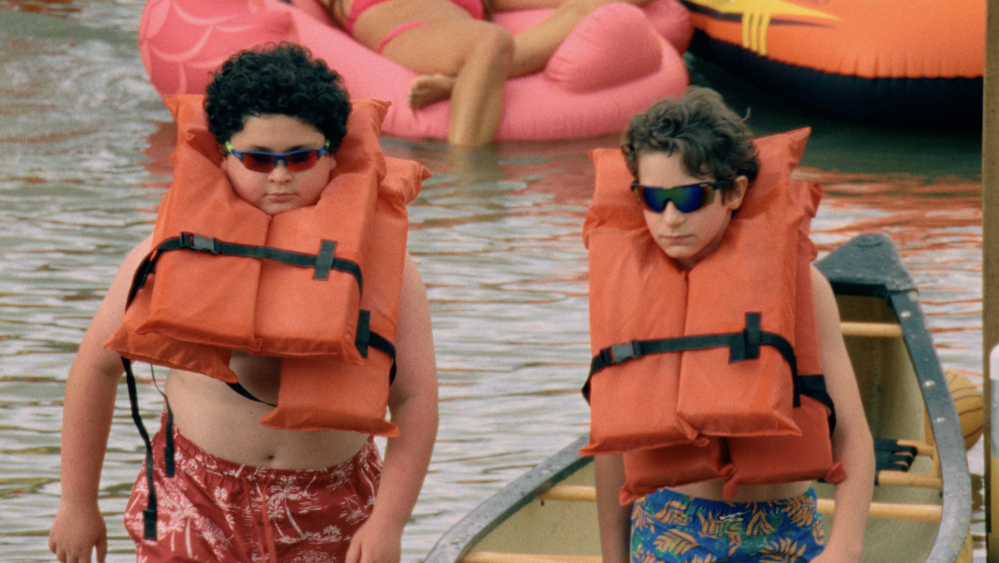
“POV: It’s the 2011 middle school dance and I’m flirting with you HARD,” reads the caption on one of Jacob Kaplan’s Instagram Reels. The 28-year-old comedian has carved out a niche playing characters from our collective childhoods: “Kid whose sleepover you immediately want to leave,” “Kid trying to make conversation after being left alone with his friend’s parent,” “Kid telling a story from camp to his friends from home.” The culmination of that work is “Tiny Fugitives,” an raunchy summer camp comedy starring a bunch of 12-year-olds and Johnny Knoxville. (Kaplan makes a cameo as a guitar-strumming counselor.) The film follows Jacob Udell (Benjamin Pajak), who believes he and his friends can stay at camp forever, if only they can evade the relentless 50-year-old counselor hunting them down. Popular on Variety Kaplan started writing a TV pilot about summer camp in 2021, when he was a writers’ assistant at “Saturday Night Live.” That script landed in the lap of filmmaker Michael Lewen, and the two collaborated on writing a feature for Lewen to direct. They brought it to Point Grey, the production house from Seth Rogen and Evan Goldberg that made “Good Boys,” a proof of concept for R-rated comedies starring pre-teens — the middle-school “Superbad” genre. After a long filmmaking process challenged by strike delays, the movie is finally being released on Sept. 18 via indie distributor Inaugural Entertainment. “When I started working on this movie, I was 23,” Kaplan says. “I didn’t know anything about moviemaking. If I knew then how difficult it would be to make this movie, I would have thought it would never get made. That naivete helped me.” Photo by Arin Sang-urai It sounds like, to make a movie, you need to have a blind optimism in the process. Oh yeah. Either you have to believe that no matter what, this movie is going to get made, and it doesn’t matter what anyone else says, or you need to not understand how movies get made. It seems like a difficult movie to cast. Tell me about that process. It was a massive effort. We really wanted to see every kid we possibly could. With a movie like this, you want kids who are real kids — you don’t want the Disney style of acting. And it’s tough at this age, because a lot of kids just don’t have that experience. We had an amazing casting director, Jess Kelly. For the chemistry reads, we brought all the kids out to a park in L.A. and did a day of camp activities with them — an egg toss and face painting and whatever — because the chemistry between all the kids is super important. You have to deal with the parents when you’re casting 12-year-olds. Did you have any issues communicating to them that their children would be saying some heinous things? A lot of parents could get a gut check upon reading the initial sides, because it’s tough to find a scene where the kids aren’t saying “fuck” or “shit.” So that maybe weeded a few people out. It wasn’t so difficult to get the parents on board because we created a very intentional and strong relationship with all of them, where the idea is: This movie does have cursing, it does have adult themes, but it is very much a movie about being the age that your kid is, and about the taking the struggles and emotions very seriously. The parents and the kids connected with that. When you were writing the film and picturing 12-year-olds delivering the lines, were there any parts of dialogue that tickled you in particular? Before screenwriting, a lot of my online videos had characters that were 13 or 14 years old. I find that age really funny to write because the stakes of your life are objectively very low, but everything feels so intense. The core of comedy is mismatched stakes. The cursing is definitely a big part of being that age, and especially misplaced cursing is funny — kids who don’t exactly know how to curse correctly. Photo by Jackie Brown In terms of what specifically tickled me, there’s a moment where Charness is saying the thing about all the bases: first base is this, second base is this, third base is this. I love that it’s kids who vaguely understand what sex stuff is trying to speak on it with authority. But Aaron Harris, the kid who played Charness, improvised that line: “Third base is you lick her butthole and you have dinner with her parents.” I couldn’t have thought of that. When he said it on the day, we were jaws-on-the-floor laughing, like, “Oh my god, that is incredible.” Only a 12-year-old could think of that. So, those moments where we let the kids’ 12-year-old voice guide what was already in the script were what I loved the most. Did the actors have questions about what anything meant? They definitely did. It was less about the sexual stuff — or maybe they just didn’t want to ask about that. There’s a joke that I think only plays to people over the age of 40: They’re shitting on Bob, and Charness goes, “Fuck Bob, he’s a million years old, he prints out his emails and he pays for AOL,” which is a crazy line for me to have written, because I wasn’t even alive when paying for AOL was a thing. There’s also a line where Benjamin Pajak, who plays Jacob, unscrews the peanut butter and it’s all black, and the kids are like, “That’s disgusting,” and he goes, “No, no, this is how peanut butter used to be before it got all woke.” We were explaining to them what that actually means. And sometimes it’s funnier if they don’t get what it means, because that is what being that age is: just saying a phrase that you’ve heard before but you don’t exactly know what it means. They were in preschool during “woke.” Exactly. Aside from the raunchy stuff, the movie asks a lot of the child actors. The characters have much more interiority than the typical part for a 12-year-old. I think all of the characters have a lot of depth to them. Jacob, especially, is an incredibly difficult role for a child to play. It’s such a specific feeling of being someone who feels like a loser at his core and overcompensates for that by being loud when you have this little world that doesn’t throw applesauce at your face. To strike that balance of being sympathetic, and being someone that people root for, while at the same time being kind of selfish and kind of a dick, and doing it because it comes from this place of hurt — I think that’s very true to being that age. I’ve experienced that myself. So much of what drew me to wanting to make this movie is not wanting to write kids as broad characters, but wanting to actually do something that feels honest to the emotions and complicated feelings you have at that age. And the kids were up to the challenge. Inaugural Entertainment Talk to me about casting Johnny Knoxville. Did he do any of his own stunts in the film? He did a good amount of it. For our stunt people, it was as if they were working with Scorsese — Johnny is the single greatest stunt person you could be working with. They cared so much about, “I don’t want to be the one to hurt Johnny Knoxville.” If anything, they were extra safe, which just made Johnny want to go harder and be like, “No, no, hit me harder, I want to do a more intense stunt.” We did have a double for him for a lot of that stuff. Did you shape the character around him at all? When we first wrote Bob, there was a lot of Johnny baked into the part — this kind of person who is an adult but lives in this very free-spirit, juvenile child’s world, and that’s what camp is for me. One year at camp, we filmed a “Jackass” parody called “Bitchass” — that’s just what kids do at camp, they recreate “Jackass” stunts. He’s such a perfect fit for the world of camp, which is: Have fun with your friends, make something out of nothing, create your own mischief. There’s also a depth to Bob, of what it feels like when that guy gets a little old for it all, or when he feels like, “I’m the only one left.” Johnny is a dad, and in the last “Jackass” movie he’s a little retrospective. He was able to bring the emotional component of that but still having that spirit in him. So when Johnny got attached, which was pretty early on in the process, we did sort of build the character around him and made it a little more stunty. What is your advice for people making comedy videos on Instagram that would love to one day make a movie? There is so much uncertainty in this profession, about what is or isn’t going to work, and at no point have I really tried to game it out. I never made the videos so that any of this could happen — I made the videos because they were funny to me. My advice is to just create the thing that you personally think is funny and don’t think about the audience or what it’s going to lead to. So much of this is just throwing shit at the wall and seeing what sticks. Just follow the comedy.
‘Tiny Fugitives’ Writer Jacob Kaplan on Making a Raunchy, R-Rated Summer Camp Comedy Starring 12-Year-Olds: ‘Sometimes It’s Funnier if They Don’t Get What It Means’
Full Article
Original Source
Read the full article at Variety →KhanList aggregates and links to publicly available news content. We do not host full articles from third-party sources. Always verify important information with original sources.