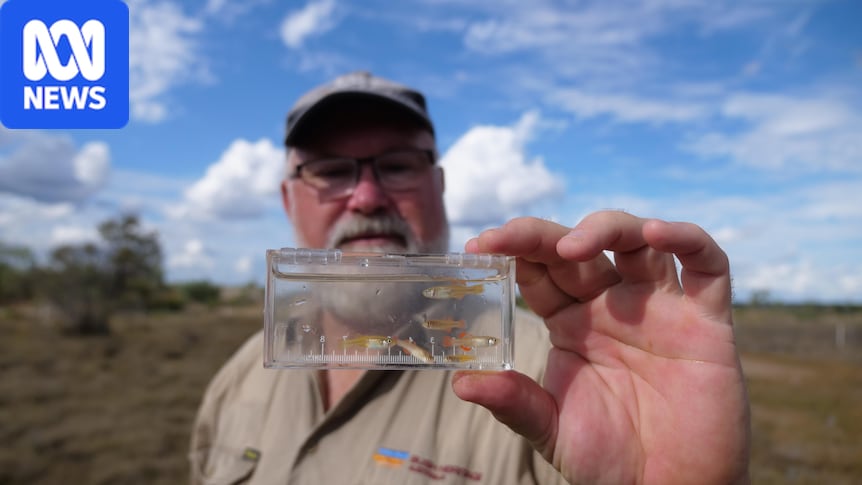
Using scoops made from milk bottles, Sarah Butler has been working tirelessly to save a tiny fish found nowhere else in the world."Every red-fin blue-eye we've caught has had some damage from gambusia," the volunteer said.Found only in a hidden network of artesian springs near Aramac in western Queensland, the blue-eyes' survival is critical, Ms Butler said."Sometimes, [the damage] presents as fungus from scales missing, [and] the fish get sick. Otherwise, there can be big chunks of the tail missing," she said.Using plastic scoops, Sarah Butler is rescuing a rare species of desert fish. (ABC Western Qld: Crispian Yeomans)"Their fry, or their babies, are just immediately getting eaten. Eggs are laid, [then] they're eaten."Flood brings predator onslaughtEarlier this year, metre-high floodwaters washed through Edgbaston Reserve, bringing in the larger, invasive mosquitofish known as gambusia.All but three of the reserve's springs have been compromised, with some of the rare fish populations already totally wiped out.Bush Heritage fish ecologist Dean Gilligan said the return of the invasive predators required an "emergency response" to save the native fish."Once gambusia get into a spring that's occupied by blue-eyes, the blue-eyes have six to 18 months [at] most before the population goes extinct," Mr Gilligan said.This spring has been compromised. (ABC Western Qld: Crispian Yeomans)After they were introduced from North America in the 1920s to control mosquitoes, the gambusia have long since spread out of control.Survival under threat, againThe red-fin blue-eye is a critically endangered freshwater species that was first formally recorded in 1990 after being discovered in seven springs on the former Edgbaston Station.The cattle property was then purchased in 2008 by Bush Heritage for its ecological significance; the livestock was removed and the property converted into a reserve.Only a few hundred red-fin blue-eye have survived the gambusia onslaught. (ABC Western Qld: Crispian Yeomans)Mr Gilligan said the tiny fish had to fight to survive."Not long after the discovery, the pest fish gambusia turned up on the reserve," he said."Within a couple of years, those seven sites had dropped back to six and five and four."Gambusia do not lay eggs and instead store male sperm to give birth at a "ridiculous" rate, Mr Gilligan said: up to 60 young per female every three weeks.This dry country is an important habitat for the rare native fish, the red-fin blue-eye. (ABC Western Qld: Crispian Yeomans)Only one Edgbaston spring survived the initial onslaught.Race to surviveAffectionately nicknamed a "puddle in the desert", the only surviving spring now contains all the species' remaining genetic diversity.Over two decades, breeding programs slowly restored the red-fin blue-eye populations and returned the fish to springs where it had previously become extinct.Mr Gilligan said the gambusia-infested waters got "scarily" close to inundating the reserve's most important spring this year but did not spill over."If the flood had been another 15 or 20 centimetres higher, we would have lost this spring as well," Mr Gilligan said.A fence managed to keep the last remnant spring safe, but only just. (ABC Western Qld: Crispian Yeomans)Volunteer Steve Baines said elsewhere, the fish were not so lucky."Unfortunately, the water level of the flood exceeded the fence that we've got [here], so, as everyone's pointed out, invasive species are now in this spring," Mr Baines said."I can see a massive drop in [red-fin blue-eye] numbers."Ecologists had hoped the knee-high steel mesh perimeter fence would be enough to keep the isolated artesian springs separate from the surrounding ecosystems.The fence's mesh was designed to be small enough to keep out the smallest invasive gambusia while still allowing water to pass through.But this year, the issue was the height. The fences were too short.Mr Gilligan said the floodwaters were unexpectedly high and a record for the 15 years Bush Heritage had owned Edgbaston Reserve.Another consideration was that the springs were growing in size following a multi-decade bore-capping program that allowed Great Artesian Basin aquifers to recover.Volunteers have saved the last known population of red-fin blue-eyes. (ABC Western QLD: Crispian Yeomans)He said he was working with the National Recovery Team for red-fin blue-eye to find a solution, including seeking help from the Queensland and Australian governments."We know that our old strategy of 50cm-high fences isn't going to work in the long term," Mr Gilligan said."We've got to come up with something more secure. [We] really don't know what that is yet, but that's what we have to figure out and move on with."For volunteer Ms Butler, the emergency call-out meant dropping everything to come out."It was last-minute," she said."I just felt that I needed to help."
Tiny 'desert' fish found only in Australia narrowly avoids extinction
Full Article
Original Source
Read the full article at Abc →KhanList aggregates and links to publicly available news content. We do not host full articles from third-party sources. Always verify important information with original sources.