
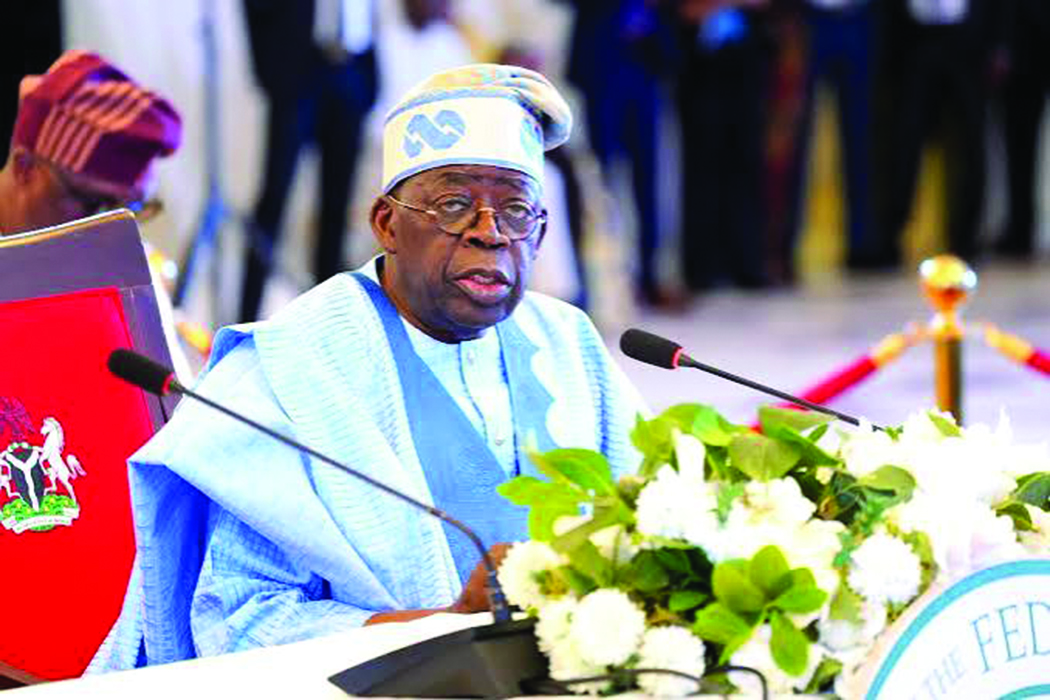
• Says external reserves at $55bn, non-oil exports exceed $6bn •Banks on 86%, private sector investment to achieve $1trn economy by 2030 •Soludo seeks double-digit growth, massive investments to realise $1trn economy President Bola Tinubu, yesterday, reviewed the over three-year-old reforms embarked upon by his government with a declaration that the difficult but necessary reforms have now begun to yield positive results for Nigerians to see. According to him, the hard economic decisions taken since he assumed office on May 29, 2023, had started yielding positive results, with Nigeria’s external reserves rising to approximately $55 billion, non-oil exports exceeding $6 billion and government revenue improving substantially. Speaking at the presentation of a book titled, “Economic Diversification and Structural Transformation in Nigeria: The Past, The Present, The Future”, authored by a member of the House of Representatives, Hon. Abdulmumini Jibrin Kofa, at the Conference Centre, State House, Abuja, the president stressed that the sacrifices made by Nigerians would not be in vain. Tinubu, who was represented on the occasion by the Speaker of the House of Representatives, Hon Tajudeen Abbas, disclosed that his government was now concentrating on converting macroeconomic stability into tangible benefits, including employment opportunities, affordable housing, improved electricity supply and increased domestic production. The president, who wrote the foreword to the book, said the federal government had established the foundation for a more productive and diversified economy, with the next phase of its development programme targeting a $1 trillion economy by 2030. His words: “The emergency is behind us. Non-oil activities now account for about 96 per cent of our Gross Domestic Product. Our non-oil exports have crossed $6 billion, the highest in our history. “Our external reserves have risen to about $55 billion, more than 14 months of import cover. Our non-oil revenue has grown from N13.63 trillion in 2023 to N16.4 trillion in the first half of this year alone. “Our task has moved from stabilisation to shared prosperity, and our compass points firmly to a $1 trillion economy by 2030, charted in the Medium-Term National Development Plan 2026–2030.” Reminiscing on the economic circumstances that confronted his government at inception three and a half years ago, Tinubu explained that the nation faced a combination of fiscal distress, currency instability, mounting debt obligations and declining industrial productivity. He noted that the removal of petrol subsidy and unification of the foreign exchange market were difficult but unavoidable decisions intended to prevent a deeper economic crisis. According to him, past governments at the centre had allowed the country’s fortunes to remain dangerously dependent on petroleum revenue, exposing government finances, businesses and households to fluctuations in international oil prices. His words: “For too long, Nigeria’s story was a song sung in a single note. We were a nation of boundless promise tied to a single product. “Our budget, our currency and the livelihood of millions rose and fell with the tides of a distant oil market. We floated on the fragile illusion of oil wealth while the foundation beneath us cracked. “When I took the oath of office, I did not inherit a calm sea. I inherited a gathering storm: a collapsing naira, debt service that swallowed nearly all our revenues, depleted reserves, a fuel subsidy that bled our treasury dry, and factories falling silent as industries and jobs fled across our borders.” The government, he further stated, faced a choice between maintaining unsustainable economic arrangements and undertaking far-reaching structural reforms to restore fiscal stability. “Two roads lay before us. One was the comfortable road of cosmetic remedies that led us to the edge of the cliff. The other was the hard road of surgery to save the patient. We chose reform over ruin. We removed the fuel subsidy. We unified the exchange rate. “These were not easy decisions, and I know the weight they placed on every household, but they were necessary. And today, the pain is yielding its promise,” he said. The president, however, acknowledged that favourable economic statistics alone would not satisfy the expectations of Nigerians, insisting that the real test of government policies was their impact on ordinary citizens. “Yet the nation is not lifted by statistics alone. Numbers must become bread on the table, light in the home, and hope for willing arms,” he said. On electricity, Tinubu identified inadequate power supply as one of the greatest obstacles to Nigeria’s industrialisation, assuring Nigerians that his administration was pursuing major investments to improve generation and transmission capacity. He cited the federal government’s victory in the $3.38 billion international arbitration dispute over the Mambilla Hydroelectric Power Project as a significant development in efforts to revive the long-delayed scheme. Speaking, too, Governor Chukwuma Soludo of Anambra State, sounded a note of warning that the solidarity plan of building a $1 trillion economy would remain impossible without double-digit economic growth and a substantial increase in public and private investments. The former Governor of the Central Bank of Nigeria (CBN) submitted that though President Tinubu’s government had successfully rescued the economy from the collapsing and restored a measure of stability, the current growth rate of about four per cent was grossly inadequate to achieve accelerated industrialisation, significantly reduce poverty and create employment for the country’s rapidly expanding population. Soludo, therefore, canvassed a new phase of aggressive economic transformation, backed by investment exceeding 30 per cent of Gross Domestic Product (GDP), sustained industrialisation, competitive exchange rate policies and continuity of reforms beyond electoral cycles. Delivering a keynote address with the theme: “Speeding Up and Building to Last”, Soludo argued that Nigeria had lost considerable time in its economic development journey and must now pursue structural transformation with unprecedented urgency.
Tinubu: Our Reforms Now Yielding Positive Results, the Era of Shared Prosperity Begins
Full Article
Original Source
Read the full article at Thisdaylive →KhanList aggregates and links to publicly available news content. We do not host full articles from third-party sources. Always verify important information with original sources.