
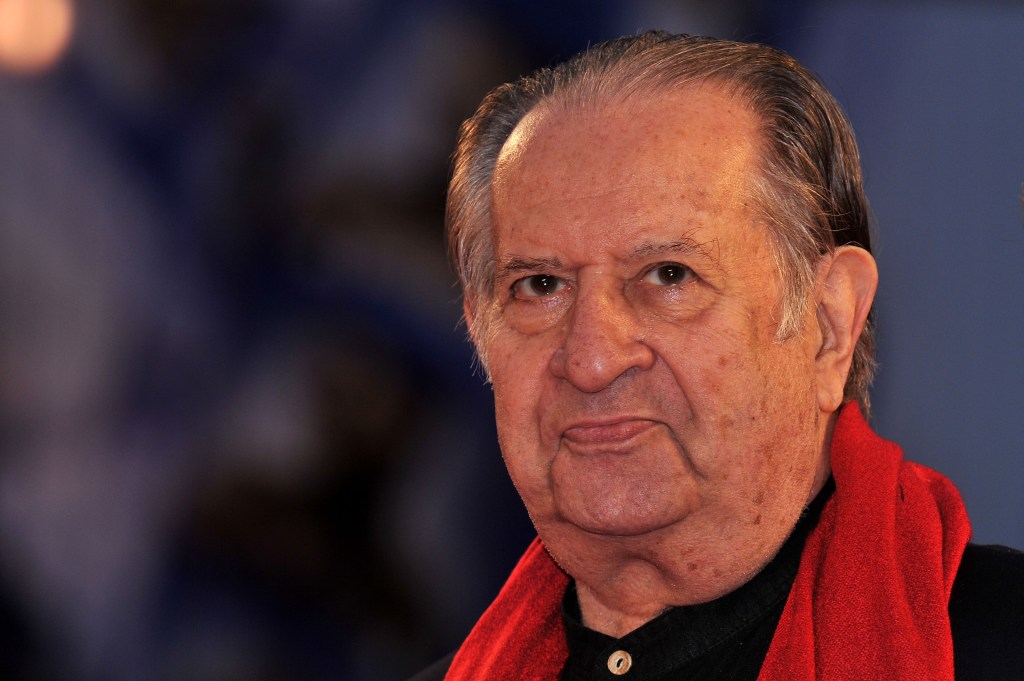
Italian film director Tinto Brass, whose filmmaking spanned many genres but came to be associated internationally with his erotic films of the 1970s, has died in Rome. He was 93 years old. His wife Caterina Varzi and children Bonifacio and Beatrice Brass announced the news of Brass’ death on Wednesday to Italian press agency Ansa. Born in Milan in 1933 to a Venetian family, Brass moved to Paris in 1957, after graduating in law in the northern Italian city of Padua. There, he connected with the Cinémathèque française directed by Henri Langlois, becoming part of the milieu of the emerging Nouvelle Vague and serving as assistant to Joris Ivens and Roberto Rossellini. He made his directorial debut in 1963 with his Venice-set tale In Capo Al Mondo, later retitled Chi Lavora è Perduto, about a young unemployed man with anti-social tendencies. Watch on Deadline It came under fire from the censors in the first of a series of battles fought by Brass over his career due to his personal nonconformist libertarian vision. Throughout the 1960s and early 70s, Brass mainly focused on avant-garde filmmaking, with his credits including two experimental shorts commissioned by Umberto Eco entitled Tempo Libero and Tempo Lavorativo. Brass spent much of the late 1960s and early 1970s in London shooting a trio of films spanning Deadly Sweet (1967), Attraction (1969) and Dropout (1970). A restored digital 4K version film of pop thriller Deadly Sweet, starring Jean-Louis Trintignant and Ewa Aulin, screened in the Venice Film Festival this year as part of its Venice Classics program. It revolves around a brief encounter between a disenchanted man and a girl with no illusions in the wake of the murder of a nightclub owner in London. In the late 1970s, Brass entered a new phase and gained fresh notoriety with cult historical-erotic films Salon Kitty (1976) and Caligula (1979) as well as The Key (1983), a free adaptation of a novel by Tanizaki Jun’ichirō. Budgeted at $25 million in 1979, Caligula was hailed as one of the most expensive independent movies ever made at the time. The production ended up in a tug of war between screenwriter Gore Vidal, Brass and the film’s producer-financier, Penthouse magazine founder Bob Guccione, after the latter added hardcore sex scenes during post-production. Vidal asked for his name to be removed from the credits, while Brass also distanced himself from the film, regarding Guccione’s additions as a betrayal of his original vision for the film. In 2023, a re-edited version, entitled Caligula: The Ultimate Cut, from which Guccione’s added scenes were removed, played in Cannes Classics. Brass continued to remain active as a filmmaker into the 2000s, with his last works spanning a string of erotic short movies including Monamour, Kick the Cock and Hotel Courbet.
Tinto Brass Dies: Italian ‘Caligula’ Director Was 93
Full Article
Original Source
Read the full article at Deadline →KhanList aggregates and links to publicly available news content. We do not host full articles from third-party sources. Always verify important information with original sources.