
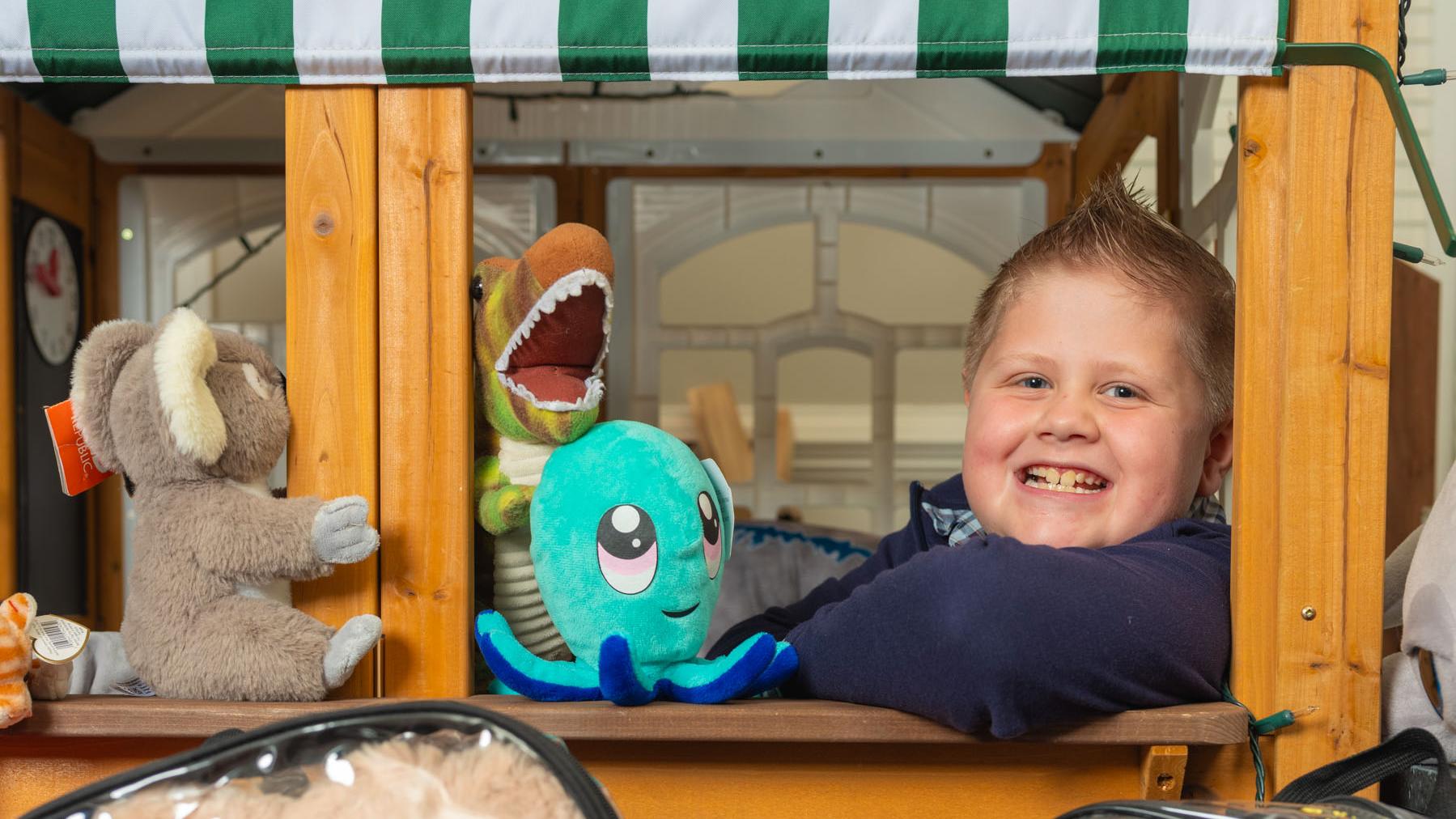
Ledger Mann at home on Oct. 25, 2026.Ledger Mann at home on Oct. 25, 2026.Matt Eich for TIMEThe little lost boy in Dinwiddie County could not know about the effort the grownups were making to find him. He hadn’t been gone very long, but the county in Virginia is wooded, with streams and thickets and tangles. Any child could become hopelessly lost there. For this boy, who has autism and experiences sensory-processing challenges, the unfamiliar environment could be especially overwhelming. So the grownups mustered the police and rallied the fire department, deployed a drone, and released the dogs, all of them scouring the dense local woods.To the profound relief of the community—to say nothing of his desperate family—the boy was soon found. He hadn’t gone far—no farther than the back deck of his home, where he had climbed into the storage cabinet below a gas grill and shut the little door behind him. That was where the first responders found him—sitting calmly and cross-legged, insulated from the intrusive buzz and searing light of the world around him.Sergeant JT Mann of the Prince George County police department was one of the searchers who found the boy. When he came home that evening, he told his wife and two sons what had happened. They would understand better than most, he knew, because the younger of his two children—Ledger, 9—also has autism. Ledger heard the story and sympathized with what the lost boy must have experienced.“I felt a little sad for him,” he says. “I felt a little bad for him.”Ledger stands with the flight crew of HCA Virginia’s Air Care Eagle emergency medical helicopter in Hopewell, VA, holding a bag he presented to the crew for the helicopter on Nov. 4, 2025. Courtesy of the Mann familyLedger—whose work has earned him recognition as TIME’s Kid of the Year for 2026 and as a TIME for Kids Service Star, our sister publication’s program highlighting young people making a positive impact—approved of the way his father had coaxed the boy out of the cabinet, playing a video on a smartphone to catch his eye and ease his fear. But he also believed that wasn’t enough. There are so many things a child on the spectrum might appreciate in a crisis, Ledger thought—a blanket, a plush toy, a book, a fidget spinner to busy their hands, wireless headphones to listen to music or stories, sunglasses to dim the outside glare. If the child is nonverbal, a dry-erase board and a marker would provide a way to write down thoughts or respond to questions. “Dad,” he said straightforwardly, “you don’t have those things.”It was at that moment last year that Ledger resolved to set things to rights. First responders should always have these types of items on hand, he said, so that all children—especially those with autism—can find comfort in traumatic situations, including car accidents and fires, when things move fast and the world seems to be coming unmoored. And, Ledger believed, all of those objects should be carried in a clear backpack so children could see and point to what they need. “He came up with that whole concept in a span of 10 minutes,” says Ledger’s mother Amanda, the elected commonwealth’s attorney for Dinwiddie County, Virginia. Since then, Ledger, his parents, and his big brother Peyton, 16—along with no shortage of friends, neighbors, first-responder groups and other volunteers—have worked to make his vision a reality. The family has a Facebook page called LGM Bags—for Ledger Greyson Mann—and is looking to register as a 501(c)(3) nonprofit. Ledger’s bags are distributed in six states, and the family doesn’t plan to stop there. Money to support Ledger’s idea started almost immediately, with a round of funding from a very fitting source: Ledger’s piggy bank. As it happened, there was ample cash on hand.“Ledger saves his money religiously,” says Amanda. “He doesn’t like to spend, so he had about $100.” That was enough to pay for the first four bags and all of the plushies and other goodies needed to fill them. The family delivered them to local police stations and firehouses, and the reaction of the first responders was so enthusiastic and so rewarding for Ledger that he pressed to make and distribute more. But since Ledger’s piggy bank could stretch only so far, JT decided to engage the community.“We reached out to civic centers—the Moose Lodge, the Fraternal Order of the Police, churches—who donated money toward purchasing the bag and the stuff that goes in it,” says JT. “Nothing in the bag is expensive. Everything is from the Dollar Tree or Dollar General. They’re not $100 headsets. They’re $5 headsets.”Before long, the Manns’ garage was piled high with the makings for dozens of emergency go bags. Before the work began, much of Ledger’s free time was spent doing homework, practicing jujitsu, and playing organized football—and it still is. But he now spends his remaining time in the garage, packing up the bags in a careful, just-so way. Each item is accounted for so every bag is complete, all carefully arranged so that nothing is hidden from view.“He’s very particular about how the bag has to be made,” says JT. “He has an assembly line and everything has to be done perfectly.”The more bags the family assembled, the more widely the Manns distributed them, and they took care to position them strategically. Dinwiddie County covers 286 sq. mi., so the Manns initially distributed bags in central locations before expanding outward to ensure no area was overlooked. The various hospitals, EMS teams, police departments, and fire departments that had bags on hand showed a ready willingness to share the wealth with other responders who didn’t.“If the fire department’s on one side of the county, our police officer [in the vicinity] wouldn’t have to go all the way back to the police station,” says JT. “The bags are located so that the police officer could pick one up at that fire station.”Ledger and his father JT, a sergeant with the Prince George County police department. Matt Eich for TIMEWord of good deeds has a way of getting around—and so it was with the Manns’ efforts. Early this year, a local television reporter approached the family to produce a story that aired well beyond the Dinwiddie County limits. Corporations, private citizens, and first-responder groups from Florida, New York, Maryland, West Virginia, North Carolina, and elsewhere in Virginia reached out to offer support or request bags for their communities.“We had one individual fly out from Texas,” says JT. “She flew all the way [to Virginia to deliver] bags from her company. She visited our police department over one weekend to meet Ledger because he was such an inspiration to her.”So far, the Manns have assembled and distributed more than 475 bags—an impressive number that is continuing to grow. Ledger the public servant is, of course, still Ledger the kid, with schoolwork and hobbies very much a part of his life. Until this year, he attended a Dinwiddie public school, but, according to his mom, the kind of specialized attention he needs as he’s grown older requires a smaller environment. Now he is one of 10 children attending a private school known as the Learning to Lead Academy. His favorite subject is math; his favorite hobby is Lego; his favorite position in football is on the offensive line. But the day before speaking to TIME, he played defense—and even recorded a quarter-back sack.Ledger has a long way to go before having to think about what he wants to be when he grows up, but he has some ideas—a couple of them inspired by his father and his brother Peyton, who is eyeing colleges and wants to study architecture. “I want to be a lot of things,” Ledger says. “A police officer, a builder, work with robotics.”With each bag the family distrib-utes, they discover something new about what kids in distress need for comfort. Children get to keep any item they select from a bag, while the bag and its remaining contents go back to the first responders, who replace the missing items. Far and away the comfort items in greatest demand are the plush animals. Ledger himself has a mountain of them.“We have a playroom full and a bedroom full of plushies,” says Amanda. “Whether it’s a boy or a girl, a stuffed animal is always a good comfort for any child. They can be in their own little world, where they’re safe and comfortable.”During weekends or when Ledger is on school vacation, the family visits the towns and counties that have requested the bags, deliver-ing completed ones and helping to assemble others on-site.“It’s healing to him and beneficial to him to go out to meet all these people,” Amanda says. “And when we go, they welcome him with open arms. They let him meet therapy animals, including horses.”The only participating locale the family hasn’t visited in person is Ulster County, New York, which committed itself to assembling 100 bags. Instead, the county and the family -arranged a Zoom conversation so that Ledger could explain how the bags should be assembled. As he had been with the other jurisdictions the family worked with, Ledger was all business, keeping a close eye on how the bags were packed. “One place was doing it out of order,” JT says. “He was not a fan of that.” During the family’s travels to various states, the first responders give Ledger challenge coins and patches, which he collects. At his suggestion—and following his design—LGM Bags now has its own patch and coin.Ledger’s passion and attention to detail continue to fuel the project—one that the family hopes to take nationwide. “I want to have this go everywhere,” says Ledger. “To all of America!”
TIME's Kid of the Year Is Helping First Responders Comfort Children in Crisis
Full Article
Original Source
Read the full article at Time →KhanList aggregates and links to publicly available news content. We do not host full articles from third-party sources. Always verify important information with original sources.