
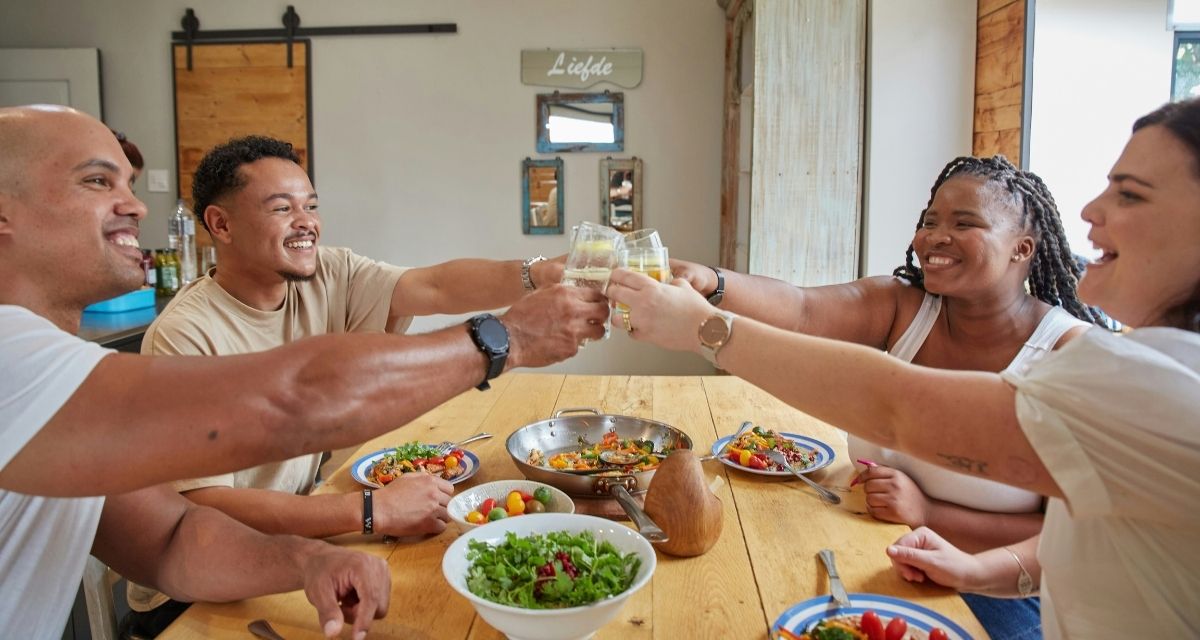
Some years ago, I read an essay singing the praises of “scruffy hospitality,” and it resonated with me deeply. Rev. Jack King, the Anglican priest who coined the term in 2014, defined it like this: “Scruffy hospitality means you’re not waiting for everything in your house to be in order before you host and serve friends in your home. Scruffy hospitality means you hunger more for good conversation and serving a simple meal of what you have, not what you don’t have. Scruffy hospitality means you’re more interested in quality conversation than the impression your home or lawn makes. If we only share meals with friends when we’re excellent, we aren’t truly sharing life together.“ Sadly, Americans seem to have lost the art of hospitality, scruffy or otherwise. A 70% decline in having people over in the past 50 years In September of 2026, Derek Thompson shared data from the DDB Needham Life Style survey showing that the percentage of American adults who say they regularly have friends over has declined 70 percent since 1975. Seventy percent in 50 years. That’s huge. Is it any wonder we’re in a loneliness epidemic? Lest we blame the internet or smartphones, this decline began way before those technologies entered our daily lives. “Between 1975 and 1998, the share of Americans who gave or attended a monthly dinner party declined by half,” Thompson explains. “The share of Americans saying they never entertained people at home tripled.” And it’s not that people are at home less. In fact, time spent at home increased through the 2000s and then skyrocketed (of course) during the COVID-19 pandemic. Between the 1970s and 1990s, entertaining at home collapsed, dinner parties withered, and picnics nearly went extinct. Everybody knows about the decline of church attendance, but notably, all of these things declined even faster than the fall of organized religion. pic.twitter.com/uFkyW3LD4v— Derek Thompson (@DKThomp) September 29, 2026 So we’re home more, but having people over less. Bring back dinner parties and game nights, but make ’em scruffy There may be many reasons for the decline in having friends over. The social landscape has shifted dramatically over the past 50 years, and those shifts have only accelerated in the digital age. One modern issue may simply be aspirational. In the early days of Pinterest and Instagram, beautiful photographs of elaborately themed parties became all the rage online, creating pressure to create perfect aesthetics in our homes. That may be why getting explicit permission, and even encouragement, to be “scruffy” resonates. We need the reminder that company doesn’t demand perfection. Most people just want to connect with others, and allowing and invite and event to be casual, with no pressure to perform, is actually a relief for many. Hosting also doesn’t have to be super frequent. If hosting a weekly potluck or game night feels like too much, just set a goal of having people over monthly. Once a month is far better than nothing. After my husband made an ambitious 2025 resolution, we’ve hosted people for dinner nearly every Saturday since January of last year and it’s been occasionally hard, often chaotic, & completely transformative for our social life. https://t.co/qkAzdKjQqw— Amanda Litman (@amandalitman) September 29, 2026 What scruffy hosting looks like and why it matters Most of us can find reasons for not inviting people over. I’m not organized enough to plan a party. My place is too small. I don’t cook. Groups make me anxious. If you’re someone who actually enjoys planning a big, themed party, more power to ya. But if you’re not, no worries. Literally, you can just text some friends and saying, “Hey, you want to come over Friday for dinner?” It doesn’t have to be a “party.” It could be a handful of friends, neighbors, or acquaintances. If your place is small or if groups make you anxious, invite just one or two people. If you don’t cook, make it a potluck or see if everyone wants to pitch in $5 for Domino’s pizza. Have people for dessert or games or a movie instead. If you’re a night owl, have a pajama party where everyone brings a late-night snack to share. If you’re an early riser, invite other early risers over for a come-as-you-are morning coffee. Can’t emphasize how much your life will improve if you put in even a small amount of effort to host things regularly.Dont like cooking for dinner parties?board game nightin person book club movie night poker night whatever it is you do, invite people to join you doing it https://t.co/K4ipYoL1VB— Matt Herdman (@MattHerdman) September 29, 2026 The benefits really do outweigh the drawbacks There are no rules here. And the benefits of inviting people over, in my experience, far outweigh the downsides. Does hosting take energy? Yes. Does it force me to tidy up more quickly than I normally would? Yes. (Though I’m always happy for that after the fact.) As an introvert, I don’t always feel like socializing and like for my home to feel like a protected sanctuary. I don’t always look forward to gatherings in my home, even when I’ve planned them. But the warm energy that’s created when you bring people into your space is special, and the social bonds created through that energy really do matter. So many people are lonely, and providing a space for people to connect is a beautiful offering. Shared stories and shared laughter are vital to our social fabric, and when it happens in your home, it can be truly transformative. Don’t overthink it. Just send the invite, keep it scruffy, and see how hosting changes your life. You can always stop doing it if you don’t like it, but you might be surprised at the difference it makes.
Time to bring back dinner parties, not as a ‘trend’ but as a vital thread in the social fabric
Full Article
Original Source
Read the full article at Upworthy →KhanList aggregates and links to publicly available news content. We do not host full articles from third-party sources. Always verify important information with original sources.