
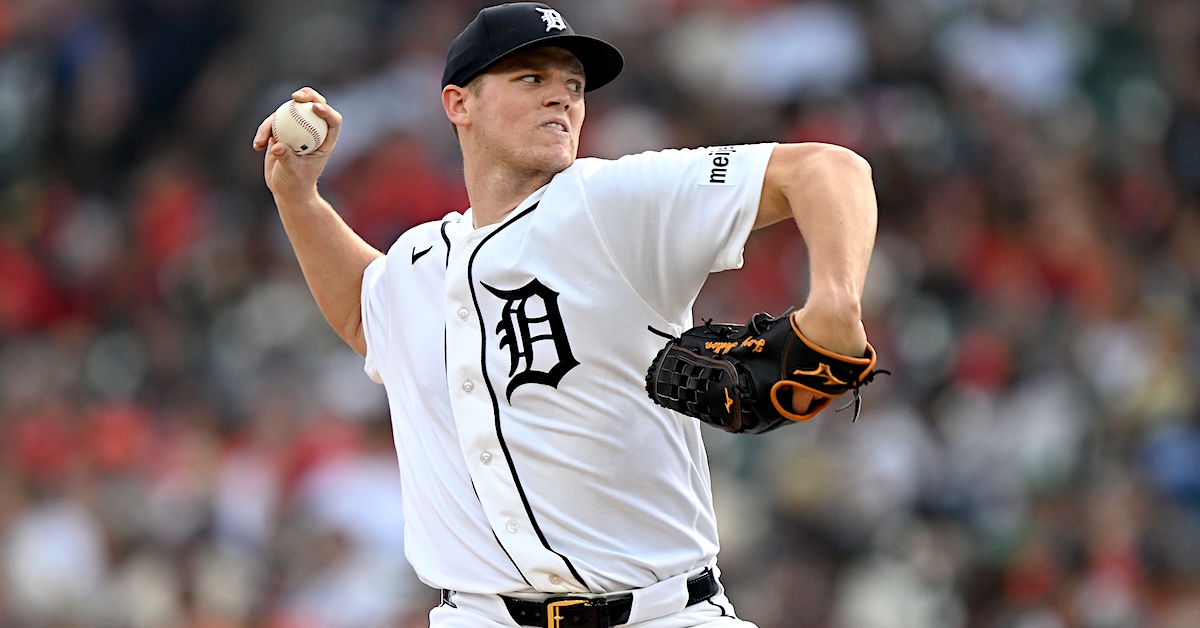
Lon Horwedel-Imagn Images While nothing this time of year whets the baseball appetite quite like a splashy free agent getting $450 million, the meat-and-potato deals are also an important part of the meal. Not everyone can get the Tarik Skubal treatment, and in the case of one of his former Detroit teammates, sometimes a new contract means receiving roughly one-tenth of Skubal’s guaranteed money. Troy Melton, the promising right-handed pitcher with 36 games of big league experience with the Tigers, signed a six-year extension over the weekend worth $46.5 million. As ESPN’s Jeff Passan reported, the details of this agreement include a club option in 2033, and incentives that could pay Melton up to $80 million if he wins a Cy Young, an improbable but not impossible ceiling for the 25-year-old to reach. More specifics: Melton gets a $2 million signing bonus and will rake in a $1 million salary for both the 2027 and 2028 seasons. From there, his salary steadily jumps. In 2029, he’ll make $4.5 million, then $7.5 million in 2030, $11 million in 2031, and $18 million in 2032, with the club option for 2033 at $23 million with a $1.5 million buyout. This extension gives Detroit two extra years of control over Melton — a player chosen by the team in the fourth round of the 2022 draft — as he would have hit free agency at the end of the 2031 season. It’s an easy bit of business to understand from both sides of the negotiating table. Melton, who has basically been making the league minimum, gets a raise, while his employers have put a firm price tag on his arbitration years. When playing the extension game, front offices must also ask themselves how much the player would get on the open market, and whether their extension would lock him up for a significantly lower price. In Melton’s case, that answer is a resounding yes. But aside from the financials, the Tigers also cement a young and productive portion of their roster as they officially close the book on the Skubal era. Melton slots into the rotation right behind veteran Framber Valdez, joining several nephews in support of the proverbial unc, whose nominal ace status really just comes from seniority at this point, and will be challenged by Melton sooner rather than later. Melton’s 2026 season ended on an ominous note, as he was pulled abruptly from a September start against the White Sox with the always scary forearm tightness. That was later formally diagnosed as arm fatigue, ending his campaign a week early. When it happened, Melton said his pitching arm got “achy” and “tight” that day in Chicago and the feeling never went away. (His 126 innings across all levels in 2026 was a new career high, surpassing the 100 2/3 he shouldered in 2024.) Weeks later, the Tigers issued an update, saying Melton was healthy and undergoing his standard offseason training, a relief that surely made the organization comfortable committing to him. It should also be noted, though, that Melton started the 2026 season on the 60-day injured list with elbow inflammation, so there is now a real history of maladies in his arm. When removed from the game in September, Melton told the media that he did not believe the two injuries were related. “I wouldn’t say they’re similar,” is how he put it. “I mean, obviously similar body part, I guess, but I don’t think it’s the same thing.” When digging into Melton’s pitching profile, the sharpest tools are his extension and velocity. A big man (6-foot-4, 210 pounds) who gets down the mound easily, Melton is blessed with 81st-percentile extension. That, in collaboration with a fastball that sits 96 mph and gets good arm-side run, makes him a difficult guy to square up, particularly at the top of the zone. But Melton also brings a dastardly cutter to the party, which creates more empty swings and limits damage better than the four-seamer. With a huge horizontal break and a pronounced velocity difference from both his four-seamer and slider, the cutter is among the game’s best. Melton likes it up, he likes it down, he likes it to righties, and he likes it to lefties. While his 2025 numbers offered a very small sample size of 45 2/3 innings and 180 total batters faced, it’s still obvious that Melton came into 2026 with a renewed trust in his cutter, even more so when seeing same-handed hitters. In 2025, he threw it just over 3% of the time when facing a right-handed batter. In 2026 that was all the way up at 23.8%, his second-highest usage of any pitch against righties. Those hitters responded with a .163 batting average on it and a .224 slugging percentage, with expected numbers that weren’t much better. The cutter is his best overall pitch, but he uses his slider, curveball, and changeup when he needs to avoid contact. All three of those pitches resulted in whiff rates above 30% in 2026, a very promising stat for a pitcher that’s still learning the ropes. The list of strikeout victims of Melton’s tight, elusive slider (the chief whiff inducer) include Junior Caminero, Bobby Witt Jr., and Munetaka Murakami. The curveball is noteworthy too, because even with its proven ability to miss bats, it’s still Melton’s least-used pitch. That is likely because he’s still learning its finer points, as he did not have a curveball as he trudged through the minor leagues. Chatting with David Laurila in 2025, Melton mentioned bailing on a sweeper in favor of the knuckle-curve, which has made hitters of all shapes and sizes do this. All told, Melton finished the year with a 20% strikeout rate, which was identical to his 2025 mark, and slightly below league average. His walk rate (7.9%) and groundball rate (42.9%) are slightly better than league average, though, with a barrel rate (6.0%) that puts him in the 77th percentile leaguewide. Melton’s easy, repeatable delivery also comes with an arm slot that creates deception, something that may help him improve both his whiff and strikeout outputs as he settles into Detroit’s rotation. As far as intangibles, Melton has also already shown oodles of poise. In just his fifth-ever major league start, he was forced to cover Game 1 of the 2025 Division Series against the Mariners, calmly tossing four innings of two-hit ball and helping the Tigers to a road win. When the dust settled on that epic five-game set, Melton had handled eight frames — all as a true rookie — while striking out eight Mariners and letting up just one run on a Julio Rodríguez solo homer. His sophomore season was a revelation, even if the Tigers missed the postseason. Melton logged 20 starts and did so with a 2.76 ERA, making him just one of 11 pitchers with an ERA that low in that many starts. Across the board, there’s much more to like with Melton than there is to dislike. For instance, this part of his Baseball Savant page seems good. In that Laurila piece from 2025, the headline teased that Melton could be Detroit’s second-best starter. Now that Skubal is gone, Melton is in line for the top spot. As his contract progresses and Valdez ages, Melton should be the Tigers’ big cat. Speaking of which, he is not the only young pitcher to make Motown news recently. Luis Gil, who just two years ago won the AL Rookie of the Year and pitched for the Yankees in the World Series, has reportedly agreed to a one-year, $2.3 million pact with the Tigers. This deal is pending a physical, however, which is important when it comes to Gil. Since that ROY-winning season, he’s dealt with a lat strain and shoulder inflammation that caused the whiff rate on his once-spectacular fastball to plunge. Should the deal go through, Gil may be better suited for a bullpen role, but he’ll at least be in the starter conversation along with Jackson Jobe, River Ryan, and fellow starter-reliever hybrids Keider Montero and Drew Anderson. The Tigers could use a little more on the edges, especially offensively, to reclaim a playoff spot in 2027 after missing out this past season. But with Melton and all-world shortstop Kevin McGonigle now entrenched, both sides of the ball have at least one player with long-term All-Star potential. The Tigers are going all-in on their homegrown talent (as of this writing, eight of the nine position players in their projected starting lineup were drafted by the Tigers, and three of their five starting pitchers were also developed in-house), much of which was integral to the club’s postseason runs not long ago. If Detroit finds itself back there soon, Melton taking the ball for Game 1 will no longer be a surprise.
Tigers Extend Troy Melton, Hoping He Can Be Their Discount Ace of the Future
Full Article
Original Source
Read the full article at Blogs →KhanList aggregates and links to publicly available news content. We do not host full articles from third-party sources. Always verify important information with original sources.