
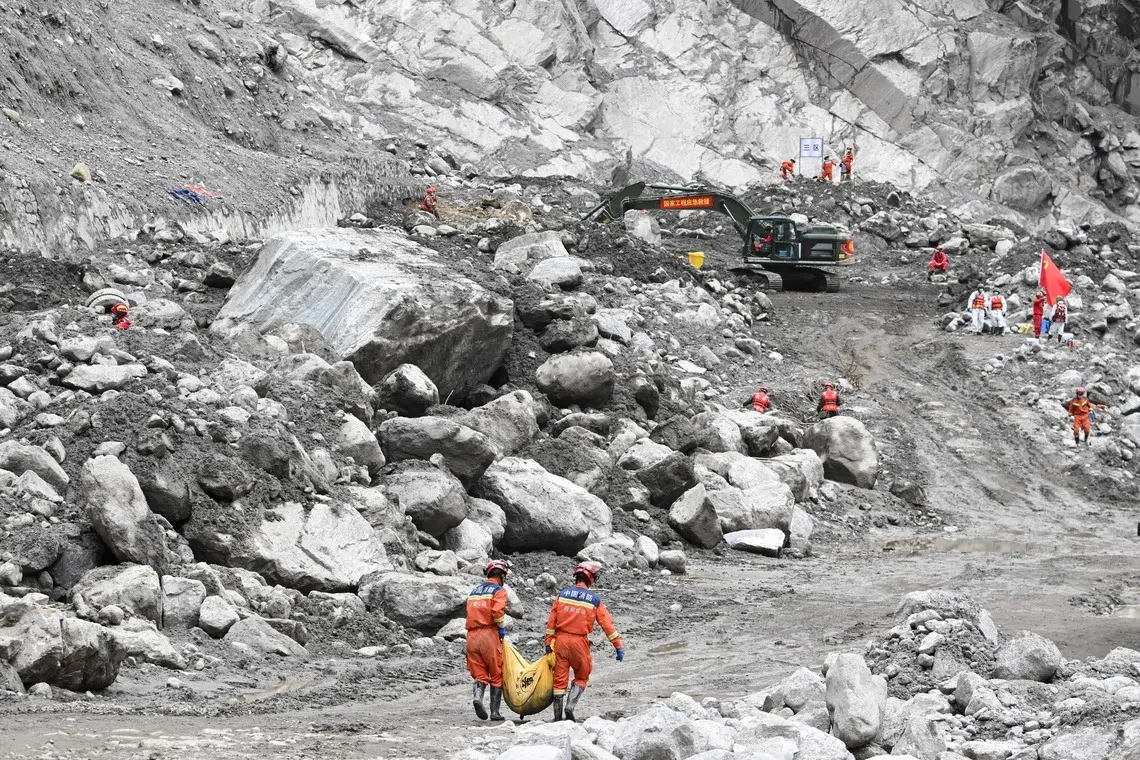
SHENZHEN - Spanish football club Real Madrid’s gesture of solidarity ended up offending many in China instead.On Aug 30, before a La Liga match against Malaga, players at the Santiago Bernabeu stadium observed a minute of silence for victims of the devastating floods and mudslides that had struck both sides of the Nepal-China border days earlier.Real Madrid posted a photograph of the tribute on X with the caption: “Moment of silence at the Bernabéu for the victims of the flood in Nepal and Tibet.”The last three words – “Nepal and Tibet” – ignited fury in China.State media Global Times and China Daily ran commentaries lambasting Real Madrid, with China Daily declaring that the club had “scored an own goal”. Fans on Weibo demanded an immediate correction and apology, pushing the controversy to the top of the social media platform’s sports hot-search list.A screengrab image of Spanish football club Real Madrid's X post on Aug 30. The post appears to have since been taken down. PHOTO: REAL MADRID/XWhy the outrage? First, critics argued that by mentioning Nepal and Tibet in the same breath, Real Madrid had placed a sovereign state and a Chinese region on an equal footing. Other Spanish clubs, by contrast, had referred to the disaster as affecting “Nepal and China”.To drive the point home for a Spanish audience, China Daily drew a comparison with two of Spain’s own regions with strong separatist movements: Would Spaniards accept references to “Portugal and Catalonia”, or “France and the Basque Country”, as though they were equivalent entities?Tibet had come under Qing imperial authority in the 18th century, but operated with de facto independence after the Qing dynasty collapsed in 1911-12 until Communist forces entered it in 1950. Beijing says Tibet has been an integral part of China for centuries and describes its takeover as a “peaceful liberation”; many Tibetans who had gone into exile after 1950 regard it as an invasion and occupation. Second, Chinese commentators insisted the club should not have used the word “Tibet” at all, arguing that the territory should be referred to as “Xizang” — or, better yet, “China’s Xizang”.What is in a name?Most English speakers simply know Tibet as Tibet. China has, however, increasingly used the autonomous region’s hanyu pinyin name “Xizang” in its English-language official documents since 2023.A State Council white paper published in November 2023 bore the title “CPC Policies on the Governance of Xizang in the New Era”. Two years before that, a similar State Council white paper called the area Tibet.Wang Zhengxu, a political science professor at Zhejiang University, has for years urged Chinese state media to adopt “Xizang” in their English-language reporting. He told The Straits Times that the term “Tibet” was popularised internationally during the turn-of-the-20th-century colonial era by the British, who then ruled neighbouring India and harboured imperial ambitions towards the region. “Continued use of ‘Tibet’ perpetuates a colonial framing that reflects a reluctance to recognise that Xizang is an integral part of China,” he said.British forces mounted two military expeditions into Tibet around the turn of the 20th century. At the Simla Convention of 1913-1914 held between British India, China and Tibet to settle Tibet’s status and borders, Britain pushed to designate much of central and western Tibet as “Outer Tibet”, where China would retain suzerainty but not exercise direct administration. China refused to sign the final agreement while Britain and Tibet did.Pro-independence activists and the Dalai Lama, a spiritual leader of the Tibetans who advocates for greater autonomy rather than independence, also use the name “Tibet”. In the Tibetan exile movement’s usage, the term covers a broader ethno-cultural realm extending beyond the Tibet Autonomous Region to encompass Tibetan-populated areas in the nearby Chinese provinces of Qinghai, Sichuan, Gansu and Yunnan.This is why Chinese state media commentators argue that foreigners who insist on calling the region “Tibet” are giving oxygen to separatist claims. In Beijing’s view, any challenge to China’s territorial integrity crosses a core red line.They also contend that using “Xizang” unambiguously denotes the autonomous region itself, preventing confusion with the broader cultural realm invoked by activists and anchoring the territory firmly within the administrative geography of the People’s Republic of China.Why foreigners default to ‘Nepal and Tibet’Given how strongly Chinese commentators feel about the name “Xizang”, it must be puzzling to them why many foreigners, when referring to the disaster in shorthand, still call it “Nepal and Tibet”.Strictly speaking, the provincial-level Nepalese administrative counterpart to Tibet would be Bagmati. But because Bagmati is little known internationally, calling it the “Bagmati-Tibet” disaster would leave many scratching their heads: Bagmati, where? “Nepal and Tibet” is simply a more readily understood geographical shorthand.If geopolitical parity at country level were the goal, then “Nepal and China” would be correct. But China is vast and a more specific geographical label is useful when it is widely understood. That is why the 2008 earthquake in Sichuan is called the Sichuan earthquake, not the China earthquake.Using “Nepal and Tibet” is not necessarily a nod to Tibetan sovereignty. It could be just practical geography.What about the Chinese argument that Real Madrid should respect Beijing’s preference to use “Xizang”?Sovereign nations have the authority to decide official place names within their borders. But issuing a national decree about a preferred name domestically does not flick a switch in the rest of the world.An important step is to communicate the change through the United Nations Group of Experts on Geographical Names (UNGEGN), the UN body that promotes the international use of nationally standardised place names.There is, however, no public record that Beijing has formally notified UNGEGN of a change from “Tibet” to “Xizang”. As of Aug 26, the UN was still using “Tibet” in its English report of the disaster. If the UN itself uses “Tibet”, it is hardly surprising that football clubs like Real Madrid, or foreign media such as this paper, do the same.Even formal notification would not make “Xizang” the norm overnight. Changing common usage takes time, repetition and, crucially, acceptance by the people who use the language.Official or local names do not always displace familiar English ones. Many English speakers still call Türkiye “Turkey”, despite its official name change in 2022. Germany, meanwhile, is “Deutschland” locally – an endonym – but “Germany” in English, an exonym.To actually shift global habit, Beijing would have to persuade rather than simply prescribe: consistently promote “Xizang” in foreign-language publications and diplomacy, encourage international organisations and mapmakers to adopt it and, with time, make the unfamiliar name familiar. That is a process of building consensus, not one that can simply be demanded of private entities like Real Madrid.Persuade, not pressureEconomic coercion is unlikely to help build that consensus.In their commentaries, Chinese state media made what amounted to a warning to Real Madrid: apologise or risk economic blowback.China has long been an important market for the club, which said in 2017 that more than 100 million people in China followed Real Madrid. This massive fan base resulted in lucrative sponsorship deals with Chinese corporate giants and boosted sales of its Adidas merchandise.History gives foreign companies good reason to heed such warnings.In October 2019, Daryl Morey, then general manager of the American basketball team Houston Rockets, tweeted support for Hong Kong’s anti-government protesters. The fallout was immediate and prolonged.Sponsors severed ties, the Chinese Basketball Association suspended cooperation, and state broadcaster CCTV stopped carrying National Basketball Association (NBA) games, apart from a brief return for the 2020 NBA Finals, before regular broadcasts eventually resumed in 2022. NBA commissioner Adam Silver later acknowledged that the rupture had cost the league hundreds of millions of dollars.It was an object lesson for any global brand operating in China: words spoken thousands of kilometres away can come with a heavy Chinese price tag.But US President Donald Trump also offers a useful lesson. His efforts to rename the Gulf of Mexico the “Gulf of America”, and more recently Lake Ontario “Lake America”, have hardly endeared the US to its neighbours. Canada continues to call the lake by the name it has borne for more than 400 years. Such unilateral renaming does little to build genuine international acceptance of a new name.If China wants the world to call its south-western region “Xizang”, it will have to make the case for the name — patiently, consistently and persuasively. Threatening a football club may extract an apology. It is unlikely to make “Xizang” roll any more naturally off the world’s tongue.
Tibet or Xizang? Why Real Madrid’s condolences for mudslide victims hurt China’s feelings
Full Article
Original Source
Read the full article at Straitstimes →KhanList aggregates and links to publicly available news content. We do not host full articles from third-party sources. Always verify important information with original sources.