
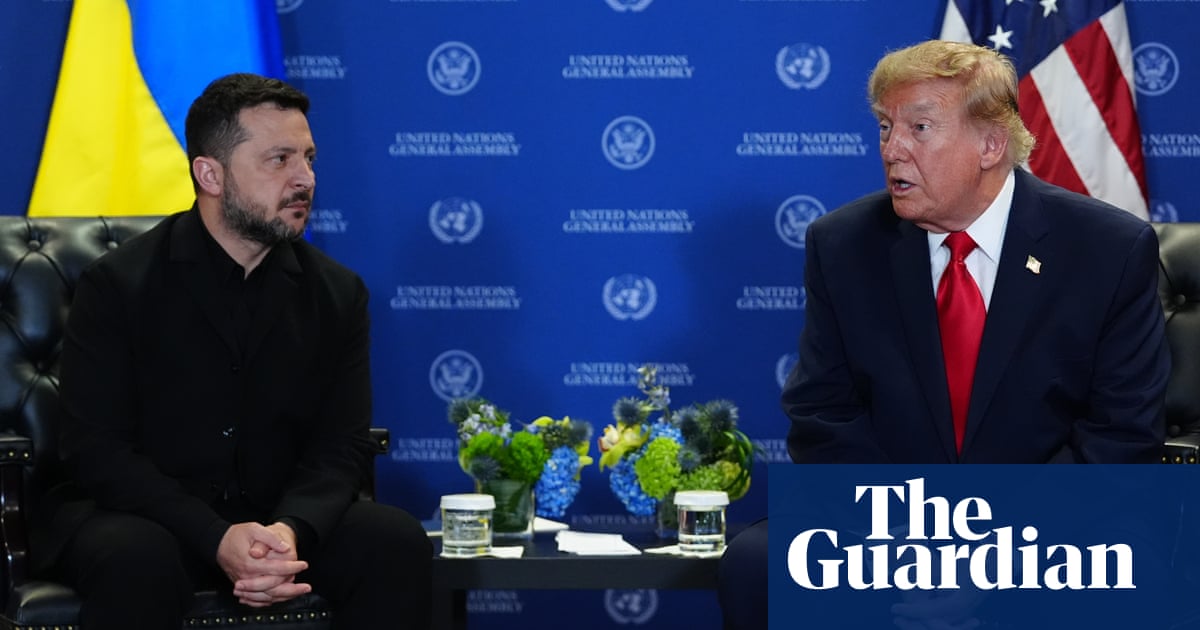
Good morning. In his usual asinine unconventional approach to international relations, Donald Trump announced on Sunday (via Truth Social, how else) an “ENERGY CEASEFIRE in the War between Russia and Ukraine”, apparently without checking with either side. Volodymyr Zelenskyy, who said any such deal was “news to me,” nonetheless declared he was “ready and we will accept it”. Vladimir Putin responded by blowing up some Ukrainian power plants.This has been the tenor of much diplomacy during Trump’s tenure: false starts, U-turns, incoherent positions (and some playful flirting with Vlad). Meanwhile fighting continues, and America’s allies attempt to manage the fallout. Andy Burnham hosted Zelenskyy at Downing Street yesterday, stating the UK is doubling down on its support for Ukraine, and pointedly calling on others to “follow suit”.It’s a negotiators nightmare. So how are ambassadors, spooks and diplomats handling the chaos? Is an actual ceasefire or peace deal within their grasp? For today’s First Edition, I spoke to career diplomat and former ambassador Nigel Gould-Davies to find out. Before that, this morning’s headlines.Five big stories UK | Sally Rooney has said she is being forced to withdraw her books from sale in the UK because of her support for the banned organisation Palestine Action. Gaza | Israel is refusing to allow a key military outpost project for Donald Trump’s Board of Peace to proceed in Gaza, the Guardian has learned. EU | Britain will benefit from much closer trading relations with the EU even if that means giving up its ability to negotiate free trade agreements, the Scotland secretary has said. Ukraine | Ukraine’s military has suddenly had its access to Starlink satellite internet terminals restricted as the Trump administration has increased pressure on Ukraine to immediately halt long-range strikes on Russia’s oil industry. Vaccine | Guinea-Bissau has not approved the controversial hepatitis B study in newborns that would be funded by the US government and private partners, the African country’s minister of health said. In depth: ‘A peace agreement is only possible when both sides believe that it better serves their interests’Ukrainian rescuers work at the site of a Russian strike on a residential building in Kharkiv. Photograph: Sergey Kozlov/EPASince Russia’s full-scale invasion of Ukraine in early 2022, efforts to secure either a temporary ceasefire or a permanent peace deal have resolutely failed. Endless rounds of talks in Belarus, Turkey, Abu Dhabi and Geneva have all proved futile. To Nigel Gould-Davies, it’s obvious why. A former British diplomat, he was head of economics at the Foreign Office in Moscow before his stint as the UK’s ambassador to Belarus. Today, he is senior fellow for Russia and Eurasia at the International Institute for Strategic Studies.Gould-Davies tells me that there are established norms for negotiating during military conflicts. Diplomats look for the interests, needs and red lines that each side articulates, in pursuit of the elusive “win set”.“A peace agreement is only possible when both sides believe that it better serves their interests to end the fighting than to continue,” he says. “You have to find that overlap in the Venn diagram that leads to a defined set of conditions which, despite involving painful compromises, is ultimately judged to better serve each side than continuing to fight.“The problem with this situation is that Russia has no interest in ending the war,” he says. Tricky to find common ground, then.It is through this lens that we should view all Russia-Ukraine talks since Trump’s return to the presidency, Gould-Davies suggests. “They have not really been negotiations,” but “parallel efforts by Russia and Ukraine to persuade the White House it’s the other side’s fault” that a peace agreement (and, perhaps more importantly to Trump, that elusive Nobel peace prize) had failed to materialise. That said, the respective red lines aren’t difficult to identify. Ukraine has time and again said it is willing to accept an unconditional ceasefire. “Russia, by contrast, has repeatedly said publicly that it is not interested in a ceasefire,” says Gould-Davies, only in a full and final end to the war that, in Russian terms, means “decisive superiority and dominance over a severely weakened Ukraine”.That’s an outcome Ukraine can’t, and won’t, sign up for.The ‘non-standard president’This is already a headache for UK, European and American diplomats, who most recently met in Miami at the end of last week. But there’s also the added Trump-shaped impediment to grapple with; what Gould-Davies diplomatically describes as the challenge of having “a non-standard president” in the White House. When Trump unilaterally declared an energy ceasefire, Gould-Davies says, it had “no basis whatsoever in reality”. Neither Moscow nor Kyiv was aware. “He simply made it up … a product of a fantasy.”The botched digital diplomacy aside, Trump’s interests also don’t appear aligned with Ukraine or traditional US allies. “[Trump’s] natural centre of gravity is to favour Russia,” says Gould-Davies, citing restrictions on US weapons supplies and past pauses in intelligence sharing. Yesterday, Zelenskyy accused Trump of restricting Ukrainian access to “military-grade” Starlink services, hampering Ukrainian drone strike missions and air defences.Granted, Trump has at times sided with the Ukrainian president: sanctioning Russian oil companies and helping Ukraine target Russian energy infrastructure. But for all Trump’s “lurching”, says Gould-Davies, his theory of ending the war involves concessions to Russia and coercion of Ukraine.The price of a dealAfter a period of relative quiet from Trump on the Russia-Ukraine front, this week Trump’s attention returned. With Americans facing soaring energy costs, he announced a plan to import Russian diesel in the hope of bringing down pump prices, much to the dismay not just of European leaders but a bipartisan group of US senators, too.Leave aside, for a second, suggestions that these imports could be illegal under American law and that quantities being discussed are seemingly too small to actually affect prices, even if the fuel could reach the US ahead of next month’s midterms, as Trump hopes.In some diplomatic circles, there are concerns that the diesel deal “is only the visible tip of the iceberg”, says Gould-Davies, with the White House privately pivoting towards a “much more substantial” pro-Russia tilt.Gould-Davies suspects that Trump could be, via Russia, seeking to get Iran to ease the blockade on the strait of Hormuz, in the hope of actually bringing down fuel prices before American voters head to the polls. Putin’s quid pro quo for brokering these efforts, Gould-Davies says, “could be an easing of America’s sanctions on Russia and an ending to America’s support for Ukraine”.It’s just a theory, he caveats, “but join the dots and it logically makes sense”.Either way, for diplomats it’s just further proof that Trump’s mercurial methods are more a hindrance than help.The quiet work behind the scenesNonetheless, diplomatic back channels remain operational: secret, closed-door meetings and off-the-record communications between all sides. Not that Gould-Davies thinks they’re worth the effort. “There is a degree of collective delusion here,” he says: “A hope that Russia can somehow be persuaded” to change course, for which “there is literally no evidence for that whatsoever”. He worries that these informal discussions could even be “actively unhelpful, because they perpetuate the illusion that peace may be around the corner”.And, while Europe might traditionally have focused its diplomatic efforts in hostile territory, attention has now turned towards the US itself. There’s still hope that Trump’s whispers might pay further dividends. As Gould-Davies puts it, this “Avengers assemble” approach has seen European leaders and diplomats descend on Washington when Trump’s veered too far off course. For all the tumult, he says, this has proved effective in averting “the nightmare scenario” of Trump binning off America’s old transatlantic partners for good.But as fans of Netflix’s The Diplomat will know, even diplomacy between allies isn’t plain sailing. “Right now even ‘the White House’ is an abstraction,” says Gould-Davies. “It consists of many different players, plenty of whom have different views privately from President Trump.” Take John Ratcliffe, director of the CIA, who visited Moscow this summer. There is “reliable speculation”, says Gould-Davies, that he hoped to “warn Russia against escalation into Europe”. It’s a totally different note to those currently being struck by Trump.“There are people in positions of power and influence still in this administration who understand the problem of Russia in the right way,” says Gould-Davies. With that in mind, western diplomats will continue to try to shift the balance of influences within the White House, but they’re reliant on what he labels a White House Kremlinology – “trying to understand the different views and moods of those around Trump and who will be the last person to whisper in his ear.”skip past newsletter promotionafter newsletter promotionWhat else we’ve been enjoyingHow We Win, a new Guardian newsletter on defeating Trumpism. Photograph: The Guardian How We Win is a new Guardian newsletter series featuring writers like Naomi Klein, Mehdi Hasan and Bernie Sanders on defeating Trumpism. Read Robert Reich’s introduction to the project here, and then sign up here to get each week’s piece directly to your inbox. Charlie Lindlar, newsletters team Are you a Hannah, a Marnie, a Jess or a Shoshanna? Or did Lena Dunham’s Girls pass you by the first time round? If it did, then this excellent piece by Louis Staples (a Marnie) may well convince you to binge the whole thing in time for the recently announced five-episode revival. Lucinda Everett, newsletters team In another of our newsletters, The Long Wave, Micha Frazer-Carroll writes about taking up Jamaican Patois classes and what learning the language taught her about shame and her connection to her ancestry. Charlie I look forward to the Wildlife photographer of the year exhibition every year, and this year’s winning images didn’t disappoint. You can see a selection of them here, including my favourite: James Lewin’s dream-like shot of a young bull elephant giving a zebra an impromptu shower. Lucinda Rachel Dixon on our travel desk has pulled together this beautiful list of Britain’s best heated lidos to keep you swimming through winter. Move over WFH, and hello WFHL? Charlie SportDésiré Doué (left) and Ousmane Dembélé savour the moment PSG open the scoring. Photograph: Tom Jenkins/The GuardianChampions League | Paris Saint-Germain romped to a 4-2 victory over Manchester City, while Bradley Barcola hit his first Liverpool goals with a hat-trick in a 6-3 win over Lask. Elsewhere, Aston Villa demolished Fenerbahce 6-0 at Villa Park.Fifa | Gianni Infantino will be questioned by Fifa council members over the aborted World Cup sell-off plan, the Folarin Balogun affair and awarding Donald Trump the Fifa peace prize at what is expected to be a heated meeting on Thursday.Formula One | Formula One has confirmed Rwanda will join its calendar, having concluded a 10-year agreement for the meeting on a purpose-built circuit, with the first race set for the early 2030s.The front pages2026-10-15-dde6e8 Photograph: The GuardianThe Guardian splashes on “Zelenskyy blames Trump for loss of protection from Russian raids”. The Times has “Zelensky: My people will die after Trump betrayal”, the Telegraph runs “More on benefits at age seven than age 50” and top story at the Financial Times is “Jump in US inflation deepens pain for voters ahead of key midterm elections”.Elsewhere, focus is on the Russell Brand trial. Brand denies all the charges and has pleaded not guilty. Reporting the prosecution’s opening statement, the Sun headlines with the quote “‘Ruthless calculated sexual predator’”, The i Paper also headlines with “Brand a ‘ruthless and calculated sexual predator’”, the Mail has “The ‘predator’ in sunglasses” and The Mirror leads with the quote “‘Predator’”.The Latest Photograph: The Guardian.India’s Cockroach protesters defy Modi’s crackdownA fresh wave of protests by India’s youth-led Cockroach movement has been met with a brutal crackdown by Narendra Modi’s government and the closure of a historic protest site in Delhi. Two of the movement’s leaders have been imprisoned for five days for violating suppression measures. The protests, which began over frustration about education and unemployment, are now focused on voting rights. Modi’s government denies claims that it is seeking to disenfranchise millions of voters. But its treatment of protesters has been criticised by the UN and Amnesty International and raised concerns that the country is sliding further into autocracy. Lucy Hough speaks to the south Asia correspondent Hannah Ellis-Petersen – watch on YouTubeCartoon of the day | Nicola Jennings Illustration: Nicola Jennings/The GuardianThe UpsideA bit of good news to remind you that the world’s not all badHive of activity … Aref Haboo (left), Bybi’s principal beekeeper, with Mohamed, a fellow apiarist. Photograph: Valdemar Ren/The GuardianOn Copenhagen’s rooftops live 80 to 100 colonies of honeybees, tended by a collective of beekeepers called Bybi.Set up in 2010 with the aim of employing marginalised people, Bybi’s work has evolved into a response to the modern economic system.With the help of volunteers, from refugees to people on incapacity benefits, they produce between four and six tonnes of honey every year, which they sell (often letting people pay what they like) or give away, asking that people share it with loved ones and plant a flower to help the bees. They also run schools programmes, supported by sponsorships from universities and corporations.“Bybi is a constellation of time, work, money, community and connection,” says founder Oliver Maxwell, “asking an open question: what would it take for bees, people and communities to thrive?”Sign up here for a weekly roundup of The Upside, sent to you every SundayBored at work?And finally, the Guardian’s puzzles are here to keep you entertained throughout the day. Until tomorrow. Quick crossword Cryptic crossword Wordiply
Thursday briefing: Thanks to an erratic Trump, peace in Ukraine is still far away
Full Article
Original Source
Read the full article at Theguardian →KhanList aggregates and links to publicly available news content. We do not host full articles from third-party sources. Always verify important information with original sources.