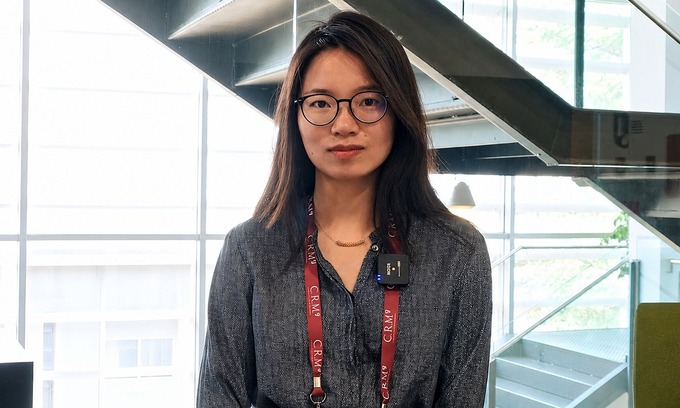
A debate has broken out in China over which country deserves credit for producing Hong Wang, who on July 23 became the third woman to win the Fields Medal, the world's most prestigious mathematics award. Wang, 35, received the medal at the International Congress of Mathematicians in Philadelphia for her proof of the Kakeya conjecture in three dimensions, written with Joshua Zahl.She and Yu Deng, honored the same day, are the first Chinese nationals to take the prize since it was first awarded in 1936 and Wang is the first Chinese woman to win it.The only two women honored before her were Maryam Mirzakhani of Iran in 2014 and Maryna Viazovska of Ukraine in 2022.Wang graduated from Peking University in 2011, took a master's at Paris-Saclay after entering France's École Polytechnique, and earned her doctorate at MIT in 2019 under Larry Guth. She teaches at New York University and has held a permanent professorship at France's Institut des Hautes Études Scientifiques since September 2025.CNN reported the win was hailed across China as a milestone in the country's bid to cement its role as a science and technology power, with the two top trending topics on Weibo the next morning both discussing it.Tian Gang, an academician of the Chinese Academy of Sciences who directs the Beijing International Center for Mathematical Research, told Beijing News that both laureates completed their foundational education in China and have credited Peking University with laying their mathematical groundwork.At the same time, President Emmanuel Macron posted on X that Wang, trained at École Polytechnique and now a researcher at IHES, embodies the excellence of French research and training, closing with an appeal to scientists to choose France. He also telephoned her to offer congratulations.Michel Goemans, head of MIT's mathematics department, called the achievements of Deng and Wang a testimony to the talent at the American institute and the mentorship it provides. Chinese mathematician Hong Wang. Photo courtesy of Centre de Recerca Matemàtica From Peking to IHESMore than half of Wang's classmates in Peking University's mathematics school had come through competition circuits, some off national training squads, and many were taking graduate-level courses as freshmen while she had not yet transferred in, Beijing News reported. Her grades placed her in the lower half of the class.She told China Science Daily she had felt nearly invisible among classmates holding Olympiad gold medals, and began to doubt she belonged in mathematics.She later left mathematics for a period during her master's in France, switching to architecture.A Beijing News commentary argued that undergraduate study builds foundations while doctoral study builds research capability, and that Peking University supplied only the first half of Wang's foundation while France supplied the second.The institutions that mattered most, it said, were the ones awarding the doctorates. The prizes do not yet place China alongside the U.S., Russia, France and Britain, it concluded, and the real marker will be a Fields Medal won by a mathematician trained to doctoral level at home.Wu Guosheng, who heads Tsinghua University's department of history of science, made a related point in remarks carried by Ifeng. Chinese students win Olympiad golds easily and Fields Medals rarely, he said, because the Olympiad is a contest with clear targets and standard answers while research rewards exploration with neither.Writing in Asia Times, Y. Tony Yang, an endowed professor at George Washington University, argued the national scoreboard does not survive contact with the biographies.Talent formation is largely national and takes about two decades, he wrote, while talent flourishing depends on mentors, seminar culture and a tolerance for a decade of apparent failure, and is increasingly transnational. "Neither half produces medals alone," he wrote.A theorem becomes a global public good the day it appears on arXiv, Yang added, and its value accrues to whoever builds on it rather than to whoever issued the passport.His concern is less who won than whether the pipeline that produced the winners survives, given that it depended on movement now giving way to sorting by nationality."Moments like this never belong to just one person," Wang said in comments shared by NYU, crediting colleagues at every stage of her career.
Three countries are claiming credit for the first Chinese woman winning Fields Medal
Full Article
Original Source
Read the full article at E →KhanList aggregates and links to publicly available news content. We do not host full articles from third-party sources. Always verify important information with original sources.