
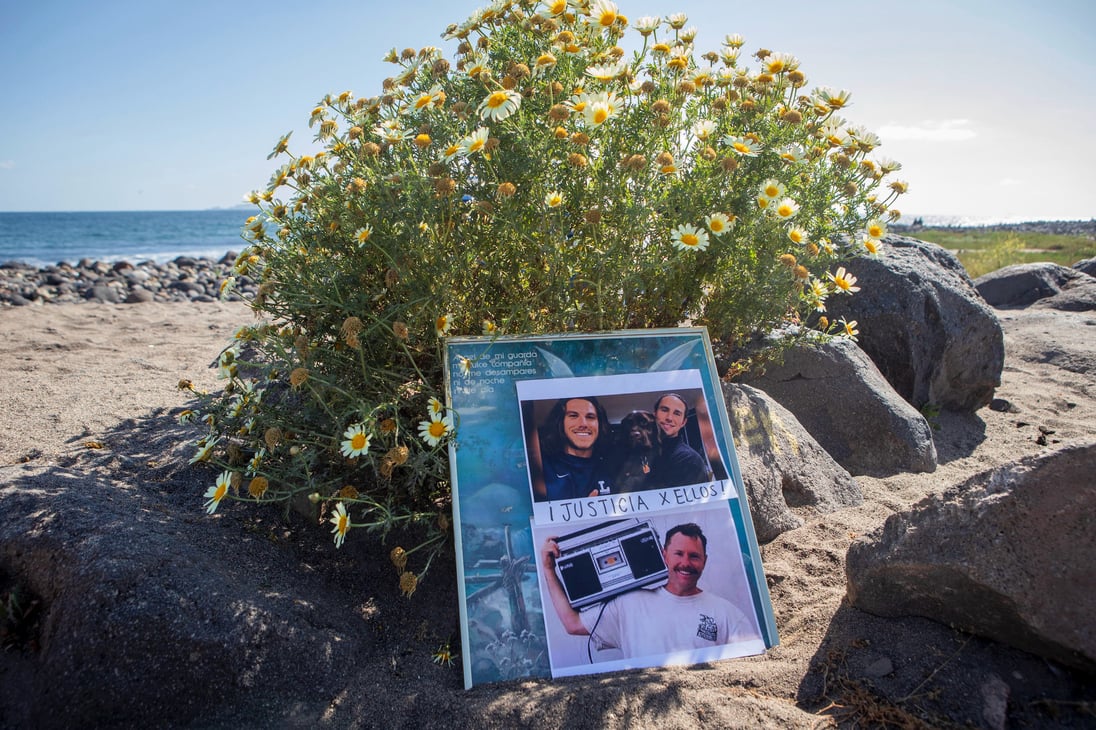
The killings of a pair of Australian brothers and an American led to international eyes on Mexico's controversial judicial system.ENSENADA, Mexico (CN) — A Mexican judge on Friday found three men guilty of killing three foreign surfers on an idyllic strip of beach along the Baja California coast.For almost a month of trial, prosecutors said Jesús Gerardo, Irineo Francisco and Ángel Jesús went to the picturesque Punta San José lighthouse bluff where the surfers were camping, stole their tires and cell phones, and shot them each in the head.The bodies of Australian brothers Jake and Callum Robinson and their American friend Carter Rhoad were discovered in a makeshift well in the tourist enclave of the state of Baja California about a hundred miles south of the US-Mexico border by state agents May 2, 2024.Prosecutors said the three defendants were tipped off by Gerado’s then-girlfriend Ari Gisell during a bender to the surfers’ whereabouts. Gisell — now sentenced to 20 years in prison for instigating the murders — supplied the narrative to the state that the murders revolved around “nice tires, good cell phones.”Rhoad’s wife testified that she became nervous when her husband didn’t answer her for days and eventually tracked his location, leading her to Gisell, who was was in possession of his stolen iPhone. The families of the surfers then enlisted authorities, who later found the well containing the bodies.The trial has gained international recognition not just because of foreigners involved but also because of the strange and brutal outlying circumstance of the crimes in what is perceived as a tranquil area of Mexico.Benjamin Smith, a Latin America historian and author of “The Dope: The Real History of the Mexican Drug Trade” said in an interview he couldn’t quite put the pieces together as to how this crime could have happened the way it did.He acknowledged a “code” amongst criminals that is generally followed: you don’t mess with foreigners. It hurts the tourism industry and in turn, the criminal’s’ own pockets.“As soon as you kill three foreigners, I mean, that’s insane — you’re basically fucked,” he said.When asked about conspiracy theories that percolated amongst reporters since the deaths — strengthened by documentation that the men were involved with the Sinaloa Cartel — Smith said there’s no reason to believe other than what it is said to be: a robbery gone wrong.“I mean, the only really rationale for executing them I can see is you have a kind of trained psychopath, who’s your friend from childhood or something who might whack them, maybe showing off to his friends, and he thinks he has complete impunity,” said Smith. “I mean, these people are broken, they’re completely mental. So I think, it’s a very sad case of kind of what I suspect to be some kind of mental illness.”This reflects prosecutors’ claim that Gerardo, known as “El Kekas,” slept with the 9mm gun tied to the murders that state agents found in his pickup truck under his pillow.Despite this, the 9mm “80 percent” pistol was the prosecution’s biggest hole in the case — the 9mm wasn’t explicitly stated as the murder weapon, though bullets linked to that gun were found in one of the victims’ leg.But it was the wounds to the head that were the cause of death. No forensic specialist has been able to discern what type of bullet caused these wounds — even though .45-caliber casings were left on the ground in the surfers’ campsite.Smith said these types of prosecutorial holes are unfortunately nothing new in the Mexican judicial system.“As soon as you try to triangulate all this stuff, you realize there are just great big holes in these cases all the time,” he said.The judge is still yet to unveil his sentencing for the three defendants, who are charged with aggravated homicide, aggravated robbery, violent robbery and grand theft auto in the Baja killings.Deliberations for the sentencing could take up to another week and differs for each defendants’ culpability in the crime as the judge sees fit.Mexican trials do not have juries. According to the Human Rights Watch, only 1 out of 10 intentional homicides are solved in Mexico.Subscribe to our free newslettersOur weekly newsletter Closing Arguments offers the latest about ongoing trials, major litigation and rulings in courthouses around the U.S. and the world, while the monthly Under the Lights dishes the legal dirt from Hollywood, sports, Big Tech and the arts.Additional Reads
Three Baja men guilty in murder of surfers on Mexico beach
Full Article
Original Source
Read the full article at Courthousenews →KhanList aggregates and links to publicly available news content. We do not host full articles from third-party sources. Always verify important information with original sources.