
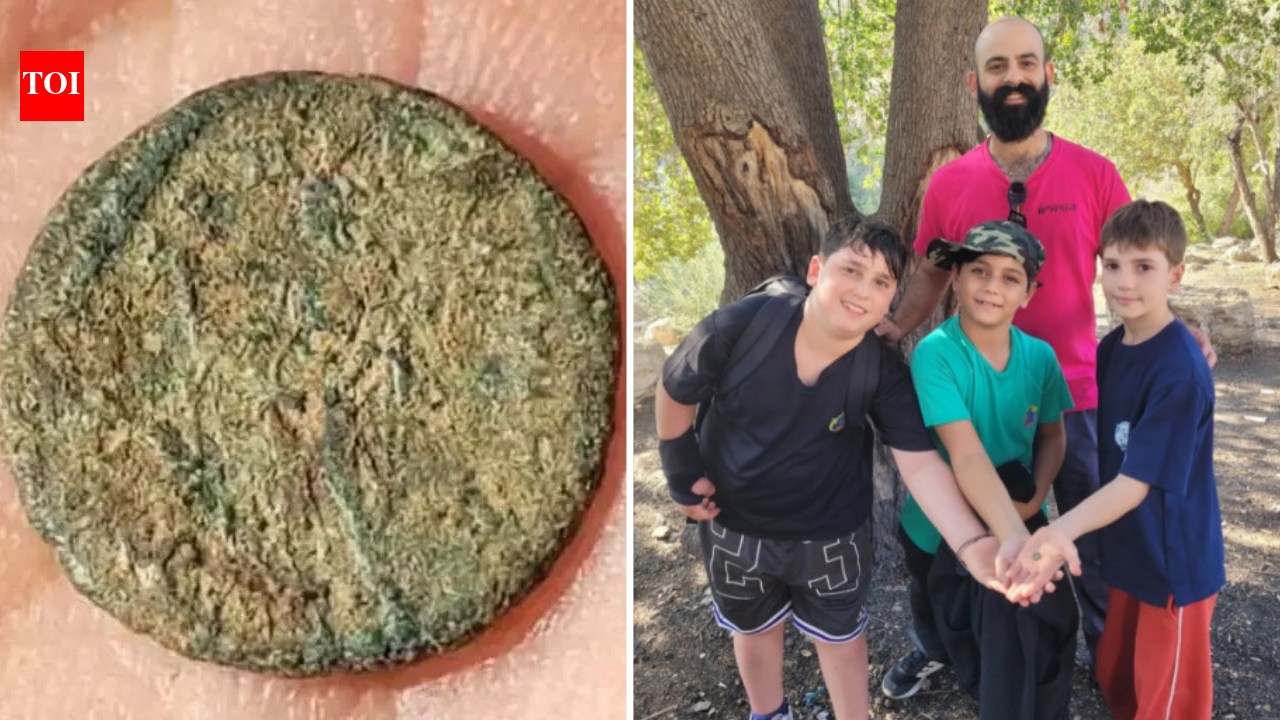
The discovery took place on November 15 at Sataf, on a terrace between Ein Bikura and Ein Sataf.Three 10-year-old schoolchildren on a field trip in the Jerusalem Hills made an unexpected discovery when they spotted a coin believed to be around 1,900 years old. The children were playing with an air blower on an ancient agricultural terrace when they noticed the object, which may date back to the reign of Roman Emperor Hadrian.The discovery took place on November 15 at Sataf, on a terrace between Ein Bikura and Ein Sataf. As reported by The Jerusalem Post, the students were part of a fourth-grade school group led by Amit Feinstein, a tour guide and archaeology student at Bar-Ilan University.The children immediately showed the coin to their class teacher, who informed Feinstein. He suspected it could be from the Roman period but, not being a specialist in ancient coins, photographed it and shared the pictures with his university lecturers. Their initial assessment suggested that it could belong to the Roman or Byzantine period. A subsequent consultation with the Israel Antiquities Authority (IAA) raised the possibility that it was minted during the reign of Hadrian, who ruled the Roman Empire from 117 to 138 CE.However, the identification is not yet final. The IAA has said that the coin needs to undergo professional examination before its precise age and origin can be established.Coin may date back to Emperor Hadrian's reignAccording to historical records, Hadrian ruled Rome from 117 to 138 CE. His reign is closely associated with the Bar Kokhba revolt, a major Jewish uprising against Roman rule that took place between 132 and 135 CE. If the preliminary identification is confirmed, the coin would offer a small piece of material evidence from a period of significant upheaval in the region.The discovery was made at Sataf, an archaeological and agricultural site in the Jerusalem Hills known for its ancient terraces and traditional farming landscape. The terraces were built into the hillsides to support cultivation in the difficult terrain.The children had been playing with an air blower when the coin came to their attention. What began as a game soon became an archaeological discovery that required expert examination.One child initially wanted to keep the coinThe discovery also gave the students an unexpected lesson in the laws governing archaeological finds. Feinstein explained that ancient objects cannot simply be taken home as souvenirs. They need to be reported to the Israel Antiquities Authority so that experts can examine, document and preserve them.According to The Jerusalem Post, one of the boys who picked up the coin initially objected to handing it over because he wanted to keep the find. Feinstein spoke to the children about why archaeological objects need to be preserved and studied. They eventually handed the coin to their school principal, while Feinstein informed the IAA.The discovery also prompted the school principal to organise a discussion with the entire fourth grade about antiquities law and the importance of reporting archaeological finds. Feinstein said he had initially tried to interest the students in the ancient agricultural methods used at Sataf. However, it was the coin that caught their attention and prompted them to ask questions about people who lived in the region centuries ago.The coin is now awaiting professional examination. Until experts complete that process, its exact identity and date remain uncertain. For the three students, however, the field trip has already become a memorable encounter with an object that may have survived nearly two millennia.
Three 10-year-olds find 1,900-year-old Roman coin on Jerusalem school trip
Full Article
Original Source
Read the full article at Timesofindia →KhanList aggregates and links to publicly available news content. We do not host full articles from third-party sources. Always verify important information with original sources.