
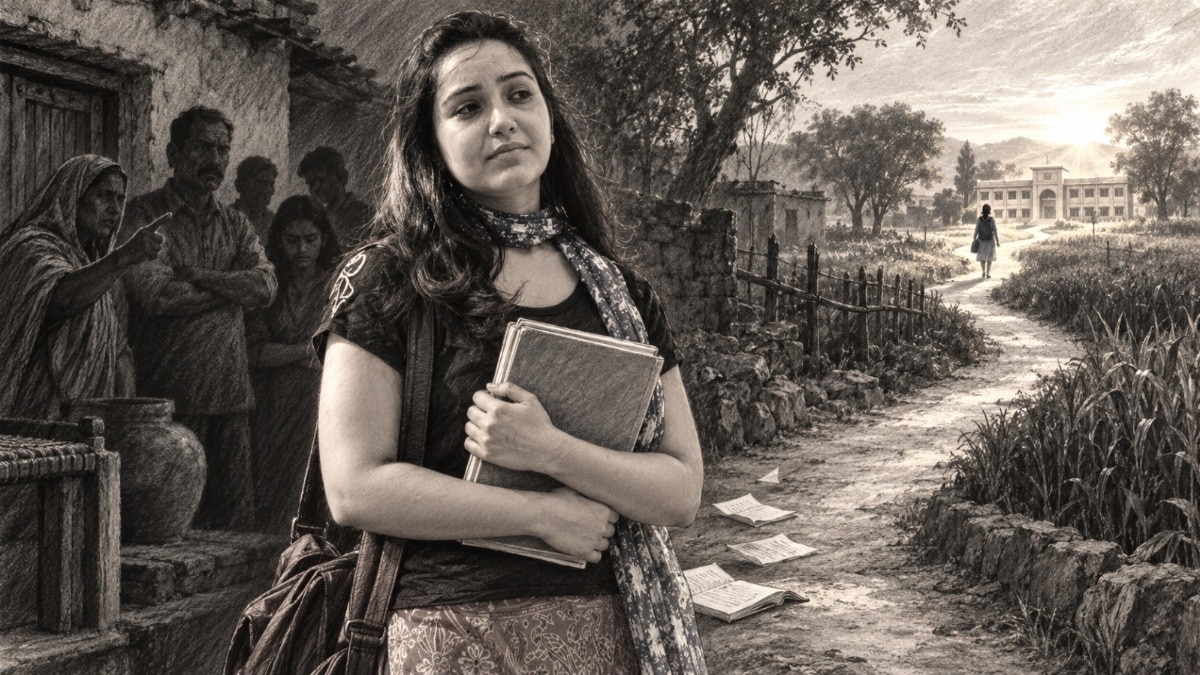
On the night of December 31, 2005, while families across India were preparing to welcome a new year, Monika was fighting for a new beginning of her own.She wanted to go to college.It sounds simple now. It was anything but then.Monika had finished Class 12 and wanted to continue her education. Her father, a farmer and government schoolteacher, had admitted her to Hindu Mahila Mahavidyalaya in Shamli, Uttar Pradesh. But inside her home, her decision to study further had become a source of conflict. Her elder brother refused to let her go.Her mother was bedridden with arthritis, and Monika says she was expected to stay home and take care of the household, while her sister handled much of the family’s work. Monika, however, wanted to study. And her father stood by her. Then, when she refused to give up, the disagreement took a frightening turn.Monika says her brother showed her a country-made pistol, or katta, and threatened to kill her if she went to college. He also told her that if anyone troubled her while she travelled by bus, he would deal with them.The argument soon spilled beyond the immediate family. Her uncle and other relatives became involved, questioning why she needed to go to college at all.On December 31, the dispute escalated into a major fight. The local police intervened. Monika says she was warned that she could be killed if she continued going to college.Her elder brother was later jailed in connection with a murder case. Monika says she has not spoken to him for the past 15 years, after the conflict over her education and the threats he made when she wanted to go to college. Holding on to her books, Monika faced a difficult choice between family expectations and her dream of education. (AI generated sketch image) Her father eventually made a difficult choice.He sent Monika’s brother to the city for a few days and sent Monika to her sister’s home in Muzaffarnagar. From there, she continued travelling to college.It was not the beginning of an easy journey. But it was the beginning of one in which Monika refused to let someone else decide whether she deserved an education.Nearly two decades later, as India celebrates Teachers’ Day, her story offers a different way of looking at what it means to educate.Sometimes, it is not just about teaching a child. Sometimes, it is about helping someone hold on to a dream when everything around them tells them to let it go.Today, Monika is in Jharkhand’s Khunti district, working with children in tribal villages who face a very different set of barriers to education: poverty, poor learning outcomes, lack of information and unsafe migration.Yet when she sees girls leaving their villages for work in cities such as Delhi and Mumbai, she does not see an abstract social problem.She sees a version of herself.“When I was in school, I used to live with relatives. I know how people treat you when you don’t have a backbone,” Monika says. “People torture you. I had a family, so I was able to do this. These girls have no one.”That memory has become part of the reason she does what she does today. A community meeting focused on creating better opportunities for children in Jharkhand. THE FIGHT THAT STARTED IN WESTERN UPMonika grew up in Karoda Hathi village in Shamli district, Western Uttar Pradesh, in a large family. She had nine brothers and one elder sister. She began school at the government school in her village and studied there until Class 8. A keen debater, she later moved to Dehradun on a scholarship and completed Classes 9 to 12 at Ram Pyari Arya Kanya Pathshala Inter College.For a girl growing up in a village, moving to Dehradun opened up a larger world. College was supposed to be the next step. Instead, it became something she had to fight for.She managed to complete her first year of college, but did not finish her degree at that time. She eventually began working, later got married and moved to Jharkhand.For the next 12 years, formal education was put on hold.It would have been easy for that chapter to end there. It didn’t. Monika eventually returned to her studies and completed an MSc. Looking back, she does not describe her life as a smooth climb from adversity to success. There were interruptions, compromises and years when education had to wait.“I think God has made my life an experimental lab,” she says. “I had a lot of problems in my childhood and later as well. But now I have overcome all those things.” Perhaps that is why education means something different to her today.She knows what it feels like when the path suddenly closes, she also knows what it takes to find another way around it. Monika Arya conducts a learning session with children in a tribal village in Jharkhand. IN KHUNTI, SHE FOUND CHILDREN FACING A DIFFERENT KIND OF BATTLEAfter moving to Jharkhand, Monika began working in communities where many children are first-generation learners. In Torpa block of Khunti district, parents may study only in Classes 6–8. Many have little information about scholarships, careers or opportunities beyond school.Poverty adds another layer.Agents sometimes approach families with offers of work for teenagers in cities. For families struggling to make ends meet, the promise of an income can be difficult to refuse. “There are agents here. They are taken out for work. They think they will earn something by going out,” Monika says. “That’s why they get manipulated and sent.”Some teenagers are taken to Delhi, Mumbai and other cities for domestic work or other employment. Monika describes this as “unsafe migration”. “They are not allowed to come back. They don’t even get paid,” she says.For a child who leaves school and a village under such circumstances, returning is not always easy. And that is where Monika’s own story comes back into focus.She once needed her father to create a safe route for her to continue studying. These children, she believes, need someone to create that route before they are forced to leave school altogether.BUILDING A SAFETY NET BEFORE A CHILD FALLSIn 2021, Monika founded Sambhav Trust, which works on child protection, education, adolescent empowerment, career guidance, scholarships, sports and safe migration in rural and tribal communities of Khunti. The idea is not simply to intervene after something has gone wrong.It is to build enough support within the village that a child does not have to face the problem alone.The organisation has worked with Anganwadi Sevika workers across 95 villages in Torpa block and helped revive Village Level Child Protection Committees across 16 Gram Panchayats. Around 5,000 school-going children have been reached through child-protection initiatives, helping them understand their rights and recognise violence, abuse, exploitation and neglect.Monika also wants children to have a voice in the institutions that govern their villages. "The children should also have a chance to speak in the Gram Sabha,” she says. “Their issues should also be raised in the Gram Sabha. They should be considered. They should be worked on." For Monika, empowerment means giving children a voice in the decisions that shape their lives. (AI generated sketch) For her, that is what empowerment looks like, not simply telling children to be confident, but giving them spaces where their voices actually matter. “There are agents here. They are taken out of work. They think they will earn something by going out,” she says. “That's why they get manipulated and sent.”But children who leave their villages for domestic work or other employment can become vulnerable to exploitation. Arya calls it “unsafe migration”. “Teenagers are taken out for domestic work,” she says. Some children may not receive the wages promised to them. Some struggle to return home. And once they leave school, getting back into education becomes much harder.“They go to Delhi, Mumbai and other big cities. They are not allowed to come back. They don't even get paid,” she adds. This is where Monika's own story intersects with theirs.She once needed someone to create a way for her to remain connected to education. Many of these children, she believes, need that support before they are forced to make an irreversible choice.BEFORE ASKING CHILDREN TO DREAM, SHE WANTS THEM TO KNOW WHAT IS POSSIBLEMonika’s idea of education goes beyond attendance. The trust has provided career guidance to more than 1,000 students in government schools across Khunti district. It has connected 150 vulnerable children with the Sponsorship Programme under Mission Vatsalya and conducted scholarship-awareness sessions across 10 universities in Jharkhand.Through this work, 80 children of vehicle drivers have been connected with the Muskaan Scholarship. The numbers tell one part of the story. The other part is what Monika sees in children who simply do not know what comes after school.A talented child may never apply for a scholarship because nobody told them it existed. A capable student may abandon a dream because nobody explained how to pursue it. A teenager may leave school for a job because earning money today feels more real than a future they cannot see.Monika wants to change that. Community members gather for a discussion in the village For her, participation is itself a form of empowerment. At the village level, she believes children should have a voice in decisions that affect them, while parents need to be more aware of the risks children face when they leave their villages for work.THE CLASS 8 CLIFFOne of her biggest concerns is what happens around Class 8. Children who struggle academically often lose confidence. By the time they reach the transition to Class 9, some have already begun to believe that they are simply “not good at studies”.Monika is developing after-school learning centres for Classes 6–8 across five villages, focusing on English, Science and Mathematics while tracking each child’s progress. The objective is not just better marks.It is to prevent a child from quietly giving up on themselves.She wants community support, experts and technology to bring better learning opportunities to tribal children without asking them to leave their villages to find them. A learning session brings children together in a tribal village in Jharkhand SHE DOESN’T WANT THE VILLAGE TO NEED HER FOREVERThere is another unusual part of Monika’s approach. She does not want Sambhav Trust to become a permanent crutch.“We are trying to make them change makers in three years,” she says. “They should be able to protect themselves and the community. We will not be in the same village for a long time. The community should be prepared,” she says.The goal, therefore, is to leave knowledge behind — among children, parents, Anganwadi workers, adolescents and local institutions. A village should know what to do when a child is at risk. A parent should know where to seek help. A child should know their rights.And, perhaps most importantly, a child should know that their circumstances do not have to determine the rest of their life.FOR HER, A SCHOOL BUILDING IS NOT ENOUGHMonika is blunt about what she sees in many government schools. “The infrastructure is very poor. The government schools are very poor. The learning outcomes are also very bad,” she says. Buildings can be improved, she argues. But a new classroom does not automatically mean a child is learning.She believes volunteers, fellows and graduates could be brought into after-school programmes to help children bridge learning gaps. “Volunteers are so many. If you make a little payment, people are ready to do the work,” she says. “You can get a fellowship, you can do something like that. There will be learning and earning of a graduate.” For Monika, accountability has to extend beyond whether a child is physically present in school.The question is whether the child is actually learning because she knows what lost years can feel like. A group of students and community members gathered during an education programme in the village. ‘EDUCATION NEVER LETS YOU LOSE’Perhaps the most revealing part of Monika’s story is the way she talks about education. For her, it is not merely a degree. It is not even simply a route to employment. It is what gives a person the confidence to make a decision about their own life.She knows this because there was a time when that decision was almost taken away from her.On that December night in 2005, she did not know what her future would look like. She only knew that she wanted to study badly enough to leave her home and travel to college from her sister’s house.Years later, she is working with children who are standing at their own crossroads. Some are being pulled towards work. Some are falling behind in school. Some do not know that scholarships exist. Some have never been told that they can aspire to something beyond the limits of their village. Monika cannot remove every obstacle from their path but she can make sure they do not have to face those obstacles alone.“I think education gives you strength,” she says. And then she puts it more simply, “Education never lets you lose.”The girl who once had to fight simply to get on a bus to college now spends her days trying to make sure other children do not have to fight alone for the right to stay in school. For Monika, perhaps that is what her own difficult journey has finally come to mean, not that she overcame every obstacle, but that she learned how much easier the road can become when someone stands beside you.- EndsPublished By: Apoorva AnandPublished On: Sep 5, 2026 08:00 IST
Threatened with a pistol for wanting to study, she now fights for tribal kids' education
Full Article
Original Source
Read the full article at Indiatoday →KhanList aggregates and links to publicly available news content. We do not host full articles from third-party sources. Always verify important information with original sources.