
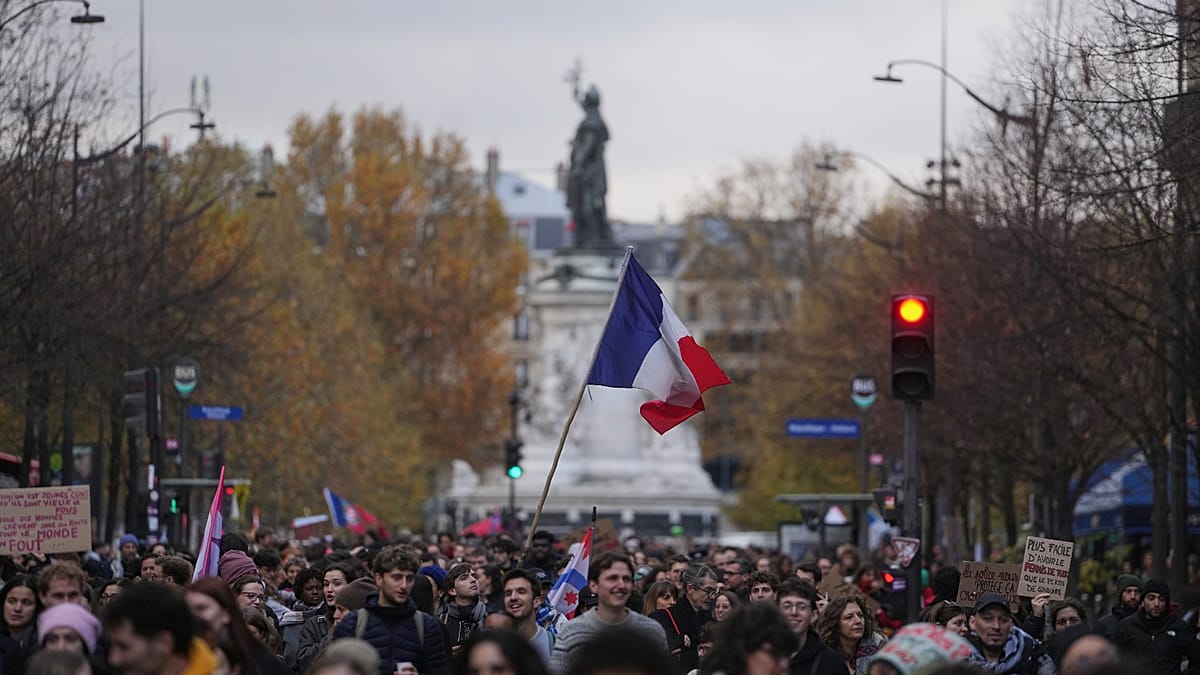
Protests over living costs and social inequality continued in Europe on Saturday, 21 November, with demonstrations in Portugal, Spain and France. ADVERTISEMENT ADVERTISEMENT In France, demonstrations over the cost of living, student rights and police violence continued for a sixth consecutive Saturday. However, turnout was considerably lower than a week earlier. During the march from Place de la République to Place de la Nation in Paris, demonstrators waved flags and wore T-shirts bearing trade union logos. Others turned out in the movement's distinctive yellow vests. According to the Interior Ministry, 82,500 people took part in demonstrations nationwide, including 21,500 in Paris. Organisers put the total at 150,000, of whom 45,000 marched in the capital. A week earlier, the authorities had counted 106,000 demonstrators across France, while organisers estimated the turnout at 200,000. In Lyon, where demonstrations had been banned across a large area, several unauthorised marches attempted to reach the city centre during the afternoon. Police dispersed the groups using tear gas, according to an AFP journalist at the scene. In Marseille, 4,600 people took part in protests, according to police, matching the previous turnout. The march later split into two groups, one of which continued as an unauthorised demonstration. Around 70,000 police officers and security personnel were deployed nationwide. The demonstrations were largely peaceful, although sporadic incidents of violence were reported, including in Marseille. The latest mobilisation coincided with the eighth anniversary of the Yellow Vest movement, which began in November 2018 in response to rising fuel taxes before developing into a broader protest against living costs and social inequality. Thousands march in Lisbon despite heavy rain In Portugal, thousands of workers took to the streets of Lisbon to demand higher wages and pensions, more affordable housing and better public services. The demonstration was organised by the country's largest trade union federation, CGTP-IN, and went ahead despite heavy rain. Protesters travelled to the capital from across the country, with special trains arriving from Porto and buses bringing demonstrators from cities including Aveiro and Faro. The union called on the government to address the growing financial pressures on households, demanding lower prices for essential goods and services, as well as measures to make housing more affordable. "They talk about the economy, but they don’t know what it’s like to stretch every penny to pay the rent and electricity bills. They don’t know what it’s like to have to choose between buying medicine and putting food on the table,” the CGTP-IN says in a campaign video shared on its Facebook page. Many demonstrators said their earnings were no longer sufficient to cover everyday expenses, particularly housing, food and energy bills. The mobilisation also reflected growing frustration over the government's proposed 2027 state budget and its approach to public services. In addition to Saturday's national demonstration in Lisbon, the CGTP-IN has called a further rally outside the Assembly of the Republic for next Tuesday, 24 November, coinciding with the final vote on the 2025 State Budget proposal. Housing and purchasing power at the centre of discontent Although the demonstrations in Portugal and France were organised separately, they shared several concerns, particularly the erosion of purchasing power and difficulties finding affordable housing. In Portugal, house prices have more than doubled since 2017, while rents for new tenancies have risen sharply. Average annual earnings in 2025 were 37 % below the EU average, according to Eurostat. The demonstrations came a day after a wider wave of student and worker protests swept through more than 20 European countries on Friday, 20 November. Thousands of people took to the streets of Barcelona on Saturday, with police estimating the turnout at 3,000 and organisers putting it at 5,000. Demonstrators called for more affordable housing, better-funded public education and stronger public services. In Madrid, a separate demonstration focused on the treatment of elderly people in care homes during the Covid-19 pandemic. Madrid protesters demand justice for care home deaths Demonstrators took to the streets, demanding justice for the 7,291 elderly people who died in care homes during the first wave of the Covid-19 pandemic in 2020. The protest, organised with the Marea de Residencias (Care Homes Movement), called for truth, justice and compensation for the victims and their families. The protesters denounced the controversial protocols introduced under the regional government of Isabel Díaz Ayuso, which restricted hospital transfers for certain elderly care home residents during the pandemic. They also called for care homes to be fully publicly owned and run. Critics have described the measures as discriminatory, while the regional government has defended its handling of the crisis.
Thousands take to streets in Portugal, France and Spain over rising living costs
Full Article
Original Source
Read the full article at Euronews →KhanList aggregates and links to publicly available news content. We do not host full articles from third-party sources. Always verify important information with original sources.