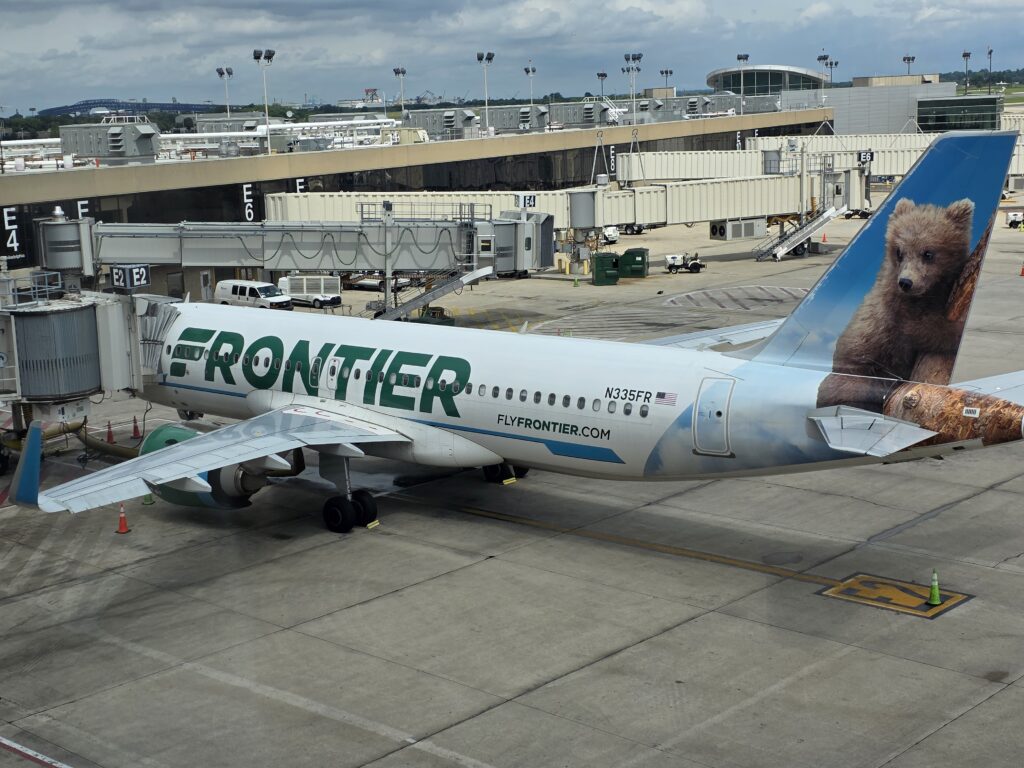
A Frontier Airlines passenger returning from Las Vegas watched his wife’s boarding pass scan successfully, but 9″ target=_blank>he was told he couldn’t get on the aircraft, because they’d changed aircraft. There were 186 passengers, and the new plane had just 180 seats. He was being involuntarily denied boarding He was entitled to no compensation And some commentators are saying Frontier has found a ‘loophole’ in the regulations to let them overbook as much as they want without paying anyone. The passenger says it took about 45 minutes before an agent explained what happened. Frontier offered him a $250 voucher as a goodwill gesture. Frontier outsources its gate agents, often to the low cost bidder. The customer service here was poor – they apparently did not even announce the overbooking. Bumped passengers just had their boarding passes rejected when they tried to board. And reports are that Frontier is using a “loophole” to swap in a slightly smaller aircraft whenever a flight is oversold, avoiding federally-required cash compensation. Enilria suggests that an airline could station a spare plane with one fewer seat in Denver and roll it out whenever it wants to escape paying bumped passengers. An Aircraft Swap Lets Airlines Avoid Paying Out Compensation Ordinarily an airline that involuntarily denies boarding to a confirmed passenger on an oversold domestic flight owes: nothing if alternate transportation is planned to arrive within one hour of the original arrival time; 200% of the one-way fare, capped at $1,075, for a delay of one to two hours, or 400% of the one-way fare, capped at $2,150, for a delay of two hours or more. Those are the current amounts in 14 C.F.R. § 250.5. (International flight thresholds are one to four hours and more than four hours.) But 14 C.F.R. § 250.6(b) says a passenger is not eligible for mandatory denied-boarding compensation when the airline cannot accommodate them because it substituted equipment with fewer seats “when required by operational or safety reasons.” Here’s the thing – the ‘get out of compensation loophole’ requires that the passenger bump was because of the aircraft substitution. The exception was included with the rule because involuntary denied boardings due to change in equipment aren’t because of overbooking. Assume 190 passengers show up for a flight on a 186-seat aircraft. The airline substitutes a plane with 180 seats. They would have bumped 4 pssengers, now they have to bump 10. But only six are ‘because of’ the aircraft swap. Even though the airline would likely deny compensation to all 10. Bureau of Transportation Statistics reporting has a a separate line for involuntarily bumped passengers who do not qualify for mandatory compensation because of a smaller aircraft. (Frontier’s whole fleet is aircraft over 60 seats, so there are no small aircraft exception passengers lumped in.) Frontier Airlines reported for 2025: 8,087 total involuntary denied boardings on 32,269,775 passenger boardings, or 2.51 per 10,000 passengers which was the highest rate among reporting airlines and about 9.5 times industry average 3,760 passengers who qualified for mandatory denied boarding compensation 4,327 passengers who did not qualify because Frontier reported an aircraft substitution So 53.5% of Frontier’s involuntary bumps fell into the smaller aircraft exception. And Frontier alone accounted for 62.7% of all passengers airlines categorized this way in 2025. Either they’re substituting smaller aircraft on sold out flights a lot, or they really are using aircraft substitutions as a loophole to avoid overbooking compensation payouts. It’s just not so clear that it’s the latter. Frontier does report that all involuntarily bumped passengers “actually received compensation, regardless of the type of compensation (e.g., voucher, cash).” Although in most of those cases it was probably a small voucher, not a large cashout. And consumer groups actually worried about airlines using the aircraft swap ‘get out of jail free card’ to avoid paying compensation that was owed. In the 2011 passenger protection rulemaking, they actually explicitly asked DOT to limit the exception to aircraft changes outside an airline’s control. JetBlue famously didn’t used to overbook flights, but still involuntarily denied boarding quite frequently because of their aircraft waps. In 2018 they reported 3,176 involuntary denied boardings, 98.3% of which were attributed to smaller-aircraft substitutions (largely A321s downgauged to A320s). Year Total IDBs Compensation-Eligible Exception Exception % 2016 3,176 54 3,121 98.3% 2024 283 256 27 9.5% 2025 195 171 24 12.3% Now they actually do overbook, and in 2025 they reported 195 total involuntary bumps, 171 eligible for compensation and just 24 due to smaller-aircraft substitutions. (JetBlue’s also dropped the no intentional overbooking pledge from its customer notice. In contrast, Richard Anderson described how Delta decided to eliminate involuntary denied boardings: rather than tell a customer who did everything right that they couldn’t travel, the airline would “buy them all off” by continually raising the offer until enough passengers volunteered. Delta reported 84,036 volunteers and zero involuntary denied boardings in all of 2025. I still don’t buy holding a dedicated spare aircraft on the ground to swap whenever there’s an overbooking situation, because that plane is more expensive stuck not flying than paying out the compensation. And DOT still has enforcement authority even with a ‘loophole’. 49 U.S.C. § 41712 lets DOT investigate and stop unfair or deceptive airline practices, looking at whether the smaller aircraft actually required for an operational or safety reason, did they first solicit volunteers as they’re required to do, and did they provide each involuntarily bumped passenger the written explanation of rights and boarding priorities? In 2020, DOT found that Spirit Airlines had misclassified more than 1,000 involuntarily bumped passengers as volunteers, filed inaccurate reports and failed to honor cash payment obligations. In 2017 they actually fined Frontier for failure to provide written denied boarding notices and airport disclosures. This is a real gap in U.S. passenger protection. A traveler involuntarily left behind by a smaller aircraft is bumped the same as if the airline had oversold the flight, but isn’t entitled to cash compensation. Frontier uses that exception far more than any other airline. I just think their operations don’t concern themselves nearly as much with how they’re treating passengers as Delta’s have since Richard Anderson was CEO. Topics on this page
Thousands Of Bumped Passengers And No Cash Compensation—Has Frontier Airlines Discovered A Loophole?
Full Article
Original Source
Read the full article at Viewfromthewing →KhanList aggregates and links to publicly available news content. We do not host full articles from third-party sources. Always verify important information with original sources.