
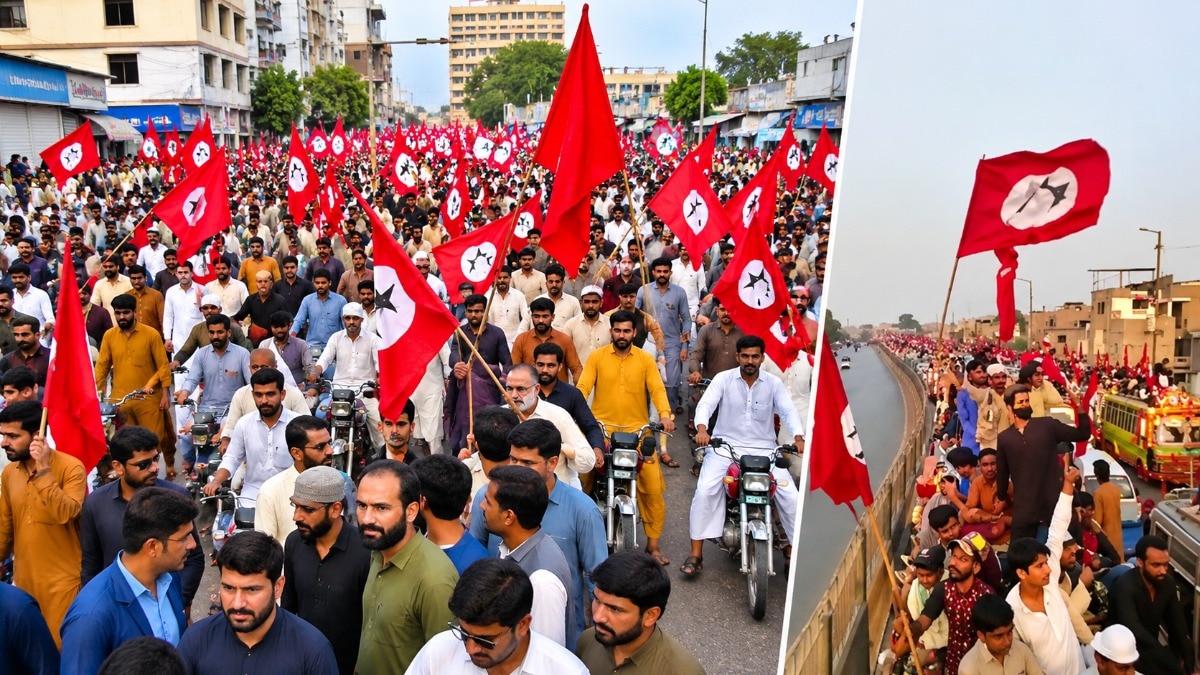
Loaded on colourfully painted Pakistani buses and sporting traditional Sindhi ajrak scarves and caps, thousands of Sindhi nationalists took to the streets of Pakistan's commercial capital, Karachi, against the proposed division of Sindh, a move by the Asim Munir-led military establishment to carve new provinces out of the existing ones. Sindhi nationalist outfit Jeay Sindh Muttahida Mahaz (JSMM) threatened an economic blockade of Punjab, Pakistan's most populous and politically powerful province, even as its members chanted pro-Sindhudesh slogans, saying Sindh's integrity was "non-negotiable".Not just in Karachi, protests have erupted across Sindh. Nationalist outfits and their leaders have accused Pakistan Army chief, Field Marshal Asim Munir, and the Punjab-dominated establishment of "conspiring to fragment their homeland". With more protests lined up and rival camps planning simultaneous rallies, fears of a confrontation on Karachi's streets are growing.Protests in Sindh erupted after Munir's aide and Pakistan's Interior Minister Mohsin Naqvi floated the proposal of creation of new provinces in Pakistan. Opposition to the proposal intensified after Bilawal Bhutto-Zardari, the chief of the Sindh-centric Pakistan Peoples Party (PPP), warned the Shehbaz Sharif-led federal government, of which his party is a part, against any attempt to divide Sindh. He said the move could result in people of Sindh taking up arms and bloodshed on the streets of Karachi and Hyderabad.While Pakistan currently has four provinces, Planning Minister Ahsan Iqbal has spoken of increasing their number to between 12 and 15. Defence Minister Khawaja Asif said on November 22 that the discussions on a referendum could take concrete shape by the end of 2026. Sindhi nationalists argue that Sindh is not just a province or an administrative unit of Pakistan. It's their historical homeland with a distinct civilisation, language and cultural identity that predates the creation of Pakistan.The fresh demand for an independent Sindhudesh comes less than a year after pro-independence demonstrations during Sindhi Culture Day on December 7, 2025, reportedly led to clashes with security personnel in Karachi. Sindhudesh is a proposed independent secular homeland for the Sindhi people, a demand championed by nationalist leader GM Syed in the aftermath of Bangladesh's creation in 1971, seeking Sindh's separation from Pakistan.SINDHI NATIONALISTS HIT STREETS, PROTESTS SPREAD ACROSS SINDHThousands of demonstrators carrying red flags marched through Karachi on Sunday (November 22) under the banner of the Jeay Sindh Rahbar Committee (JSRC), a coalition of four Sindhi nationalist parties, Pakistani newspaper Business Recorder reported.The march was led by Jeay Sindh Mahaz chairman Riaz Ali Chandio, Niaz Kalani and other nationalist leaders. Lawyers and civil society representatives also joined the demonstrations, which prompted the temporary closure of several roads in Karachi.The leaders rejected the proposed referendum, arguing that it could be used to legitimise a predetermined decision on Sindh's division. They also clarified that their campaign was not directed against Urdu-speaking residents or other ethnic communities, Pakistani newspaper Dawn reported."Today, Sindhi nationalist political parties are holding a march against the creation of new provinces and administrative units. Whenever Islamabad tries to change Sindh's demography, Sindhis have always reacted against it. Sindhis have never let Islamabad divide Sindh," Pakistani journalist and activist Veengas said in a social media post.Pakistani journalist Qazi Asif described the mobilisation as a "peaceful protest on the roads of Karachi against division of Sindh."The Karachi march took place days after demonstrations were organised in other cities and towns of Sindh like Hyderabad, Nawabshah and Larkana, The Express Tribune reported.On November 21, another protest against Sindh's proposed division was held in Mehar, a town in Sindh's Dadu district."The massive and enthusiastic participation in last night's Mehar Jalsa against the conspiracies to divide Sindh is a powerful message of resistance, unity and political awareness. The people of this small town, Mehar, have demonstrated that Sindh's integrity is non-negotiable," Pakistan Supreme Court advocate Ayaz Latif Palijo wrote on X.Separately, the Jamiat Ulema-e-Islam-Fazl (JUI-F) staged demonstrations in Karachi and several districts, including Sukkur and Jacobabad, on November 22. Its Sindh leader, Rashid Mehmood Soomro, suggested that Bilawal, Maulana Fazlur Rehman and Sindhi nationalist parties could come together to oppose Sindh's division.Of late, JUI-F chief Rehman has sharpened his criticism of the Shehbaz Sharif-led government and the military establishment. Since the imposition of Governor's Rule in Khyber Pakhtunkhwa in October, Rahman has doubled down on the criticism. Rehman has also accused the establishment of interfering in politics and alleged that his party leaders were being threatened with corruption cases for refusing to join the federal government.SINDHI NATIONALISTS SLAM MUNIR, THREATEN PUNJAB BLOCKADEBeyond the opposition to Sindh's partition, allegations of economic exploitation and political subjugation by Punjab also featured in the nationalist mobilisation.According to a report by news agency ANI, citing a press release from the organisers, nationalist leaders accused Munir and Punjab of using the proposed administrative restructuring to undermine Sindh's territorial integrity.They also accused the Pakistani establishment of taking over millions of acres of agricultural land, coastal islands and the province's oil, gas and coal resources.The JSMM, whose activists participated in the Karachi rally despite the outfit not being a constituent of the JSRC, announced plans for an economic blockade of Punjab.The outfit also announced that its campaign against Sindh's division would be expanded into a movement for the complete independence of Sindhudesh, ANI reported."Sindh is not Pakistan," said Shafi Muhammad Burfat, the Germany-based chairman of the JSMM."The Sindhi nation rejects Pakistan as an unnatural state, a Punjabi colonial occupation, and every conspiracy by the deceptive Punjabi military to divide Sindh. It appeals to the world, the United Nations, and the international community to support the independence of Sindhudesh, its homeland. Sindh is not Pakistan; the national restoration of Sindhudesh is the fundamental objective of the Sindhi nation's struggle," Burfat said on X.WHAT IS PAKISTAN'S PROVINCE-SPLITTING PLAN?The debate and row over Pakistan's administrative restructuring started gathering momentum after Mohsin Naqvi advocated the creation of smaller administrative units at the Pakistan Economic Summit in Islamabad.While Naqvi suggested holding a referendum, Bilawal hit back, warning against bypassing constitutional procedures.The PPP, which has governed Sindh continuously since 2008, fears that the province's division, particularly the separation of Karachi, could weaken its political stronghold and economic clout.While the PPP is opposing Sindh's division, its provincial rival Muttahida Qaumi Movement – Pakistan (MQM-P), also an ally of the ruling Pakistan Muslim League-Nawaz (PML-N), is supporting the proposal of carving out new provinces.However, no agreed map of the proposed provinces or draft constitutional amendment has been made public.While the protests in Sindh have largely remained peaceful so far, the possibility of confrontation looms. With another major nationalist march scheduled for November 29 in Karachi, the MQM-P are planning a rally on the same day in support of new provinces, and Sindhi nationalists threatening an economic blockade of Punjab. Pakistan's province-splitting row risks escalating into a wider confrontation.- Ends
Thousands march against Munir's split-Sindh plan, demand independent Sindhudesh
Full Article
Original Source
Read the full article at Indiatoday →KhanList aggregates and links to publicly available news content. We do not host full articles from third-party sources. Always verify important information with original sources.