
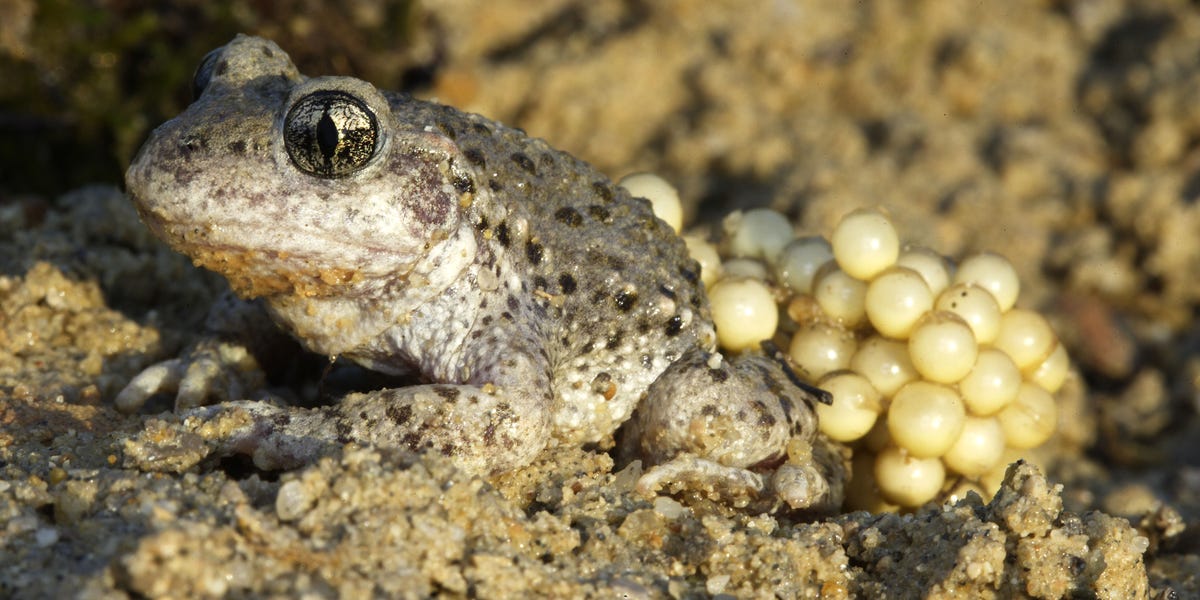
7 min readAustrian biologist Paul Kammerer conducted groundbreaking experiments on inheritance of acquired characteristics before his 1926 death, which followed accusations that he’d fraudulently altered a midwife toad specimen.Kammerer’s reputation was destroyed by the toad scandal orchestrated by rival William Bateson, though modern epigenetics research has largely vindicated his controversial evolutionary theories.A Jewish leftist scientist in antisemitic Vienna, Kammerer may have been the victim of a deliberate frame-up conspiracy rather than an actual scientific fraudster, according to recent biographical research.The midwife toad (Alytes obstetricans) is an odd creature. The toads mate on land, after which the male carries around his mate’s fertilized eggs atop his rear end in a spectacularly visible manner, which is how the species gets its moniker. Because the midwife toad mates on dry land, males lack the bumpy “nuptial pads” that are characteristic of aquatic toad species that need to grasp their mates while they do the deed.This odd toad lent its name to the English edition of a 1971 book called The Case of the Midwife Toad by the celebrated British-Hungarian novelist Arthur Koestler. This short nonfiction work is about a famous scientist whose name, quite against his own will, became indelibly associated with that odd toad species. But according to Koestler, the whole scandal was based on misrepresentations, and maybe even a malicious conspiracy.In any case, for the Austrian biologist Paul Kammerer, the association proved fatal.On September 23, 1926—exactly 100 years ago—Kammerer died by suicide in a wooded area near Vienna. In a note he left behind, he complained of what he considered unjust treatment by his scientific colleagues. The historical record suggests he had reason to feel wronged.About six weeks before Kammerer’s death, a pair of articles in Nature revealed that a dead specimen of a midwife toad from his laboratory had been artificially made to look, through injections of India ink, like it possessed nuptial pads on its feet. The implication was that Kammerer had created the fraudulent specimen to demonstrate the inheritance of acquired characteristics—a theory known as Lamarckian evolution for its early proponent, Jean-Baptiste Lamarck (1744-1829).In several notable scientific publications over the previous few years, Kammerer had reported breeding midwife toads for multiple generations in a watery environment to produce physical features that normally only appear in aquatic toads. Kammerer claimed that after five generations, midwife toad specimens with nuptial pads began emerging inside his lab at the Vivarium in Vienna’s Prater park.Ironically, Kammerer himself repeatedly indicated that he considered the case of the midwife toad irrelevant to proving the theory of the inheritance of acquired characteristics. But as Kammerer explained in a 1923 lecture to the Cambridge Natural History Society, it was entirely possible that the midwife toads he bred in water weren’t producing a genuinely new, acquired characteristic at all. Since the midwife toad was thought to have descended from ordinary water-mating toad ancestors that did have nuptial pads originally, forcing the midwife toads back into water probably wasn’t producing a new, acquired characteristic at all. Instead, it might have been a simple case of atavism—the sudden reappearance of a remote ancestor’s characteristic.Kammerer considered his previous, well-documented research with salamanders, sea squirts, and the blind cave newt to be much more robust demonstrations of inheritance of acquired characteristics. Those cases couldn’t be explained as some form of atavism, and his work on those creatures dated to before the start of World War I. The controversy around Kammerer’s work began instead in the atmosphere the Great War, in the white-hot furnace of the ideological battle between the newly-formed schools of neo-Lamarckism, popular with Europe’s left-wing idealists and revolutionaries, and neo-Darwinism, which deployed the logic of Mendelian genetics to explain the random mutation of the germ cell line as the primary driver of natural selection.Unfortunately for Lamarckism, it was heavily supported by the then-nascent Soviet Union, and thus was drawn into the losing side of an ideological battle that lasted most of the 20th century. To the proponents of the Soviet party line, the idea that your environment could affect the genes your kids inherit was red meat. So in the heated atmosphere of post-WWI ideological conflict, evolutionary science became embroiled in vitriolic public debates. Perhaps not coincidentally, shortly before his death, Kammerer had accepted an invitation to build and direct a biological research institute in Moscow under the wing of Ivan Pavlov, of Pavlov’s dogs fame. Kammerer had already begun packing up his lab equipment in Vienna for the move, visited the Soviet legation days before his death to arrange the shipment, and was due to leave for Moscow within days when he shot himself instead.In the mid-1920s it wasn’t necessarily surprising to see the famous inventor of the field of genetics, the English biologist William Bateson, become the animated antagonist of Paul Kammerer, a man known for breeding wonderful lizards in a lab building in Vienna’s most delightful park. Bateson fixated on the midwife toad and elevated it into the central scientific battleground precisely because he’d completely failed to breed the toads in his own lab. His failure convinced Bateson that he’d found Kammerer’s weak point to attack.Every biologist who ever came into contact with Paul Kammerer, including his adversaries like Bateson, testified that he possessed a splendid ability to care for and nurture lizards and reptiles that other scientists couldn’t breed. This talent was, according to Koestler, a reflection of an intense affection for animals of all kinds. Kammerer grew up with three much older stepbrothers who doted on him from infancy. Charley, in particular, was an expert trainer of Alsatian dogs, and he passed his animal-handling skills on to young Paul, nurturing a gift that later extended to the snakes, frogs, and toads that Kammerer worked with professionally. As an adult, Kammerer had a famously complicated love life, which included an affair with the famous Alma Mahler. But during his first marriage to Baroness Felicitas Maria Theodora von Wiedersperg, he lived in a kind of animal-lover’s paradise that reinforced his childhood tendencies. His father-in-law kept snakes, monkeys, a bat, a squirrel, and a pet stork on a country estate where Kammerer and his wife spent a great deal of time joyfully interacting with the animals.However, the greatest love of Kammerer’s life, at least as a biologist, were the lizards of the Dalmatian islands off the coast of Croatia. It was on the sun-soaked, uninhabited islands off Dalmatia that Kammerer’s gift took full flight. There, he collected lizards himself instead of buying them from a dealer’s crate, because a cowed and overfed captive lizard that had forgotten how to be wild couldn’t be coaxed to breed in his lab. Kammerer’s whole goal was to breed the lizards in environments that were radically different from their natural ones, so they had to be robust and well-cared-for. On the beautiful Dalmatian islands, Kammerer came to know the lizards the way a shepherd knows his flock. On the bare Adriatic rocks near the shore, he grew closer to his animals than he ever managed to get to most of the humans who later sat in judgment of him. When his prized collection of lizards died during the deprivations of World War I, Kammerer was emotionally crushed.aaron007//Getty ImagesA Dalmatian wall lizardKammerer never deliberately chose to bet his reputation on the midwife toad. He actually staked it on salamanders that swapped their birth method between water and dry land, on sea-squirt siphons that grew longer with each cut, on a blind cave newt whose eyes reopened under red light. He consistently emphasized that those were the cases that mattered, since they couldn’t be explained as the return of recessive traits that their ancestors had been carrying all along. History remembers Kammerer for the midwife toad because that’s what William Bateson, having failed to breed a single water-mating toad himself, picked a fight over. Whether Kammerer injected the ink into the specimen in question, or someone else did so, is still a matter of debate. But at least one researcher has proposed that Kammerer was the victim of a conspiracy. Klaus Taschwer’s 2016 biography argues the frame-up had an antisemitic dimension, tied to Kammerer’s identity as a Jewish leftist in an increasingly antisemitic Vienna.In the 21st century, advances in epigenetics have permitted a kind of retrospective reevaluation of Paul Kammerer’s central ideas, and on balance, the verdict is positive. Certainly, modern science hasn’t validated the strange idea, often attributed to people with views like Kammerer’s, that chopping off a mouse’s tail for five generations will result in the sixth generation being born without a tail. That caricature has little to do with the types of phenotypic variations that Kammerer reported. A wild specimen of the midwife toad with nuptial pads was independently documented in 1924, and in 2017, a scientific reappraisal found that Kammerer’s research is consistent with epigenetic mechanisms that scientists didn’t begin to understand until decades after his death. As the authors of that study put it, “Kammerer’s experiments do not contain any phenomenon that cannot be explained by currently known experiments and epigenetic mechanisms.”Finally, the midwife toads that Kammerer bred showed something called a parent-of-origin effect, which means that a trait’s expression in offspring depends on which parent transmitted it. In 1911, scientists didn’t know of any genetic mechanisms that could explain such an effect. We now call it genomic imprinting, and it’s a commonplace textbook phenomenon.The scientific debate about how the experiences of organisms might influence their germ line has survived for more than a century now. But the man who could coax a wild lizard from a bare Adriatic island into breeding in his Vienna lab couldn’t survive the hostility of his own species. The ink in the midwife toad’s toes wasn’t necessarily Kammerer’s, but it destroyed his reputation—and his life.If you or someone you know is experiencing a mental health crisis or having thoughts of suicide, call or text 988 to reach the 988 Suicide & Crisis Lifeline, or chat at 988lifeline.org. Support is available 24/7.Shawn Gorman is Deputy Editor of News for Popular Mechanics. Before joining Pop Mech, he specialized in academic reading for educational testing. His diverse academic background also includes time spent as a lecturer and librarian at institutions such as the University of Kentucky, SUNY, and Harvard University. Shawn holds a Ph.D. in Modern Foreign Languages and Literatures from Boston University, an M.A. from The Ohio State University, and a B.A. in History from the University of Oregon. His favorite subjects to explore include computer science, physics, math, and biology. He lives on a medium-sized cat ranch in Easton, Pennsylvania, with his wife and two daughters.
This Weird Toad Drove a Brilliant Scientist to His Death. What If He Was Framed?
Full Article
Original Source
Read the full article at Popularmechanics →KhanList aggregates and links to publicly available news content. We do not host full articles from third-party sources. Always verify important information with original sources.