
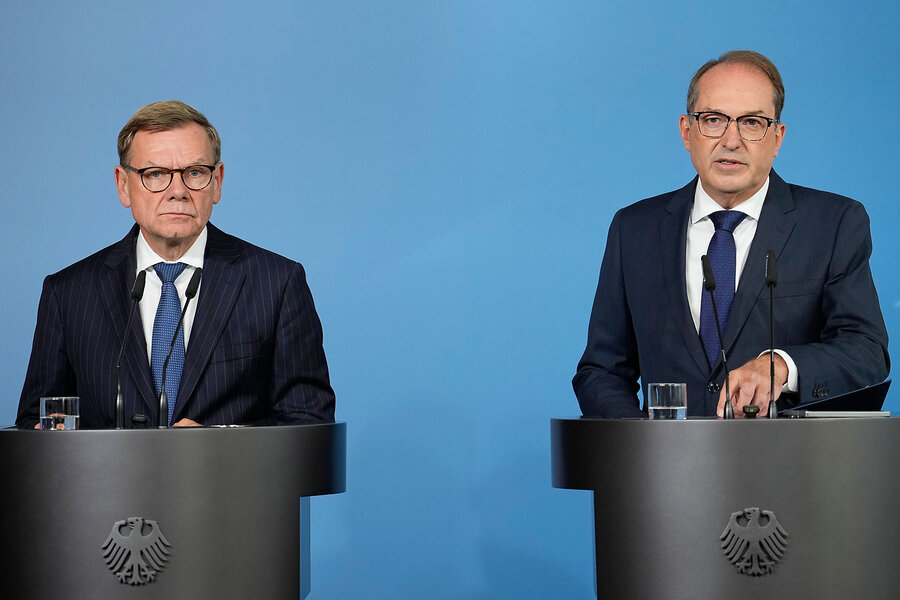
The German government did something Wednesday it has so far largely avoided. It pointed a finger at Russia.Russia and the West have basically been in a low-level conflict since Soviet days, but things have ratcheted up in recent years, particularly regarding the war in Ukraine. Disinformation campaigns, cyberattacks, cutting cables on the Baltic Sea floor, and other acts of sabotage are well-worn parts of the “hybrid warfare” playbook – not quite open warfare, but causing a serious security threat.The discovery of two drones near Leipzig/Halle Airport in August pushed Germany over the edge. One laden with explosives appeared to be targeting a Ukrainian transport plane. Another was found days later in a field near the airport. On Wednesday, German officials blamed Russia. Why We Wrote This Germany has been wary of calling out Russia’s hybrid warfare in Europe in case doing so exacerbated tensions. But the discovery of two suspected Russian drones in Leipzig last month proved the last straw for Berlin. It crossed a threshold of sorts. Germany has long attributed such attacks to vague foreign powers. The accepted wisdom in such cases is not to overreact, which could make things worse.The fact that Germany dialed up its response speaks to the rising threat. Russia responded by closing Russian branches of the Goethe Institute, a German cultural organization.The language, too, became spicier. German officials accused Russia of “open hostility” and said “Germany will defend itself.” Even the British government reacted to the Leipzig incident, summoning Russia’s top diplomat Thursday “to condemn the attack in the strongest terms.”“We’re at a moment when [this kind of attack] becomes attractive for a lot of reasons,” says Ian Lesser, a security analyst at the German Marshall Fund of the United States in Brussels.It allows Russia to test its ability to recruit individuals who can carry out such operations. But perhaps more important, it is a way of stoking a sense of fear and instability in the West.“A lot of it is simply about keeping strategic opponents on edge,” Dr. Lesser says. Russia is trying to impose a “cost of supporting Ukraine.”While Russia’s intentions are always opaque, experts do not see any grander strategy to invade Europe. But there is a danger to hybrid operations, shown by the German response this week. Escalation might not necessarily be in Russia’s best interest, given how it is tied down in Ukraine.The best answer, says Dr. Lesser, is for NATO allies to improve surveillance. “Understanding more about what is going on is the beginning of wisdom.”
This week, Germany stopped putting up with Russia’s hybrid war
Full Article
Original Source
Read the full article at Csmonitor →KhanList aggregates and links to publicly available news content. We do not host full articles from third-party sources. Always verify important information with original sources.