
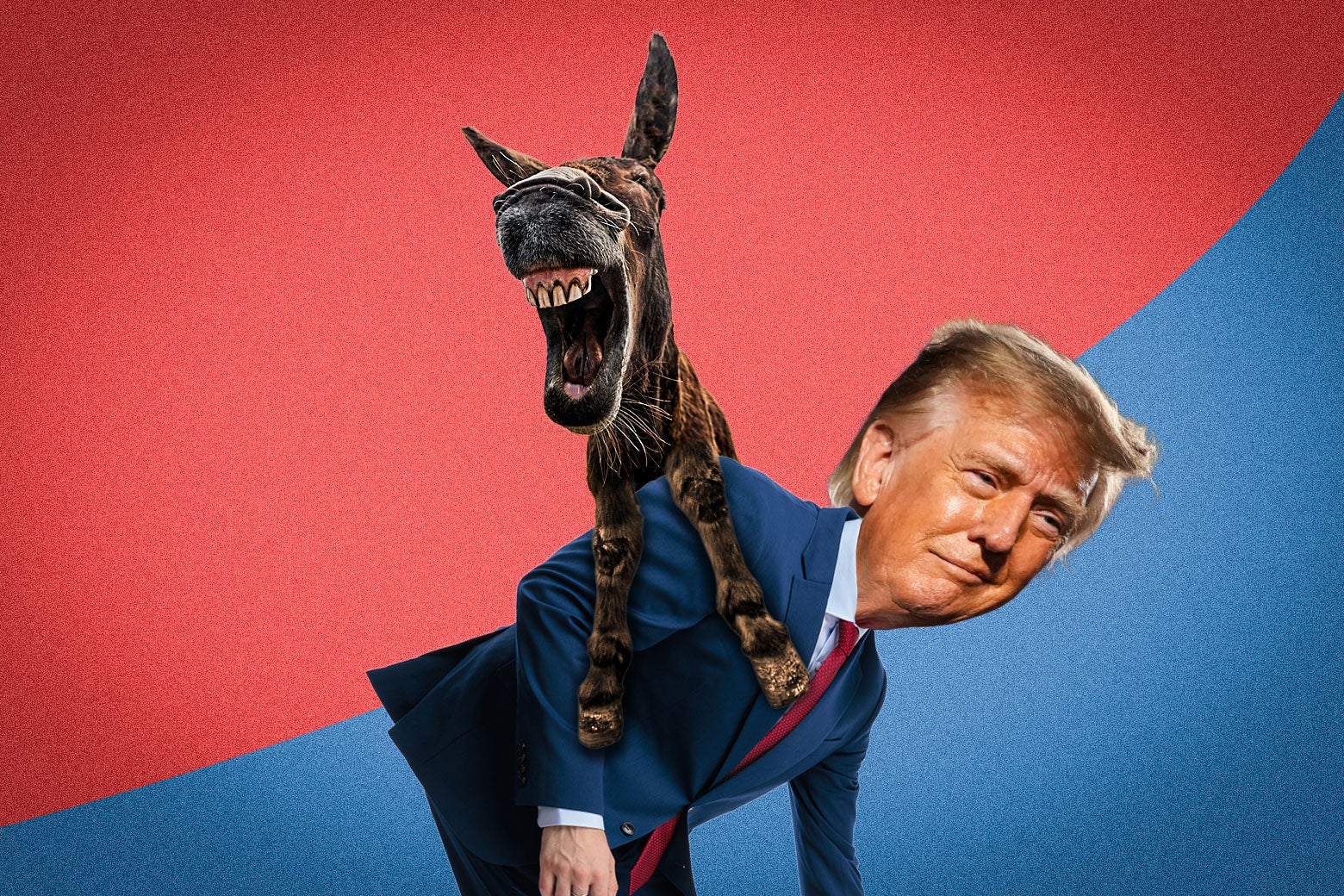
Politics How Did We Get Here? Two years ago, Democrats were at rock bottom, and saw little hope of retaking the Senate in 2026. Now, they’re favored to win. What exactly happened? Photo illustration by Slate. Photos by Andrew Harnik/Getty Images and Getty Images Plus. Sign up for the Slatest to get the most insightful analysis, criticism, and advice out there, delivered to your inbox daily. Shortly after their 2024 disaster, Democrats couldn’t even console themselves with thoughts of 2026. The House might have been in play, but they were facing a brutal Senate map—one that made it hard to see them picking up many seats even if voters had soured on the party in power. The only Senate Republican up for reelection in a state won by Kamala Harris was Maine Sen. Susan Collins, and Collins is famous for her inability to lose. The next best opportunity was North Carolina Sen. Thom Tillis’ seat, but Democrats hadn’t won a presidential or Senate race there since 2008. After that? Bupkis. Once-swing states like Iowa, Florida, and Ohio had become red states. Texas hadn’t been blue once this century, and retreated into safe GOP status in 2024. Plus, Democrats would have to defend Democratic seats in Georgia and Michigan, two states Trump won in 2024. Now, one day before the 2026 midterms, Democrats don’t just have an opportunity to net the four seats they need to retake the Senate majority. They’re actually narrow favorites to do so, according to election forecasters. Democrats hold delicate polling leads for Republican-held seats in Maine, Texas, Ohio, Alaska; are neck and neck in Iowa and Kansas; and are throwing a few bucks South Carolina and Mississippi’s way in the event of a generational night. On the defensive side, Democrats’ biggest threat of losing a Democrat-held seat is in the tight Michigan contest. And, by all accounts, Jon Ossoff has put the Georgia Senate race to rest, as has Gov. Roy Cooper in North Carolina’s Senate race. That Democrats have this good of a shot at the Senate majority isn’t something they would have believed two years ago—or a year ago, or six months ago, or even three months ago. It is, however, just a shot. A 2- or 3-point polling lead in any of these improbable states is within the margin of standard polling error. There’s a world in which Democrats outperform their own incredible polling, and the evening resembles the biggest landslide since the 2008 election. But there’s another in which they underperform it, even modestly, as red states revert to their partisan lean in the end. It could either be a historic night for Senate Democrats or a night with a historic number of impressive but close losses. Still, if you would have offered Democrats these odds in 2024, they would have scrambled for them. So how, then, did Democrats get in this unlikely position? For the most part, Donald Trump put them there. We’ve never seen a president do less to help his own party heading into an election, with so little to show for it, than Donald Trump has. There are 6 or 7 million instances we could recite in which Trump has done the opposite of attempting to help his party win, but the two defining policy moves of his second term (so far) are directly responsible for the creation of this map. Trump weaponized (and at times exceeded) powers ceded by Congress to both blanket the globe with tariffs and threaten countries whose foreign leaders were mean to him with additional levies. This has raised prices under a president who won the 2024 election on his promise to bring prices down. The pain has been especially acute in farm country, which can’t export its products due to retaliatory tariffs; the U.S. auto industry, whose supply chain is closely integrated with that of Canada; and both northern and southern border states. We refer you, again, to the map of Senate battlegrounds. Whoops. And then, of course, there’s the war in Iran, a major conflict the president launched after running on a pledge of no more forever wars. Aside from increasing gasoline prices for everyone, it spiked diesel and fertilizer prizes, placing yet another burden on rural America. It has resulted in the death and injury of Americans abroad, and caused a rift in the Republican coalition between more traditional hawks and MAGA isolationists. It’s also a war that has not, at the present time, been won by the United States. These issues make the 2026 midterms such a different beast than the midterms of Trump’s first presidency, in 2018. In 2018, the economy was pretty good, and Trump’s approval rating on his handling of the economy wasn’t half bad, either. Those midterms centered around some material factors—the attempted repeal of Obamacare, for example. But so much more of it was a reaction to Trump’s very presence in the White House, and the shock of his behavior, and his tweeting. That revulsion allowed Democrats to pick up 40 House seats largely concentrated among suburban, college-educated voters drifting away from the MAGA-fied GOP. But it didn’t spread into red America—especially with the Brett Kavanaugh confirmation fight that fall firing up Republican base voters—and the GOP that year flipped Democratic Senate seats in North Dakota, Missouri, Indiana, and Florida. This year, Trump’s approval over his handling of the economy is in the low 30s, while his overall approval rating is only 5 or so points better. It’s much more fertile ground for Democratic gains across blue, purple, and red America than would be a campaign against Trump’s poor manners. “The president is making it harder to pay your bills” is also a more effective line of attack than—valid as they may be—highfalutin arguments about Trump’s threats to democracy and the Constitution. But Trump’s behavior has not been entirely excised from Democrats’ message. Instead of emphasizing his foulmouthed tweets, Democrats are marrying a populist corruption argument with their broader criticism of the economy: that while you are suffering, Trump and his allies are enriching themselves. Corruption, according to some recent polls, has joined the economy as voters’ most pressing issue. Democrats were able to meet this opportunity in red states with quality recruits. The North Carolina Senate race has effectively been over since Democratic Gov. Roy Cooper entered it. The only Democrat who’s won an Ohio Senate race this century, Sherrod Brown, opted to run again. The only Democrat to win a federal election in Alaska since 2008, Mary Peltola, was also convinced to run for Senate instead of governor. (We’ll put a slight asterisk on the quality of the overall effort to elect Peltola in light of recent news developments.) Democrats landed friendly and compelling preacher types in Kansas and Texas, and a moderate Paralympian in Iowa. Party leaders failed to get their preferred candidates in Michigan and Maine—a purple and a blue state, respectively—but the anti-GOP atmosphere may well carry Democratic nominees Abdul El-Sayed and Troy Jackson to victory. (Of course, things got more complicated Sunday for El-Sayed when his primary appointment retracted her support and endorsed his Republican opponent.) So Democrats got the environment, gift-basketed to them by Donald Trump. They got the message. They got the candidates. How gettable, really, is the Senate majority? We need to reemphasize how tall an order this is, and the amount of ground Democrats need to make up relative to 2024. That year, Trump won Iowa by 13 points, Ohio by 11, Kansas by 16, Alaska by 13, and Texas by 14. All of those numbers are just on the cusp of what Democrats’ advantages in the national environment, candidate quality, and messaging will allow them to reach. If polls are underestimating GOP turnout in these states even a little bit—or not able to capture a last-minute GOP awakening—Democrats could be in for an agonizing night of close misses. Trump has brought Democrats back from how far they’d fallen in 2024. Now it’s just a question of whether they can breach the walls that two years ago seemed impossibly high. Democrats Donald Trump Elections Iran Senate 2026 Midterms
This Wasn’t Supposed to Be Senate Democrats’ Year. Here’s What Changed.
Full Article
Original Source
Read the full article at Slate →KhanList aggregates and links to publicly available news content. We do not host full articles from third-party sources. Always verify important information with original sources.