
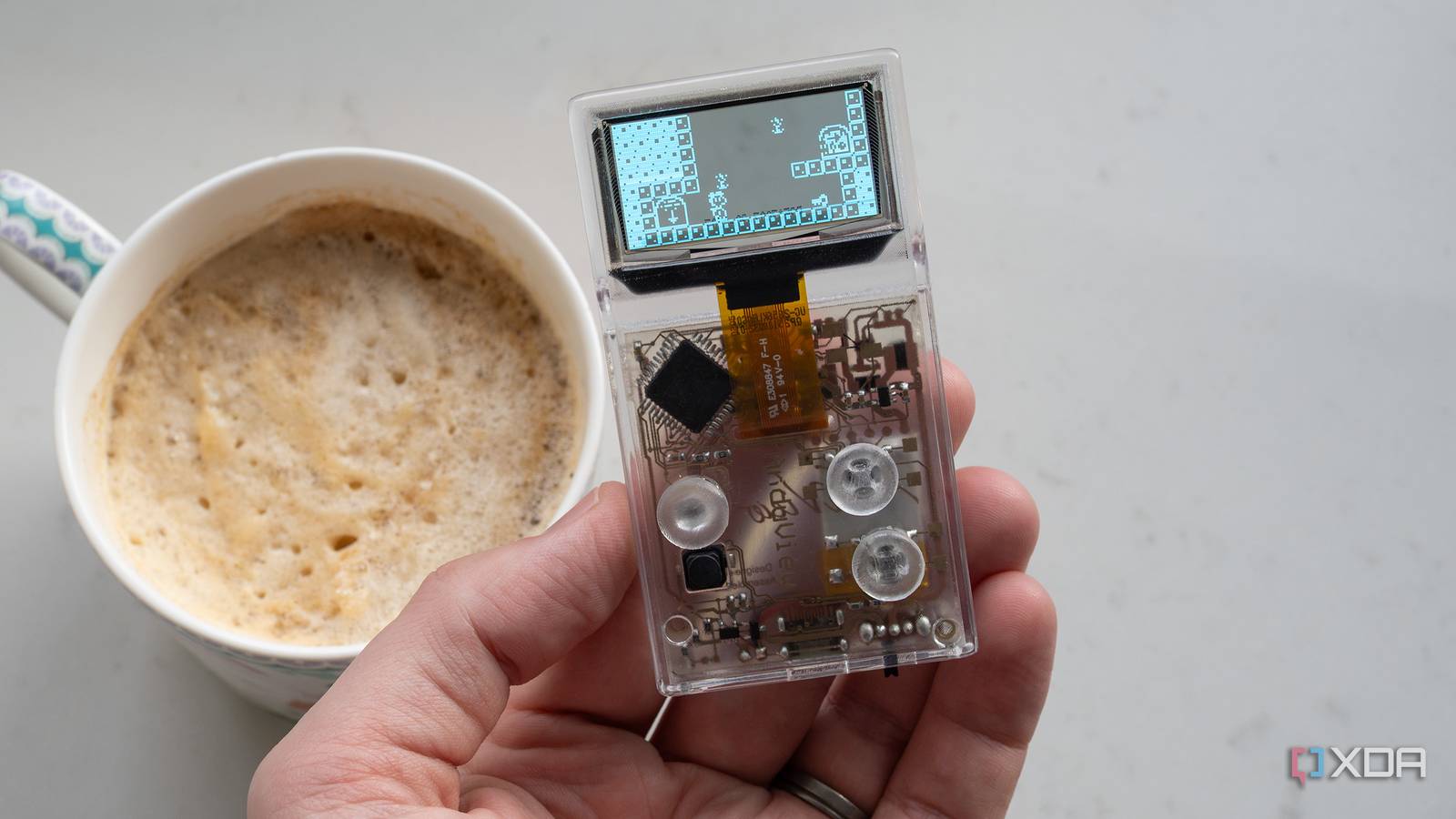
Published Nov 26, 2026, 11:30 AM EST Patrick O'Rourke is XDA's News Editor and Entertainment Segment Lead. Previously, he was Pocket-lint's Editor-in-Chief, the Editor-in-Chief of Canadian tech publication MobileSyrup, and earlier in his career, he worked as the technology editor at the Financial Post and Postmedia. He's based in Toronto. Over the past 15 years, he's written thousands of articles. Patrick has also interviewed dozens of tech industry executives and covered GDC, E3, Gamescom, WWDC, Apple keynotes, Samsung Unpacked events and more. Patrick has a BA in journalism from Toronto Metropolitan University. I'm a sucker for gaming handhelds, especially if they have some sort of retro appeal to them, so when an email from the team at Arduview landed in my inbox, I knew I needed to check out the portable. In a homage to the 90s and early-2000s, the tiny Arduview is entirely translucent, similar to ModRetro's M64. It also takes things to another level because its actual display is see-through. Wild, right? The team behind the handheld calls the Arduview the world's first transparent game console, even going so far as to display that claim on the handheld's boot-up screen. While that might not be 100% true, given you can't see through every component that makes up the gadget, it's still an undeniably unique looking device. Along with its 1.51-inch 128 x 64 pixel resolution display, even the main PCB board and joystick buttons are translucent. I've had the Arduview for a few weeks now, and it's just a joy to hold in my hand, or even to look at from across my desk. I seriously can't get enough of this thing The Arduview is easy to slip into a pocket and take on the go The main draw here beyond the cool-looking design is the translucent 1.51-inch display. It's obviously super low resolution, but the pre-installed games are simple enough that they feel right at home on the miniscule screen. It's also easy to see in various lighting conditions, despite being mostly see-through, which surprised me. There's a thin line of what appears to be adhesive near the bottom of the display that I found distracting, so I hope this gets removed in the final version of the handheld (I was sent a pre-release build). It's also worth noting that all the visuals are blue, in the same way that Nintendo's ill-fated Virtual Boy outputs entirely red graphics. I think this looks kind of cool and that it makes games pop in a unique way on the Arduview's translucent display, but I can see some people taking issue with the lack of any color. Other key specs include an 8-bit ATmega32U4 chip, a 120mAh battery, and a USB-C port for charging. There's no 3.5mm audio jack, but there will be a built-in speaker (it didn't work on the pre-production unit Arduview sent me). The tiny handheld also weighs just 0.1lb (50g) and is roughly the size of a credit card, making it easy to slide into my pocket and take on the go. Overall, it's just a really cute-looking handheld. On the game side, the Arduview features the same built-in titles as the Arduboy, a more traditional handheld that looks like a Game Boy. Most of the 300 games are pretty simple, which makes sense given the handheld's small screen and limited hardware power, but a few have actually caught my attention in a way I didn't expect. The built-in games are simple time killers Don't expect to find deep video game experience on the Arduview First, there's Hopper, a game played from an up-down perspective that has you jumping between what seems to be trampolines. There are also more traditional platformers like The Crawl, which features a surprising amount of detail for such a small screen, along with snappy controls. Other games like Circuit Dude are homebrew takes on known arcade-style games like Chip's Challenge. The games I've tried so far are pretty surface-level, but they're fun for killing time and have actually kept me from doomscrolling on my phone a little less. One key issue I've encountered so far is that the Arduview's buttons don't feel great. They're loud, stiff, and surprisingly inaccurate. I'm hoping this gets fixed before the final version of the handheld ships to buyers, because it would definitely get me using it more. The team behind the project says they're working on improving the buttons before the handheld ships to backers. The Arduview is currently available on Kickstarter for $74 with early-bird pricing, with a retail price of $149. The campaign has raised $38,600, and it ends on December 8th.
This tiny retro handheld makes me wish translucent tech had never gone away
Full Article
Original Source
Read the full article at Xda-developers →KhanList aggregates and links to publicly available news content. We do not host full articles from third-party sources. Always verify important information with original sources.