
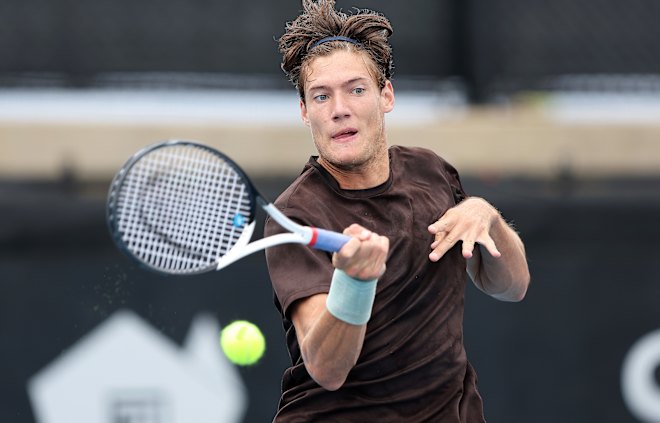
November 1, 2026 — 5:00amThis is not the Matthew Dellavedova you probably know of.But this Matthew Dellavedova, the tennis player – not his NBA championship-winning cousin, who he has never met or spoken to – is becoming known in his own right, without LeBron James as his teammate or the money to hire a coach.Matthew Dellavedova has broken into the top 240 in the world.Getty ImagesThe 26-year-old from Wonga Park, a leafy suburb about 30 kilometres north-east of Melbourne, during the week in Tamworth became the first player since Ivan Lendl 44 years ago to record at least 100 match wins in the same season.Dellavedova’s tally includes 98 main-draw victories and nine of his 13 career titles, including slashing almost 300 spots off his ranking to reach a career-best No.237.All this after losing five of his first six matches in January and watching his ranking sink to 530.Dellavedova has enough perspective not to compare himself to Lendl, whose 1982 season included a 44-match winning streak amid a remarkable 107-9 win-loss record on the ATP Tour.The Victorian has instead mostly toiled away on the lower reaches of the tour – from $15,000 tournaments up to Challengers – but no one can begrudge the results that have transformed his tennis life and put him on track to make Australian Open qualifying.“It’s pretty cool. At the start of the year, or even recently, I hadn’t really thought about the match wins, and it’s obviously at a different level, so I understand it’s hard to be put in the same sentence as Lendl,” Dellavedova told this masthead.“But I can also acknowledge that it’s been a very successful year … considering [winning 102 matches is] something no one has done since Lendl.”In an unforgiving sport where players spend months overseas at a time trying to bankroll themselves – while pushing the limits physically – Dellavedova has had one week off all year.And he wouldn’t have it any other way.A self-professed recluse, Dellavedova parked himself in Asia for five consecutive months mid-year, competing in China, Thailand, Japan and South Korea.Far from the riches that Jannik Sinner, Carlos Alcaraz and co. play for, those in Dellavedova’s position – the journeymen hoping to one day join the elite – need to be frugal with their money.“The biggest thing for me when I’m in Asia is I will have an outrageous amount of rice,” he said.“The best thing about Asia is at basically all restaurants, they have stations of rice in there for free, included within the meal. I’ll have white rice and chicken as a go-to, or within south-east Asia, I get a lot of beef pho … it’s just rinse and repeat.”That type of penny-pinching has helped keep his financial outlay, including accommodation and racquet stringing (he does his own), to about $50,000 – roughly the same as the average annual mortgage in Australia.To put Dellavedova’s situation in perspective, he has pocketed barely $75,000 prizemoney despite his mountain of wins. It is why he remains reluctant to take the plunge and hire a coach.But a reward may be on the horizon. Dellavedova’s ascending ranking – assuming he can maintain it – means he could contest qualifying at all four grand slams next year.Dellavedova hopes to contest all four grand slams next year.Getty ImagesHe would have scored more than $40,000 for losing in the first round of Australian Open qualifying this year, and more than double that if he reached the third and final round.“Essentially, the slams are the closest thing tennis players get to a contract. It’s the first real breathing room you have because you get a big injection of cash,” Dellavedova said.“I was talking about it with some of the other players; about how tennis changes only once you get to that top-240 mark because that’s when you get into slam cuts.“Everything else is more about opportunity. You’re giving yourself an opportunity to be seeded or get into draws, but getting into the slams gives you that financial freedom to make choices that you otherwise wouldn’t be able to make.”Rising tennis talent Matthew Dellavedova and his basketballing namesake. Getty ImagesIt is a lonely existence compounded by crippling pressure and self-doubt, which Dellavedova said was ever-present.“Whatever you do, you don’t have that feeling of progression,” he said.“It’s almost like you push so hard for so long, but you’re never satisfied. Complacency is a sin. You’re always trying to strive for more. But in that regard, having those doubts makes me push harder and stay humble.”A two-time junior Australian champion, Dellavedova never contemplated doing anything else with his life.His father, Peter, was a professional tennis player who went head-to-head with the likes of John McEnroe and Pat Cash – and now runs the Dellavedova Tennis Academy with another of his sons, Andy, in Wonga Park.Dellavedova was travelling overseas for tournaments by age 14, and school became a distant second priority as he chased his dream.“I knew from basically when I was eight that this is what I wanted to do. I was obsessed with it,” he said.“Not only was I hitting all day, but I would come home and watch tennis all night. It’s also a burden when you’re so ambitious … but that’s how I function as a human, to just constantly be at it.”News, results and expert analysis from the weekend of sport sent every Monday. Sign up for our Sport newsletter.More:Australian OpenNBANBLATP TourAustralians in sportFrom our partners
This tennis player shares his name with an Australian basketball great and just matched Lendl
Full Article
Original Source
Read the full article at Smh →KhanList aggregates and links to publicly available news content. We do not host full articles from third-party sources. Always verify important information with original sources.