
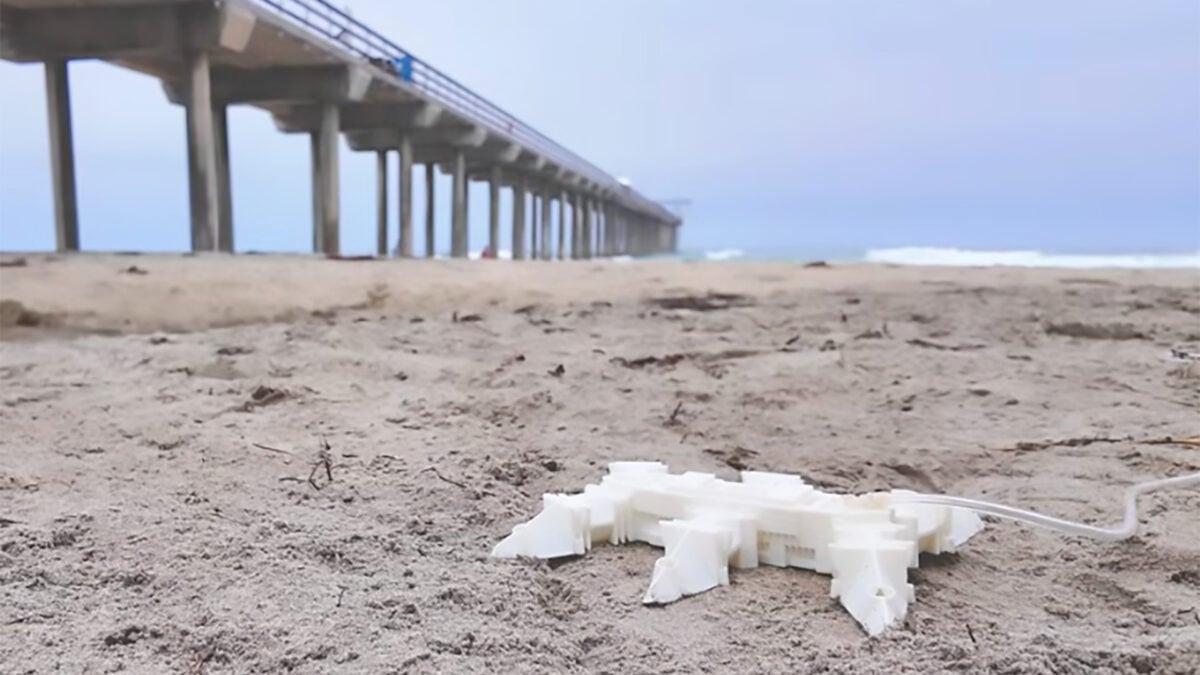
When you see the term “soft robotics,” the speed at which such robots move probably isn’t the first thing that comes to mind. However, in Grand Theft Auto VI… no, OK, just kidding. Even though it’s GTA Day, this post does not involve Rockstar’s omnipresent new release—it’s about a new paper in the journal Science Robotics detailing researchers at the University of California San Diego’s attempts to build the fastest soft robot in the land. The result of their work is a six-legged, air-powered robot that can skitter around at speeds of up to 4.72 m (around 15 and a half feet) per second. The robot is made entirely of a single soft, 3D-printed part and looks like a cross between a faintly terrifying arthropod and a small, turbo-charged terrier. I mean, dear lord, just look at it go: To put that speed in perspective, the researchers’ previous soft robot topped out at a sluggish 4 centimeters per second. This new version is more than 100 times faster; quite a leap for a machine made of squishy plastic. You might notice in the video above that the robot appears to be on a leash. That’s actually a compressed air lead, without which the little fellow can’t function. The paper also explores the idea of powering it with water pressure, and explains that water’s non-compressibility means that the robot performs in a markedly different manner as a water-powered device than its air-powered incarnation: “Compressed air enabled high-speed locomotion, whereas operation powered directly by tap water allowed the use of existing water supply systems, pointing to applications in irrigation systems, agricultural environments, and water-based cleaning tasks.” Perhaps the most striking thing about the robot is that it works without any onboard electronics, whether powered by air or water. Its lack of any control circuitry or electronic components makes it relatively cheap to produce and opens up potential applications in environments where electricity could prove a hindrance—like the “water-based cleaning tasks” mentioned above. The double-expansion oscillators take a steady supply of compressed air and distribute it through the robot in a repeating sequence of pressure pulses, causing its six legs to move in a coordinated running motion. The system also makes more efficient use of the air pressure, helping the robot achieve speeds that were previously out of reach for this type of soft robot. The results can be seen in the video above, where the robot handles a variety of terrains like they ain’t no thing. It rockets across concrete, grass, and dirt alike, but perhaps its most impressive work comes in two environments that can present a challenge to humans: soft sand and water. In both cases, the robot performs with aplomb, and it’s these abilities that allow it to glide across the beach in Vice City with— wait! No! Sorry! We’ll stop now!
This Squishy Little Robot Can Run 10 MPH Without Electronics
Full Article
Original Source
Read the full article at Gizmodo →KhanList aggregates and links to publicly available news content. We do not host full articles from third-party sources. Always verify important information with original sources.