
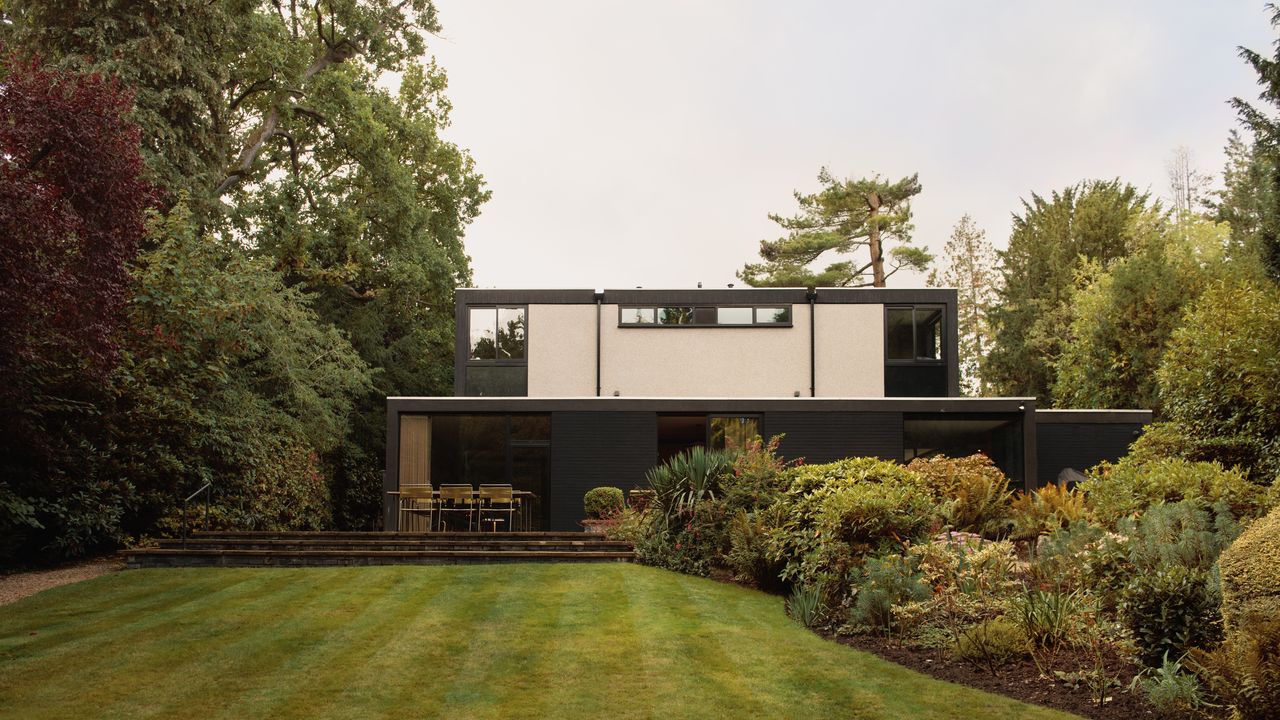
On a quiet lane in Hampstead, London, a minimalist home by British modernist architect Patrick Gwynne makes a statement. “The split-level house stood out at the time for its flat roof, its brick and stuccoed concrete, and its floor-to-ceiling glass walls,” explains Iwan Halstead, who, with Emily Potter, cofounded the interior design firm Daytrip Studio. It’s a home that’s emblematic of midcentury style—and its half-acre landscaped garden isn’t too bad either. While the house already underwent a respectful renovation a few years back, its new owners—a family and their dog—tasked Daytrip with completing yet another.The house, located in Hampstead, was designed in the 1960s by Patrick Gwynne, a leading figure in British modernism. It is distinguished by its split levels, flat roofs, brick and concrete-plastered walls, and floor-to-ceiling windows. A 1950s copper vase by Angelo Bragalini (béton brut) is perched near the bottom of the original terrazzo and glass staircase. Overhead light bathes the staircase, which provides a spectacular connection between the different levels. A midcentury jewelThe house is listed as a Grade II property—in the UK, this means the building is of special historic interest and warrants preservation. Accordingly, the interior retains many of its original features, including white-painted brick walls, grooved pine paneling, an open-tread staircase, and a custom kitchen. Apart from the necessary preservation of these elements, Daytrip wanted to stay true to Gwynne’s architectural vision.The original layout may have been avant-garde in 1960, but today, it offers a fluid and spacious path suited to contemporary family life. The large entry opens onto a similarly generous living area which flows into a cantilevered dining room and separate kitchen. A sculptural staircase made of terrazzo and glass provides an artful connection between the different levels. Upstairs, each one of the four bedrooms has an en suite bathroom.When the built-in desk is closed, it creates a spacious seating area for the armchair and ottoman designed by Charles and Ray Eames. The kitchen, a remarkable example of midcentury-modern design, had suffered over time. Its restoration, which included vibrant orange mosaic tiles, required striking a balance between historical accuracy and contemporary functionality. A Cloud coffee table by Louise Liljencrantz (Veermakers) stands in front of a sculptural, custom rosewood sofa (Daytrip)—behind it is an Encchi lamp (Matthew Verdon). A floor lamp by Freddie Tuppen (Max Radford Gallery) and a glass table by John Pawson (Wanderglass) flank a chaise longue in muted shades of warm brown and anthracite. A pair of Hi Tech armchairs by Piero Lissoni (Living Divani) and a lacquered side table by Andu Masebo (Max Radford Gallery) furnish the living room terrace. A respectful renovation“The interiors stand out for their warm color palette, which combine richness with simplicity,” says Potter. “In the living area, the original pine paneling, the rich wood floors, and the textured wall treatments made with plant fibers come together to create a natural foundation.” Daytrip custom made a 16-foot-long sofa for the living room. Upholstered in a rust-orange fabric, it rests on a sumptuous fawn-brown alpaca rug and is surrounded by brass-toned accents, like an Encchi lamp by Matthew Verdon.Nearby, a large steel-and-glass partition, featuring carefully restored shelves in Verde Alpi marble mosaic, separates the living room from the dining room, where a hand-lacquered black-and-gold bar echoes Chinese motifs found in other Gwynne-designed homes. A crimson silk rug with ivory trim evokes a bold mod color scheme. Sheer curtains made of a natural silk blend diffuse light from the floor-to-ceiling windows; their delicate sheen highlights the home’s midcentury character.Gianna Dispenza’s bronze and marble sculpture Palm sits atop the large steel-and-glass unit. In front of it, Niels Moller’s Model No. 80 chairs surround a rosewood-and-brass table designed by Angelo Mangiarotti. An Eye pendant light by Kevin Reilly (Holly Hunt) hangs above. Sculptural candlesticks by artist Grace Prince stand on the table. Behind it, the hand-lacquered black-and-gold bar echoes certain motifs found in other homes designed by Gwynne. A timeless minimalism“We drew inspiration from Patrick Gwynne’s most famous house, The Homewood in Surrey, as well as his favorite furniture designers,” Halstead shares. He and Potter sourced a mix of custom and designer pieces for the home: Pieces from renowned Italian and Swedish designers sit alongside avant-garde works, from the Cloud coffee table by the Swedish studio Veermakers, to Bruno Mathsson’s sheepskin chaise longues, to a glass table by architect John Pawson. Accordingly, Daytrip created a subtle dialogue between eras, textures, and materials within the home.In the kitchen, Daytrip updated an original orange bench with new cushions, and paired it with a Charlotte Perriand table and chairs by Pierre Chapo. The office also retains its original woodwork—there, a built-in folding desk serves as a testament to Gwynne’s interest in functional cabinetry. And in the principal bedroom upstairs, a rosewood and silk bed serves as a refined focal point. On the bedroom’s balcony, furniture swathed in muted tones creates a welcoming setting amid the canopies of the surrounding trees. The owners can look out over the garden, where Daytrip chose a monochromatic palette of moss green for the armchairs and table, both designed by Walter Lamb.The original, built-in, fold-down desk reflects Gwynne’s enduring interest in functional and flawlessly executed cabinetry. Now restored, a woven lamp by Freddie Tuppen (Max Radford Gallery) sits atop it. In the principal bedroom, the textured plant-fiber wallpaper is an exact replica of the original 1960s design. A silk-upholstered headboard (Daytrip & Treeslounge) complements a custom rosewood bed. On the balcony of the principal bedroom, furniture in muted tones creates a welcoming setting for quiet moment amid the canopies of the garden’s trees. An outdoor dining area on one of the terraces surrounding the house. The table and chairs are Walter Lamb designs. This London home was originally published by AD France. It was translated by John Newton.
This Restored London Home Proves That Terrazzo Stairs and Marble Shelves Never Go Out of Style
Full Article
Original Source
Read the full article at Architecturaldigest →KhanList aggregates and links to publicly available news content. We do not host full articles from third-party sources. Always verify important information with original sources.