
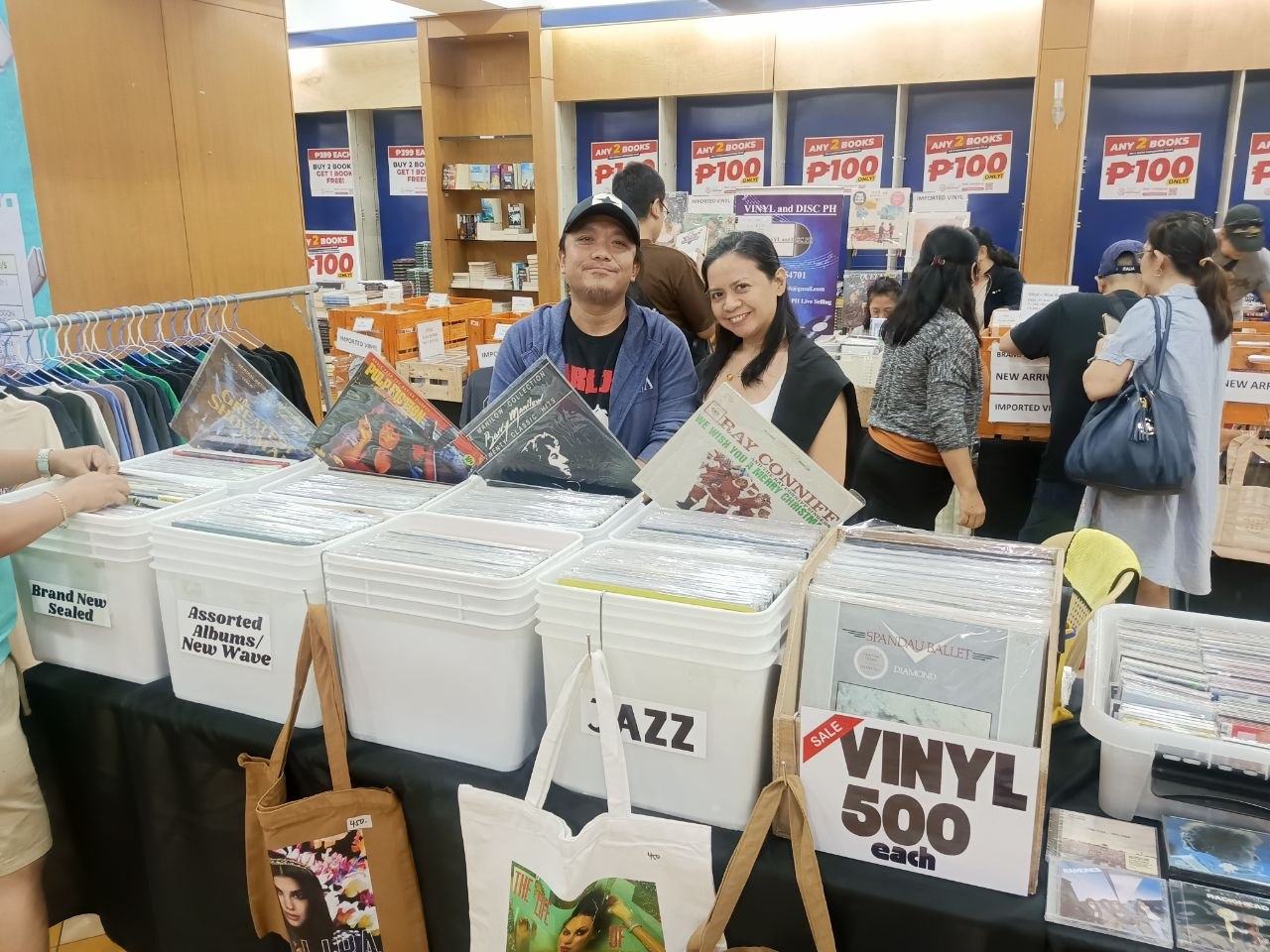
Ge Timbreza has lived and breathed music for as long as he can remember. In his younger years, he played in a band with his friends. Then, he started collecting CDs and cassette tapes just for the fun of it. TImbreza was just in high school when he bought his own cassette player. To this day, the nostalgia of listening to old records hits just as hard — and it’s a feeling he believes he can never replicate from streaming music online. Timbreza’s love for music didn’t just take him down memory lane. In 2017, it also led him to establish Spin The Reel Music Trade, which now operates daily in Pasig City. His wife, Charm, has always been supportive of him. His 16-year-old son is also one of the reasons why the business keeps running, since he also inspires him to pursue music. In the dusty shelves of Spin The Reel Music Trade are decades of history representing the hard work of artists, ready to be reached for by collectors. For collectors like Timbreza, there is a certain type of magic in being able to feel physical records and play them through turntables, cassette players, and CD players. The process is more personal, where the listener builds their own taste brick by brick, rather than having online algorithms decide the next song they should tune into. At Spin The Reel Music Trade, unassuming customers turn into regulars, and eventually pass that hobby on to their peers. Clearly, word-of-mouth is a big weapon in the world of analog music. So long as it’s kept alive by collectors and collectors-in-the-making, Timbreza believes the industry will remain. Hobby of the youth You’d think that Baby Boomers, Gen X-ers, and millennials would make up a large chunk of a record shop’s customer base. Physical media was what they grew up with after all. But Timbreza would be in for a surprise when he’d find himself doing business with Gen Zs wanting to buy and collect records of their own. Yes, the same generation that spent much of their teenage years listening to their favorite tracks on Spotify, YouTube, or Apple Music. But there will always be something to go back for when it comes to physical media. “Marami mga kabataan na gusto ring maranasan ‘yung mga dating physical media. May vinyl, ‘yan. CDs, lalo na CDs, ang dami! Pero siyempre ‘yung mga dating generation na, ‘yung mga medyo ’80s, ’70s na, naghahanap pa rin sila kung ano ‘yung mga gusto nila.” (There are a lot of young people who also want to experience physical media. Vinyls, CDs, especially CDs, there are a lot! But of course there are older generations from the ’80s and ’70s that still look for records they want.) Spin The Reel Music Trade stocks a wide range of physical records across different genres and eras. There are “oldies but goodies” that Timbreza himself listens heavily to, like The Beatles, along with modern artists like Taylor Swift. Of course, the shop is also a gold mine for physical copies of OPM hits — think Eraserheads’ Cutterpillow and Circus, Up Dharma Down’s U D D, and the more recent Grandma by Unique Salonga. Timbreza, however, is always pleasantly surprised to see the young ones come into his shop looking for older records that they first learned of through their parents. In online platforms, the algorithm automatically detects your music taste and suggests similar genres you might like. Timbreza, being in the physical records industry, values human interaction and conversations by personally recommending similar genres and music to people who ask. For Timbreza, manual playlists are better since the listener gets to handpick the music they want to listen to. Later, they get to develop a music taste through human connection rather than fed by the algorithm. These kinds of recommendations are what makes music listening more human. Connection among business owners like Timbreza and physical records enthusiasts enables personal ears for music. It inspires more people to be musicians, to develop skills in determining what they want to listen to, and eventually, how they want their own music to sound similarly to. “Iba rin ‘yung generation ngayon ng mga artists. Sila [fellow business owners] din gano’n din, nagtatanong din sa amin, ‘Oh sir, paano ‘yung mga ganito? Ano ba ‘yung mga tugtugan nito?’ Tulungan lang din kami talaga.” (The generation of artists today are different. Fellow sellers also ask us, ‘Sir, are you familiar with this? What genre of music is this?’ We all help each other.) If music is a form of expression, physical records give way for more emotions. For Timbreza, turntables produce fuller sounds compared to phones, not just in a literal sense, but in a way that it feels like you’re listening to a song while it’s being recorded live. “Kumpleto kasi ‘yung instrumento na naririnig mo doon sa tugtog mismo. And sa mga [online streaming platforms] kasi ngayon, lalo na sa Spotify, hindi mo marinig eh. Hindi mo ma-feel eh. Dito kasi sa plaka minsan parang naririnig mo parang nandoon ka sa mismong recording studio nila dati.” (Instruments you hear in physical records are clearer. Compared to Spotify, you can’t hear some details. You can’t feel much. In physical records, you can feel as if you’re in the recording studio.) Timbreza also said there were more physical records sellers like him during the early 2000s, but most of them left the industry because of the competition with online platforms. Online platforms weren’t treated as hindrances for Timbreza’s business. In fact, he utilized social media to do live-selling of his products, especially during the pandemic from 2019 to 2020. Because of that exposure, people online realized that physical records are still being sold, even virtually. “Mas maganda rin na malaman nila na, “Uy, buhay pa pala… buhay pa pala mga physical media! Mayroon pa rin palang nagbebenta.’” (It’s still good to let people know that, ‘Oh, it’s still alive… Physical media is still alive! There are still sellers.’) Loss of local pressing plants Pressing plants in the Philippines that used to mass produce vinyls and CDs have stopped operations around early 2004. However, local pressing services still exist, most of which are independent businesses. “Although sabi naman nila, ‘yung mga talagang collector ng plaka, hindi naman talaga nawala. So nandoon pa rin sa kanila. So ang nawala lang talaga ‘yung mga nagbebenta, pati ‘yung mga stores dati na nagbebenta, nawala din sila eh.” (Although they said, the collectors of records, they’re never really gone. The records are still with them. What disappeared are the sellers, the stores, they also left.) He hopes that the Philippines can once again have traditional pressing plants like before. He also advocates to reduce piracy when it comes to buying physical records. “Sana tuloy-tuloy pa rin ‘yung adbokasiya namin hangga’t mayroong physical media na nakukuha sa ibang bansa, o kung may magkaroon man tayo ulit dito ng pressing plant, much better, mas mura.” (Hopefully our advocacy will continue as long as there is physical media that can be obtained in other countries, or there can be a pressing plant here [in the Philippines] again, much better, much affordable.) Classics are also designed manually. Even with the rise of AI-generated designs, Timbreza appreciates human-made album covers better. “Mag-uusbong pa rin in the future ang mga physical media natin. Iba pa rin ‘yung original kasi eh. Iba pa rin. Parang sa mga art din nakita ko, minsan nakikita ko sa ginagawa sa AI ‘yung pag-design-design nila. So I think hindi ‘yan mawawala. Tatagal pa ‘yan, tatagal pa.” (Physical media will still emerge in the future. Originals still hit differently. Like the art I see today, some designs are AI-generated. So I think it [physical records] won’t be gone. It will last long.) Timbreza still encourages artists today to release their music through physical records to capture more audiences and inspire their fans to buy more of them. Artists are the forefront of physical media, and they can help in keeping dust away from vinyls. “Para sa akin siguro mas okay pa rin i-release nila nang physical records. Para sa akin talaga mas okay para bumalik pa rin ‘yung mga tao, tsaka mas mabebenta siguro lalo na sa mga fans nila.” (For me, maybe it’s still better for them to release music as physical records. For me, it’s better so people can also go back, and for them to sell more to their fans.) Among the music enthusiasts that contribute in keeping physical records such as vinyls, cassette tapes, and CDs alive, Timbreza vows to retain the industry in his bloodline and for more generations to come. “Sa akin naman kasi tuloy-tuloy lang kami. Tuloy-tuloy lang kami sa pagbenta hanggang sa tumanda na kami. Tuloy-tuloy lang hangga’t kaya, hangga’t buhay pa ang physical media, ipo-promote namin sa mga kabataan pa rin. Kasi feeling ko hindi naman mawawala ‘to eh.” (For me, we’ll just keep going. We’ll continue to sell until we grow old. Keep going as long as we can, as long as physical media is alive, we promote them to the youth. The feeling will never fade or disappear.) – Rappler.com Angel Camille Dio is a Rappler intern pursuing her BA Journalism degree at the Polytechnic University of the Philippines.
This record shop owner strives to keep cassette, vinyl music alive
Full Article
Original Source
Read the full article at Rappler →KhanList aggregates and links to publicly available news content. We do not host full articles from third-party sources. Always verify important information with original sources.