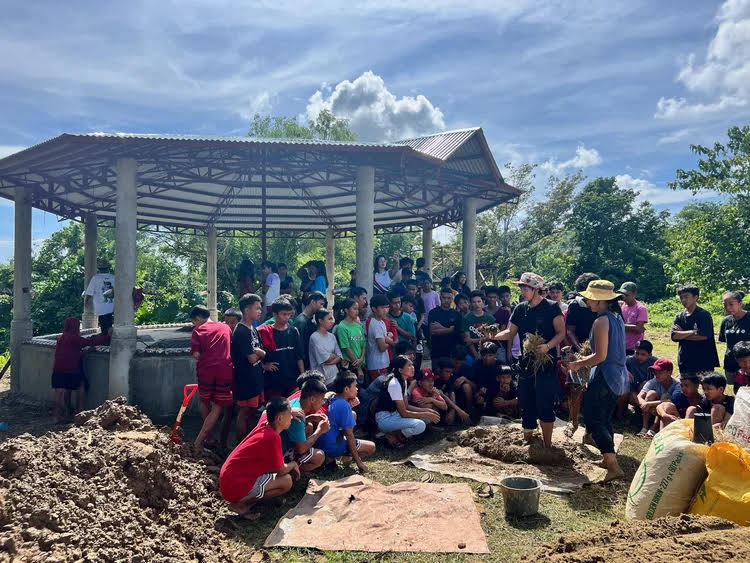
PALAWAN, Philippines – Beyond Puerto Princesa City’s bustling streets, a narrow road winds toward an off-grid community in Barangay Bacungan, where pristine beaches, forests, and a slower way of life surround Maia Earth Village, home to the Maia Earth Organization Incorporated founded in 2010. About 15 minutes from the village stands Bahay Pangarap at Bacungan National High School (BNHS), a mud wall classroom built not only with earth from the community but also with more than 2,000 discarded plastic bottles transformed into ecobricks. The project was made possible through the collaboration of Maia, Malaya Permakultura, and the Department of Education. Bayanihan spirit What began as an environmental initiative grew into a community-wide effort that brought together students, teachers, volunteers, and residents through the Filipino spirit of bayanihan. Over two years, from 2023 to 2025, students collected plastic bottles, filled them tightly with nonbiodegradable waste to create ecobricks, and helped construct what Maia describes as the country’s first student-built mud wall classroom. It was completed in July 2025. FEET AT WORK. Volunteers and students work together to mix the materials needed for the construction, making the building process a shared learning experience. Photo courtesy of Maia Earth Organization Inc. For Pi Villaraza, founder of Maia Earth Organization Incorporated, Bacungan offered more than just a location for the project. “Bacungan has a lot of potential to create these prototypes for sustainable communities,” Villaraza said. “It’s still accessible to the city, but it’s far away enough so that we can see the transition between the modern and the traditional lifestyles.” He added that Bacungan is home to communities and initiatives striving to protect Palawan from development driven purely by profit, making it a fitting place to demonstrate sustainable living in practice. Off-grid vision Rather than using conventional construction methods, Bahay Pangarap was built using mud sourced from the village itself and ecobricks made from plastic bottles tightly packed with nonbiodegradable plastic waste. Jesharelle Parcia, a Bacungan resident who helped build Bahay Pangarap, admitted she initially doubted the project would be completed because construction stretched over two years with long periods of inactivity. “I didn’t think Bahay Pangarap would be finished because the progress wasn’t continuous,” Parcia said. “When it was finally completed, it felt fulfilling because we knew we were part of that dream. We stepped on the mud and filled the bottles until it all came together.” For Graziele Burmann, a member of Maia Earth and a former teacher, the project’s greatest achievement was the enthusiasm it inspired among young people. “It was really memorable to see their enthusiasm,” Burmann said. “Everyone got curious about ecobricks, the idea of painting with rocks. With time, everyone wanted to be part of it. The plan started small; we didn’t have to force anything, and things just happened naturally. It was just about strengthening the bond within the communities.” BAHAY PANGARAP. It stands amid the greenery of Bacungan, Puerto Princesa, built through the collective efforts of students, volunteers, and the community using earth and ecobricks. Photo courtesy of Maia Earth Organization Inc. Learning beyond the classroom The construction site became an extension of the classroom itself. “Normally, when you go to school, it’s theoretical,” Villaraza said. “But this project is active-based learning. We’re not just building the school; we’re also training the kids.” Rhea Mae Tacan, a student at BNHS who helped build Bahay Pangarap, admitted she initially doubted that mud and plastic waste could be turned into a classroom. “Seeing Bahay Pangarap finished made me realize how much waste we had transformed into something meaningful,” she said. “It showed that we can build without harming the environment.” The initiative also encouraged residents to rethink plastic waste. Villaraza noted that improperly discarded plastic can persist for centuries, while burning it contributes to carbon emissions. Through ecobricks, he said, waste that would otherwise end up in landfills or the environment became a useful building material. The impact extended beyond Bahay Pangarap. Villaraza recalled that students from BNHS organized a cleanup drive that reached the entire barangay, demonstrating how environmental stewardship can begin with young people and spread throughout the community. CREATIVE LEARNING. Children take part in a creative activity at Maia Earth Village, where learning expands beyond conventional classrooms. Photo courtesy of Maia Earth Organization Inc. Building a different future For Burmann, however, the project’s lasting legacy is not measured by the classroom’s mud walls but by the mindset it helped cultivate. “People need to see that it is possible,” she said. “If you don’t change the mindset, if you don’t show that there is a different way to see things, then it’s very hard to change.” That mindset continues to shape Maia’s work beyond Bahay Pangarap. The organization is currently building a health and wellness center with barangay partners and doctors to promote nutrition and natural medicine. It is also working with persons deprived of liberty, or PDLs, at Iwahig Prison and Penal Farm, introducing natural building as a therapeutic and rehabilitative activity. Today, Bahay Pangarap stands as proof that when a community builds together, even discarded waste can become the foundation of dreams. – Rappler.com Vic Albert Bagaan is a petroleum engineering student at Palawan State University in Puerto Princesa City, Palawan. The development communication editor of Pioneer Publication, he is an Aries Rufo Fellow for 2026.
This Puerto Princesa community rethinks plastic waste, builds a classroom out of it
Full Article
Original Source
Read the full article at Rappler →KhanList aggregates and links to publicly available news content. We do not host full articles from third-party sources. Always verify important information with original sources.