
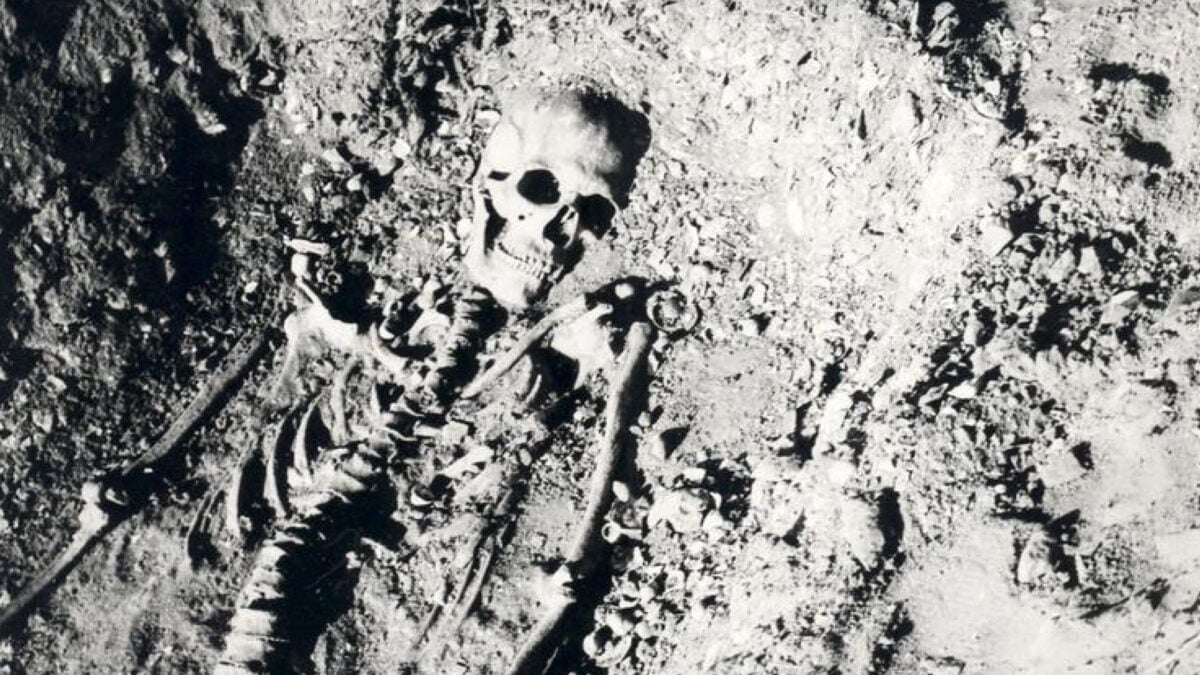
For decades, scientists were puzzled by the Rødhals Man, a skeleton from prehistoric Denmark. His bones told two different stories—isotope analysis showed a typical diet of a Mesolithic hunter-gatherer, whereas carbon dating said he lived alongside Neolithic farmers. As it turns out, his life was actually a little bit of both. In fact, the Rødhals Man may be the first known “eyewitness” to the Neolithic Revolution in the archaeological record, according to a study published today in Antiquity. The man lived roughly 6,000 years ago and was buried in a shell midden on the island of Sejerø in Denmark. The new findings build upon previous analysis of his remains while presenting new data on his bones, teeth, and genetic information. Specifically, the team believes that he grew up as a Mesolithic hunter-gatherer but later in his life interacted with the first generation of Neolithic farmers. “He did not fully embrace the farmers’ lifestyle or run away from them but adopted some components of farmer culture while maintaining the way of life of his indigenous ancestors,” John Meadows, a corresponding author of the study and an archaeologist at Kiel University in Germany, said in a statement. A paradigm shift The Neolithic Revolution is also known as the Agricultural Revolution. Although the specific timeframes vary for different regions, it was around 10,000 BCE that humans transitioned from small, nomadic hunter-gatherer groups to larger agricultural settlements. Researchers believe there was a combination of factors that led to this change. This also marked the advent of towns, cities, and massive civilizations—and subsequently the emergence of science, technology, and culture unique to humanity. Radiocarbon dating helps researchers determine when prehistoric humans lived, while isotope analysis offers clues about how they lived. Both methods depend on what survives in the archaeological record. Ideally, we’d have a representative sample from every period, but gaps in the record make it hard to trace changes over time. “Foragers seemed to have disappeared abruptly from the archaeological record just as the first farmers arrived,” Anders Fischer, the study’s lead author and an archaeologist at the University of Gothenburg in Sweden, said in the statement. The bridging evidence Credit: John Lee, Danish National Museum/Anders Fischer This was why the Rødhals Man is such a remarkable find. Radiocarbon dating indicated he died around 3800 BCE, although DNA analysis showed he was a male with “typical” European hunter-gatherer ancestry. Compared to others like him, however, the Rødhals Man’s diet was “unusually rich in terrestrial food” for a hunter-gatherer who lived near the coasts, according to the study. The new analysis revealed a remarkably detailed set of information. For instance, the Rødhals Man was roughly 5 feet (155 centimeters) tall and died when he was between 30 and 40 years old. Skeletal evidence indicates he was right-handed. The dental wear more closely resembles that of Mesolithic humans than that of Neolithic humans. He appears to have been quite healthy in his early life but later developed inflammation or vitamin deficiency. Genetic analysis points to black hair, dark skin, and an 85% probability of blue eyes. An impressive level of detail, no doubt. The new neighbors Two observations strongly suggest that he grew up Mesolithic but later adopted a Neolithic lifestyle. First, isotope analysis shows he was reliant on marine resources as a child. Then an apparent shift to terrestrial foods came during his adolescence and adulthood. Sure, he might have just been a prehistoric weirdo. But it makes more sense to assume he may have been friendly with his farmer neighbors—also supported by the fact his burial is more Neolithic in style, the team added. And if the latest analysis is correct, his story shows how human history tends to fall along a continuum of adaptation and co-existence. “It is only one person’s story, and only one generation,” Fischer admitted. But the resolution at which we’re now able to study prehistoric humans gives us “hope that we will eventually understand the choices, or fate, of any children and grandchildren of Rødhals Man,” he concluded.
This Prehistoric Hunter-Gatherer Witnessed the First Farmers—and Found a Way to Coexist
Full Article
Original Source
Read the full article at Gizmodo →KhanList aggregates and links to publicly available news content. We do not host full articles from third-party sources. Always verify important information with original sources.