
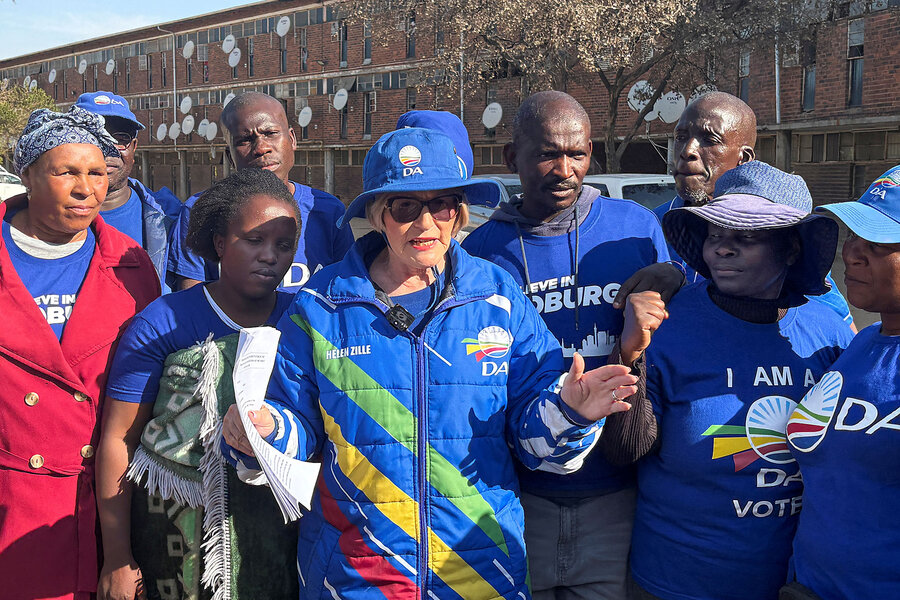
Johannesburg | Nov. 04, 2026, 12:58 p.m. ET | 5 min read Depending on who you ask, South Africa’s national sport is soccer, rugby, or laughing your way through difficult circumstances.Case in point: Helen Zille, the leading candidate to become the next mayor of Johannesburg on Wednesday. In recent months, she has repeatedly gone viral on social media for joking about the city’s collapsing infrastructure.“Here we are with a free and wonderful Saturday afternoon snorkel,” she deadpanned in one video as she dog-paddled through a flooded pothole. Ms. Zille is an unusual front-runner in more ways than just her online presence. A white septuagenarian with a flair for the politically incorrect, she has been a polarizing political figure in South Africa for a generation.Her improbable success reflects a country on a political precipice.Support for the country’s long-time ruling party, the African National Congress (ANC), is in free fall. But it doesn’t yet have an equal among the opposition parties sopping up its lost votes. Ms. Zille’s Democratic Alliance (DA) comes the closest, and the party hopes wins in Johannesburg and other major cities Wednesday will set it up for a national victory in 2029. But Ms. Zille’s campaign also offers clues that achieving a DA-led South Africa will require far more than zip-lining over a few sinkholes.Critiques of powerTo put it bluntly, many Black South Africans are not picking up what the DA is putting down. Courtesy of Helen ZilleHelen Zille began her career as a political reporter at the anti-apartheid Rand Daily Mail in Johannesburg in the 1970s. To hear Ms. Zille tell it, her politics – and the DA’s – transcend race. Supporters often point to her life story as evidence. She has what South Africans call “struggle creds,” a badge earned in part from her years as a rabble-rousing political journalist needling the apartheid government and its white public.Ms. Zille’s irreverence for power continued after the transition to democracy as she climbed the ranks of the DA, a reborn apartheid-era opposition party. Now her target was the ANC, who she called an “authoritarian racist government” in a 2009 column written during her tenure as mayor of Cape Town. A decade and a half later, she still frequently decries other parties for playing the “race card” at the expense of serving voters.“I can tell you that people just want a decent life, which means water in their taps, lights that work, not being mugged when they leave home,” Ms. Zille explained to The Times of London at the start of her mayoral campaign last December. (Through her office, Ms. Zille declined an interview for this story.)Echoing the words of former Chinese leader Deng Xiaoping, she continued: “They don’t care if a cat is black or white as long as it catches a mouse.”Nevertheless, the DA attracts far more white cats than black ones. In the last national election in 2024, the DA finished second with 22% of the vote and formed a ruling coalition with the ANC. But in a country that is about 80% Black African, just over 4% of Black voters ticked DA. Now Ms. Zille is banking on winning converts frustrated by a decade of political musical chairs in Johannesburg. Since 2016, no party has had a majority on the city council. And while unstable coalitions repeatedly fused and dissolved in the halls of power, outside these halls pipes burst and roads crumbled. At the same time, opportunistic politicians and their allies took to swiping cash from the collection plate.Sighing taps and shredded roadsThe results of that decade of decline are everywhere. In the days leading up to the election, residents across the city have often opened their faucets only to find them heaving air, as though sighing along with urbanites about the mounting water crisis. A quarter of the city’s water supply spills out of burst and leaking pipes, flooding streets with clean, clear drinking water as taps run dry. Screengrab from InstagramHelen Zille swims in a cavity created by a burst pipe in the Johannesburg suburb of Douglasdale in March 2026 as part of her campaign for mayor. It’s not just the water. On a 10-minute drive to hear Ms. Zille speak at a press conference a few days before the election, the Monitor’s reporter counted eight broken traffic lights. Headless light poles lined the road, whose tarred surface looked and felt like it had been shredded by a giant cheese grater.“Honestly speaking, Joburg has become a ghetto,” says Carlos Da Rocha, the white DA ward councillor for the area. “It has deteriorated so badly that places where we grew up, we now stay away from.”That rhetoric may play well in the suburbs, but in the Black township of Alexandra, DA candidate Selaelo Stephinah Mohlala takes a different approach. “I just want to see the community living in a place where they’re treated like human beings,” says Ms. Mohlala, a cleaner by profession.“Many options and few alternatives”A dense, high-poverty neighborhood in Johannesburg’s north, Alexandra forms half a breathtaking tableau of the city’s inequality. Here, goats nose through massive piles of garbage left uncollected for weeks in the simmering 90-degree heat. Water and electricity cuts, the growing woes of Ms. Zille’s suburban supporters, are an ordinary fact of life. Themba Hadebe/APDemocratic Alliance (DA) mayoral candidate Helen Zille is seen on an election billboard in Alexandra township, on the outskirts of Johannesburg, Oct. 31, 2026. Visible on the smog-smudged horizon, meanwhile, is the skyline of Sandton, a business district often dubbed “Africa’s richest square mile.”Many Alexandra residents see a similarly stark divide in politics.“The DA is a white party trying to blend in with Black people, when it’s clear they don’t understand us,” says Lucky Majoro, who is in his mid-20s, part of South Africa’s post-apartheid “ama2000s” generation. “They think we can’t see that, but we can.” Mr. Majoro has weighed what he sees as his two bad options – a white grandmother spinning donuts in a tricked-out township BMW, and an arrogant ANC that has barely campaigned. Ultimately, he decided not to vote at all.“Voters see many options and few alternatives,” says Nompumelelo Sibalukhulu Runji, the founder of Critical ThinkAR, a political intelligence and risk strategy firm. “People aren’t necessarily picking the DA. But they are rejecting the ANC.”Low turnout in majority Black areas could work in Ms. Zille’s favor. Leading up to the election, however, the DA was still polling under 40%, ahead of other parties but still short of a majority. It will almost certainly need a coalition partner to govern. Deepen your worldviewwith Monitor Highlights.Politics with respectGet political stories with respectful analysis.There‘s a world of new ideas in everyBooks newsletter.There‘s more to life, enrich yours withCulture & Learning weekly.Follow humanity‘s discoveries withScience & Nature stories in your inbox.Gain a spiritual perspectivefrom the stories in your inbox.Want to understand the deeper impact of critical events? Learn the Monitor‘s insight.Already a subscriber? Log in to hide ads. The most likely candidate?The ANC. ALREADY A SUBSCRIBER? LoginReal news can be honest, hopeful, credible, constructive.The Christian Science Monitor was founded in 1908 to lift the standard of journalism and uplift humanity. We aim to “speak the truth in love.” Our goal is not to tell you what to think, but to give you the essential knowledge and understanding to come to your own intelligent conclusions. Join us in this mission by subscribing.
This polarizing, pothole-snorkeling gran is leading the race for Johannesburg mayor
Full Article
Original Source
Read the full article at Csmonitor →KhanList aggregates and links to publicly available news content. We do not host full articles from third-party sources. Always verify important information with original sources.