
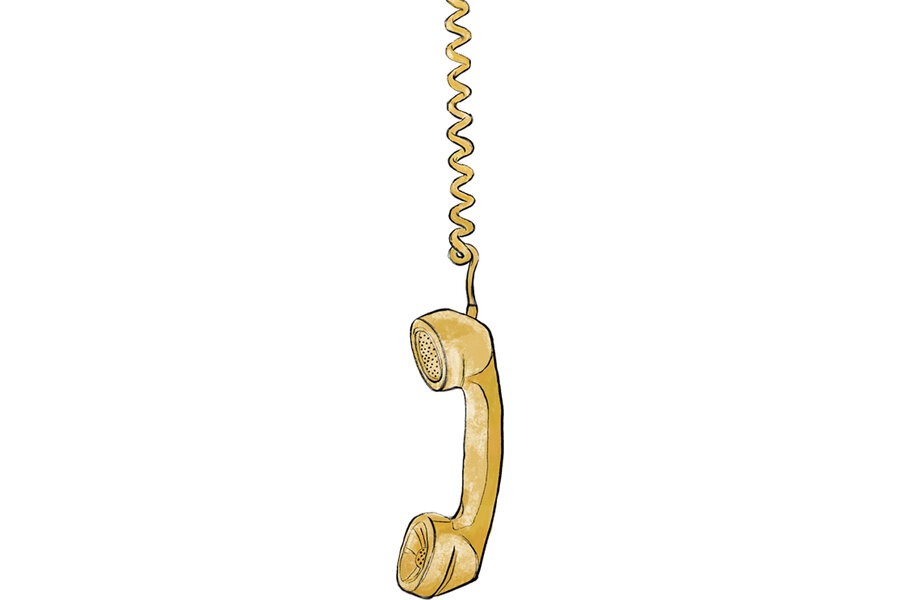
In the winter of 1975, a three-alarm fire erupted at the New York Telephone Company switching center, leaving 170,000 telephones in 300 blocks of lower Manhattan “silent and inert – gargoyles of plastic, taunting their owners with their uselessness.” Police stations, severed from emergency telephone service, sent “radio cars” out for people to flag down. Business owners, reliant on phones to verify credit cards and for customers’ orders, feared going under.During the three weeks it took for phone service to be restored, local newspapers opined about New York before telephones, where communication was conducted via calling cards, love letters, and meetings. In an era where the telephone had been taken for granted, sociologists at the time began to wonder: What do we miss when we miss the telephone?So begins “The Telephone: A New History,” the latest book by science historian James Gleick. It’s a sweeping look at the telephone as a technological artifact – from a battle over patents in the invention’s early days to the dissolution of the Bell System’s telephone monopoly in the 1980s – and as an intrinsic piece of humankind’s social fabric. The telephone’s origin story is one that might ring familiar. After years of experimenting with telegraphy, Alexander Graham Bell developed what came to be known as the telephone in 1876. But what might not be as familiar to readers is the story of rival inventor Elisha Gray, who lost a patent dispute to Graham Bell after the two men filed patents for similar inventions the very same day. The book also details forerunners to the telephone, such as Johann Philipp Reis’ 1861 Telephon, which acted like an eardrum as sound traveled through it. Other early contraptions included the hearing trumpet, which was a tubular instrument that funneled sound waves into the ear, and the “tin-can telephone,” which conducted sound waves via a string or a wire connected to metal containers.By the turn of the 20th century, Scientific American declared that “everyone, everywhere, no matter how remote, will be able to speak with everyone else.” The telephone was a great unifier.As telephone lines sprang up around the country and Graham Bell’s telephone enterprise Bell System (also known as “Ma Bell”) came to dominate, the telephone ushered in new sociocultural norms. The role of switchboard operator came to be seen as women’s work, though women of color were largely barred from the telephone industry until the 1960s. In a later chapter devoted to the telephone’s influence on storytelling, Gleick offers a deep dive into the phone’s role in the thriller genre.But then, “in an eye blink,” the cellphone arrived in the late 20th century.“The phone booths were left to rust, the phone books stopped arriving at the door, and the busy signal and the party line ... became memories,” he writes.After constant innovations, the telephone had nearly innovated itself out of existence.The cellphone “advertised a new freedom” without pesky landline cords and pay-phone prices. Telephone customer care lines staffed by human operators were replaced by automated systems and internet portals. Customers could now opt out of the phone book. “Something had flipped in people’s relationship to their phones. The connectedness once so cherished now seemed a burden,” Gleick writes. “Cell phone owners hardly ever wanted their numbers made public. They no longer wanted to be found.”At times, “The Telephone” can be dense with technical detail, but Gleick’s passionate examination of one of the most influential inventions of human history makes for a captivating read. Deepen your worldviewwith Monitor Highlights.Politics with respectGet political stories with respectful analysis.There‘s a world of new ideas in everyBooks newsletter.There‘s more to life, enrich yours withCulture & Learning weekly.Follow humanity‘s discoveries withScience & Nature stories in your inbox.Gain a spiritual perspectivefrom the stories in your inbox.Want to understand the deeper impact of critical events? Learn the Monitor‘s insight.Already a subscriber? Log in to hide ads. While the telephone as it existed in the 19th and 20th centuries may be difficult to find, traces of it remain. Though New York City officially took its last pay phone out of service in 2022, “phone booths continued to be spotted for some time.” And in a world now dominated by screens, a new generation is seeking out landline phones.“The telephone waits on a small shelf. It is not the thing in our pockets,” Gleick writes. “It is heavy and solid, a black base, a dial with ten finger holes; a handset resting in its cradle. It is disconnected.” ALREADY A SUBSCRIBER? LoginReal news can be honest, hopeful, credible, constructive.The Christian Science Monitor was founded in 1908 to lift the standard of journalism and uplift humanity. We aim to “speak the truth in love.” Our goal is not to tell you what to think, but to give you the essential knowledge and understanding to come to your own intelligent conclusions. Join us in this mission by subscribing.
This phone book connects readers with history
Full Article
Original Source
Read the full article at Csmonitor →KhanList aggregates and links to publicly available news content. We do not host full articles from third-party sources. Always verify important information with original sources.