
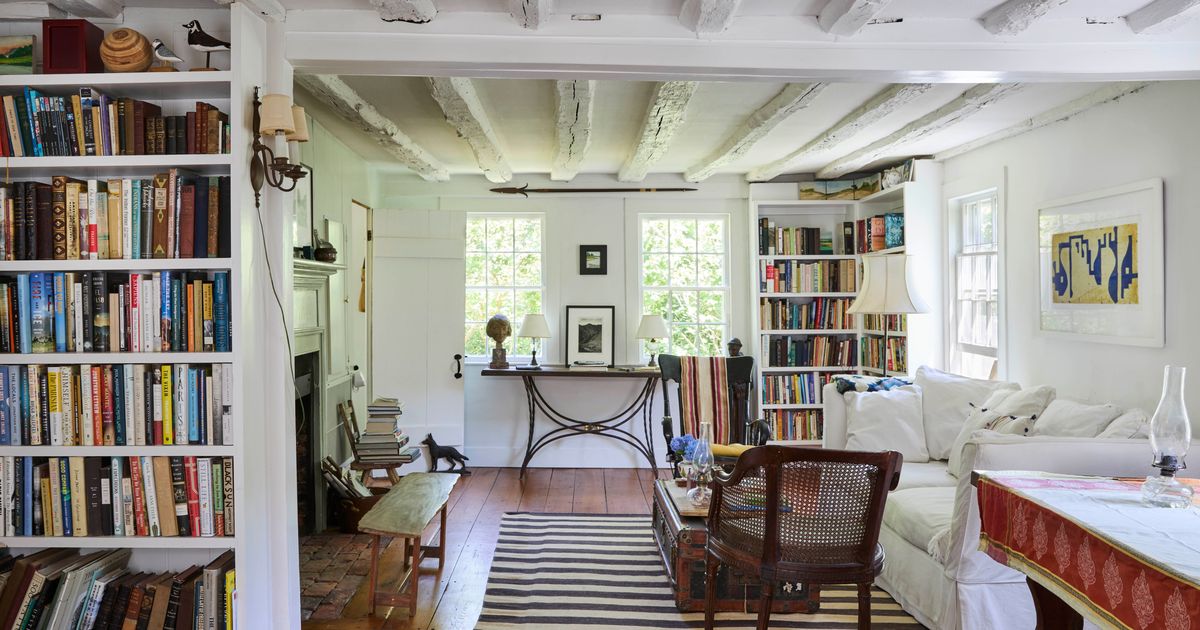
This Old, Very Old, Hamptons House The restoration of an 18th-century cottage in the Springs proves worthy of its bohemian past. By , Curbed and New York Magazine’s design editor who covers the city’s most spectacular interiors. The Living Room The wicker-backed chair belonged to Pamela Morgan’s grandmother Marie Norton Harriman and her second husband, W. Averell Harriman. The bust of Marie is by Jo Davidson. The watercolor is by Morgan. The framed photograph is by Nicholas Vreeland. The etching over the sofa is by Caio Fonseca. The rug is from Carpet Culture. Photo: Annie Schlechter The Living Room The wicker-backed chair belonged to Pamela Morgan’s grandmother Marie Norton Harriman and her second husband, W. Averell Harriman. The bust of Marie is by Jo Davidson. The watercolor is by Morgan. The framed photograph is by Nicholas Vreeland. The etching over the sofa is by Caio Fonseca. The rug is from Carpet Culture. Photo: Annie Schlechter Twenty-five years ago, the artist and custom framer Pamela Morgan got a call from a friend alerting her to the sale of a worn cottage house in the Springs believed to date back to the late 1700s. Its last owner was the literary muse Patsy Southgate. Morgan, a granddaughter of Cornelius Vanderbilt Whitney, had been renting a former chicken coop in Bridgehampton for many years with her daughter Rachael, and she had not been looking to buy. “But I listened to my friend and I came out on a horrible winter day in February. I hit the driveway, and it was too much driveway,” she recalls. The zigzagging dirt path led to grounds so overgrown with scrub oaks and tangled vines she had no idea where the property lines began or ended. The living-room windows were shrouded by wild lilacs. “I went, Oh, it’s perfect,” Morgan says. She knew how she would fix it up and that it would take a long time. “I visualized all the possibilities and got to work.” Morgan cleared the land, planted a vegetable garden, and turned an open shed into a playhouse and guest bedroom for her grandsons. She also converted a part of the house built in the 1980s into her bedroom and studio, where today she paints still-life and landscape watercolors. The newer addition was the work of Southgate, a writer and translator who had relocated to the Springs with her husband, the novelist Peter Matthiessen, after several years at the center of the American-expat scene in mid-century Paris. Their social circle on Long Island included Jackson Pollock, Willem de Kooning, and Frank O’Hara, who makes reference to visiting Southgate out East in his famous poem “The Day Lady Died.” O’Hara and Southgate were such close friends that his lover Joe LeSueur lived with her for decades. LeSueur died in 2001, and a year later Morgan bought the house from Southgate’s daughter. Southgate “had been dead a few years, but part of her arrangement was that Joe could continue living here,” Morgan says. A friend gave her a bush of climbing roses, which now covers LeSueur’s former living quarters. “Suddenly, you don’t see it’s an addition at all.” For the most part, Morgan has filled the interiors with heirloom furnishings, including the battered Louis Vuitton steamer trunk her grandparents Cornelius and Marie took on their honeymoon in the 1920s (Marie would later marry New York governor W. Averell Harriman). The hard-edge suitcase is now a coffee table that sits in the living room between the wood-burning fireplace and a sofa that’s the only significant piece of contemporary furniture. Morgan prefers to keep her home free of modern trappings. “Don’t forget,” she says. “This is one of the first houses around.” The Garden The original brick path was rediscovered by Morgan when she dug to clear the vegetable garden around 2003. The grape arbor and vines were in place when Morgan bought the property. Photo: Annie Schlechter The Main Bedroom “The bed frame came from a tag sale and cost $50,” Morgan says. The chair belonged to her grandmother Marie and was reupholstered by Morgan’s sister Alida, an artist and landscape designer. Morgan opened up the room, which was closed off, and installed doors that had belonged to her friend David Zinsser. Photo: Annie Schlechter The Kitchen The open shelves hold Morgan’s decades-old bowls from Pottery Barn as well as the Calyx Ware Lowestoft china that is a family heirloom. The table came from Morgan’s former rental home in Bridgehampton. The light fixture is from the since-closed Grand Brass Lamp Parts. Photo: Annie Schlechter The Kitchen Backsplash The yellow tile was installed by Southgate. Photo: Annie Schlechter The Staircase The stair “runner” leading to a former bedroom was painted blue when Morgan got the house. She decided to keep it that way. “It’s one of the reasons I loved the house so much,” she says. Photo: Annie Schlechter The Porch “I did not plant it, but I trained it,” says Morgan of the ivy covering the wood posts of the screened-in dining area, where she serves meals in summer. The table is made of salvaged parts, including a piece of wood found on the street in Manhattan in the 1980s. The hanging lantern was found at a yard sale. Photo: Annie Schlechter The Studio “The table by the wall belonged to my cousin, Nancy Whitney,” Morgan says. “The freestanding table came from the Stony Brook home of my paternal great-grandparents, Alida and Christopher Temple Emmet.” Morgan’s watercolors are on the wall. Photo: Annie Schlechter The Exterior The oldest part of the house is on the right, and the addition that Southgate built for Joe LeSueur is on the left covered by climbing roses. Photo: Annie Schlechter Pamela Morgan in the garden where she built raised beds for flowers and vegetables. Photo: Annie Schlechter Wake Up and Smell the Pine Trees North Fork Perch The Tree House Next Door See All This Old, Very Old, Hamptons House Your product is saved! You’ll receive emails when your saved products go on sale. Manage preferences.
This Old, Very Old, Hamptons House
Full Article
Original Source
Read the full article at Curbed →KhanList aggregates and links to publicly available news content. We do not host full articles from third-party sources. Always verify important information with original sources.