
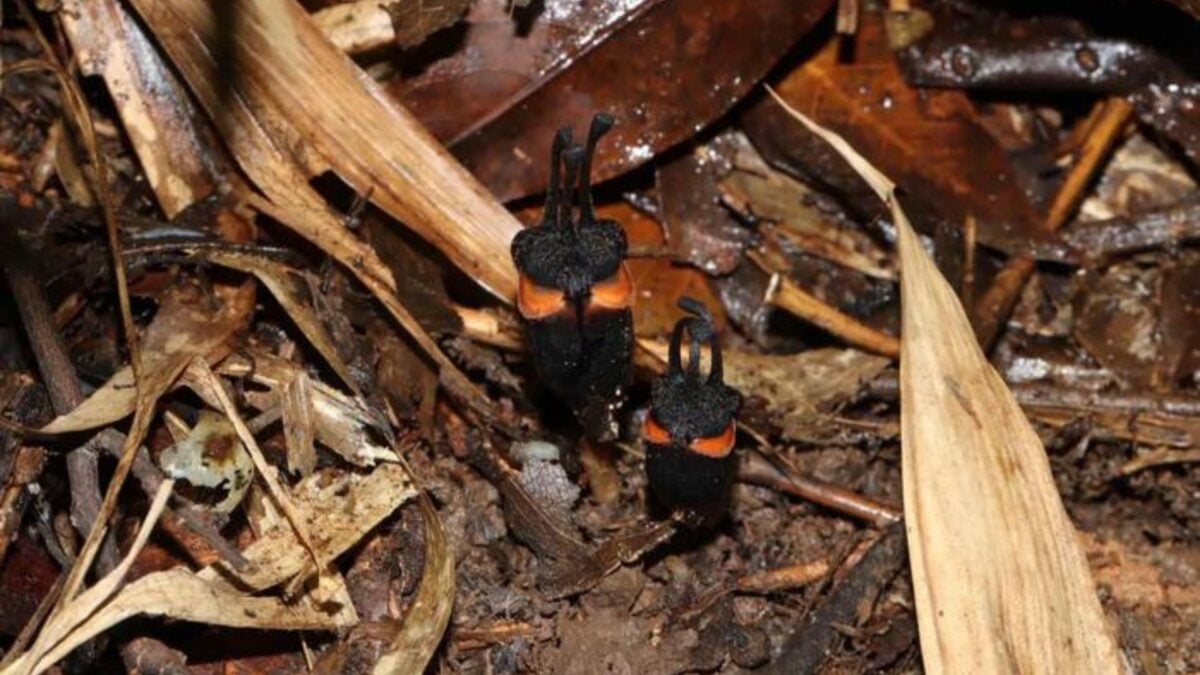
If you’re looking for some real-life inspiration for your Halloween decorations this year, you’re in luck: Scientists have just discovered a plant so spooky that they named it after the devil. In a recent study, researchers detailed how they found the plant hiding amidst a small patch of forest in Thailand’s Thong Pha Phum National Park. Adding to its demonic similarity, the mostly black leafless plant doesn’t even use sunlight for nutrition and looks like it has horns. The researchers have formally classified the new species Thismia daemona. “The specific epithet ‘daemona’ refers to the devil-like appearance of the flower, with its dark orange outer lobes and horn-like appendages,” they wrote in their paper, published last month in the journal PhytoKeys. A devilish flower Thismia is a rare genus of small flowering plants usually found in leaf litter. Commonly called “fairy lanterns,” these plants are known for not having chlorophyll, and thus, lacking the ability to photosynthesize. Instead, they’re mycoheterotrophic, meaning they draw their subsistence from underground fungi that have a symbiotic relationship with more traditional green plants. In other words, they’re parasites. Various views of Thismia daemona. © Seelanan, et al/PhytoKeys Thismia plants are eye-catching in general, but T. daemona might be the most interesting example found yet—and not only due to its devilish look, according to corresponding study author Sahut Chantanaorrapint. That’s because the plant was discovered in an environment far drier and higher in elevation than other genetically similar Thismia plants. “T. daemona belongs to Thismia section Geomitra, a lineage previously thought to be restricted to the perennially wet, lowland rainforests of the Malesian region, such as Thai-Malay Peninsular, Borneo, and Sumatra,” Chantanaorrapint, a botanist at the Prince of Songkla University in Southern Thailand, told Gizmodo. “Finding this species in western Thailand not only establishes the northernmost geographical limit for the section, but also demonstrates that these plants can adapt to seasonal, montane forests at higher elevations (nearly 1,000 meters above sea level).” Of course, the plant’s appearance is still plenty noteworthy, Chantanaorrapint adds. “Its distinctive morphology—particularly the striking combination of dark coloration and horn-like appendages—adds an intriguing layer to our understanding of floral diversification and potential pollinator specialization in mycoheterotrophic plants.” Critically endangered A closer look at Thismia daemona. © Sahut Chantanaorrapint Intriguing as this discovery is, T. daemona is probably facing a tough time surviving. The researchers have so far only documented a single population of fewer than 50 plants in an area no bigger than a football field. And though this area is protected, it’s also commonly visited by tourists, raising the risk that human activity could threaten it. The team has preliminarily designated the plant as critically endangered under the International Union for Conservation of Nature guidelines—the category right before a species goes fully extinct in the wild. More research is needed to better understand T. daemona and its less scary fairy brethren, the team says, along with sustainable efforts to ensure its survival moving forward. In the meantime, the team hopes their nifty discovery can highlight the crucial role these plants play in their environments. “Because Thismia species do not photosynthesize and rely entirely on subterranean mycorrhizal fungal networks, they serve as vital indicators of undisturbed, healthy forest ecosystems,” Chantanaorrapint said. “Discoveries like T. daemona emphasize how fragile and interconnected soil ecosystems are; protecting such peculiar organisms requires preserving the intact forest habitats and mycorrhizal networks that sustain them, ideally through community-led stewardship and conservation awareness.”
This Newly Discovered Demonic-Looking Flower Is Nightmare Fuel
Full Article
Original Source
Read the full article at Gizmodo →KhanList aggregates and links to publicly available news content. We do not host full articles from third-party sources. Always verify important information with original sources.