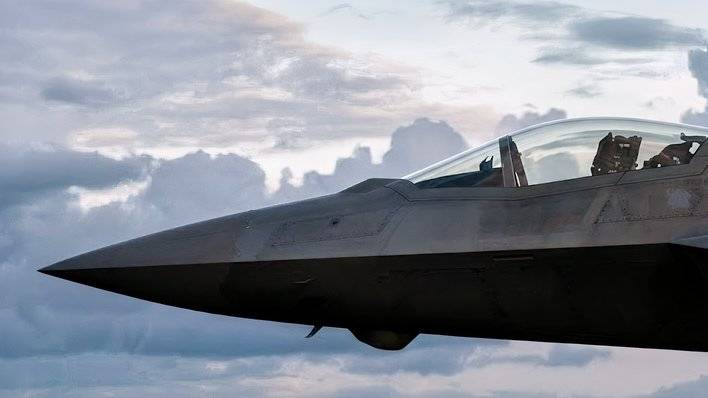
Published Aug 15, 2026, 5:00 PM EDT Chris earned a Master’s degree in Defense and Strategic Studies (Highest Honors) from the University of Texas at El Paso. His graduate work concentrated on Global and National Security, Low-Intensity Conflict, Modern Warfare, and US grand strategy. He also undertook extensive regional studies, analyzing how key regions integrate into the broader US security architecture. This rigorous program provided him with a comprehensive understanding of U.S. military operations, global strategy, and weapons systems. Additionally, he gained a strong appreciation for great power competition.—an increasingly central force shaping international relations and conflict for the foreseeable future. It seems that fifth-generation aircraft are beginning to give way to the next era of air combat, as the competition to develop a sixth-generation fighter has been underway for several years. The difference now is that these aircraft are quickly becoming a reality, with China publicly displaying its J-50 during test flights, the Boeing F-47 expected to conduct its first flight in the coming years, and the Global Combat Air Program (GCAP) continuing its development. While these aircraft all share the common goal of achieving air dominance, they appear to be pursuing distinctly different design philosophies, with the J-50 perhaps the most radical due to its clean tailless configuration and absence of vertical stabilizers. Some observers have suggested that the aircraft is simply a redesign of the F-47, but the available evidence points in a different direction. Rather than relying on traditional aerodynamic stability, the J-50 appears to represent a deliberate bet that advanced flight control software can enable a more stealth-oriented airframe by compensating for the instability inherent in a tailless design. China's J-50 Places Software At The Center Of The Aircraft's Design Credit: Weibo A significant diverging and unavoidable feature of the J-50 is that the aircraft, or at least the demonstrator models displayed to date, lack vertical stabilizers. These act like a weather vane, helping to keep the aircraft pointed into the relative airflow while resisting unwanted yaw caused by factors ranging from crosswinds to asymmetric thrust. Further, these control surfaces house the rudders, allowing the pilot or flight control system to command yaw. The natural conclusion would be to question the aircraft's stability in flight, and this would be logical. However, in order to maintain control, Chinese engineers appear to be integrating what are believed to be 2D thrust-vectoring nozzles featuring serrated edges, similar in appearance to those on the Lockheed Martin F-22 Raptor. These allow engine thrust to be redirected to improve the aircraft's pitch authority while potentially contributing to directional control in the absence of vertical stabilizers. Additionally, pivoting wingtips appear to serve as supplementary, variable control surfaces during low-speed flight, approach, or other low-energy maneuvers. While additional control surfaces aid in its stability, by design, the aircraft would essentially be impossible to control without advanced flight control software. Therefore, the J-50 would have to rely on a sophisticated flight control system that makes constant control inputs across the aircraft to ensure stability, also known as "constant adaptive control." Such a system enables efficient and safe flight in the Northrop Grumman B-2 Spirit, which likewise relies on a sophisticated, quad-redundant fly-by-wire system. By accepting the challenge of engineering an aircraft that relies on software to maintain stability, China could gain from the stealth and aerodynamic advantages offered by a tailless design, potentially strengthening its pursuit of regional air superiority. The development, testing, and public appearance of the J-50 are particularly notable and may reflect growing confidence in the aircraft's flight control system while also signaling that China intends to remain competitive with the United States and its allies in the race to field a sixth-generation fighter. Three Sixth-Generation Programs Appear To Be Pursuing Different Design Philosophies Credit: USAF While the J-50 is seemingly the only sixth-generation fighter to have publicly demonstrated a flying prototype through several flight tests since 2024, the US F-47 and the GCAP, under joint development by the United Kingdom, Japan, and Italy, remain known primarily through official artist renderings and large-scale models. Despite the limited public information, these concepts still provide insight into each program's respective design philosophy. Nevertheless, the F-47, awarded an initial contract valued at approximately $20 billion and scheduled for a first flight in 2028, appears to be pursuing a similarly tailless configuration, albeit with one important distinction. According to official artistic renderings, the aircraft will apparently feature fore-mounted canards, marking a notable departure from previous generations of US combat aircraft, although the exact configuration remains unconfirmed. If the F-47 does in fact include canards in its production configuration, they would likely provide strong pitch authority, reduce trim drag under certain flight conditions, and improve control at high angles of attack. Such operational advantages would be particularly beneficial for a long-range aircraft expected to accommodate substantial internal fuel and payload. Further, the added control authority provided by the canards could improve supersonic performance and combat maneuverability. However, the inclusion of moving foreplanes would present additional challenges in managing the aircraft's radar signature. As stated by Global Defense News: "Their possible adoption would suggest that Boeing believes their radar returns can be controlled through planform alignment, positioning, materials, and precise coordination with the aircraft's other flight-control surfaces." Unlike the J-50 and F-47, GCAP appears to have adopted a more conventional configuration featuring twin-canted vertical stabilizers. While the aircraft remains in development, the design suggests that the partner nations have opted for a more evolutionary approach, building upon decades of experience with stealth fighter development rather than pursuing a radically unstable airframe. Although vertical stabilizers can increase radar reflections compared with a tailless design, they also provide proven directional stability and reduce reliance on highly complex flight control systems, potentially lowering technical risk while helping the program meet its stated goal of entering service by 2035. The 2030s: A Strategically Significant Decade Defined By Sixth-Generation Fighters Credit: BAE Systems It is well known that air power has long been a determining factor in the outcome of warfare. The ability to control the air domain grants the superior force the ability to influence events on the ground and at sea, prevent opposing forces from entering a region unchecked, and, if hostilities ensue, leverage superior numbers and technology in terms of aircraft design and ordnance to overwhelm an adversary. In this light, it is particularly notable that the J-50, F-47, and the Global Combat Air Program (GCAP) are all seemingly on track to achieve initial operational capability during the mid-2030s. For China, the reasoning appears fairly clear: Beijing seeks to gradually push the US out of Asia and establish itself as the dominant military power in the region. Fielding the J-50 and J-36, while continuing to expand its already formidable navy, are key components of this effort. If produced in significant numbers, the two aircraft could provide China with greater numerical and technological advantages, enabling it to challenge the US and its regional allies for control of the Asian air domain. For the US, the stakes are equally high. Since the conclusion of World War II, its carefully constructed global order and security mechanisms have been underpinned by a worldwide system of US alliances, and Asia is no exception. The regional anchor in the latter is Japan, which hosts thousands of US military personnel and significant quantities of high-end military equipment. If China were to establish regional military dominance, its influence would extend further into the Pacific and place greater strategic pressure on US allies and interests. In this context, the F-47 is expected to become a vital component of the United States' future air superiority strategy, strengthening deterrence, countering Chinese military advances, and reinforcing US security commitments to Japan and other regional partners. Attaining sixth-generation capabilities is likewise a vital national interest for Japan, and the GCAP fighter is intended to provide Tokyo with the means to resist growing Chinese military pressure. Between April and June of this year, the Japan Air Self-Defense Force (JASDF) "...scrambled 181 times — 139 of those against Chinese aircraft and drones, and 42 against Russian aircraft. That is roughly two emergency launches every single day." If China were to field the J-50 in significant numbers, the operational demands placed on the JASDF would likely increase further, strengthening the rationale behind Japan's insistence on achieving the GCAP program's stated 2035 operational target. The Sixth-Generation Race Is No Longer A Future Competition Credit: Boeing The development, production, and fielding of sixth-generation fighters are vital to controlling the high ground of the modern battlefield. With China continuing to strengthen its military and the US seeking to maintain its regional influence in Asia, having the GCAP and F-47 ready for operational service has become an increasingly urgent priority. This sense of urgency is undoubtedly shared within the Pentagon, Washington, and Tokyo's National Diet Building. Within the next fifteen years, military enthusiasts will see how this strategic competition unfolds. If Beijing secures an edge with the J-50 and J-36, it may feel increasingly confident in pursuing its regional ambitions. Its navy could operate with greater freedom in the South China Sea, while China may be better positioned to increase military pressure on Taiwan and Japan and further challenge the US role as the region's primary security guarantor. Conversely, if the F-47 and GCAP enter service on schedule and are forward deployed, they will strengthen the ability of the United States and its allies to deter aggression, reinforce regional security commitments, and preserve the existing balance of power in the Indo-Pacific.
This New Tailless 6th-Gen Fighter Ditches Vertical Stabilizers & Bets The Airframe On Software
Full Article
Original Source
Read the full article at Simpleflying →KhanList aggregates and links to publicly available news content. We do not host full articles from third-party sources. Always verify important information with original sources.