
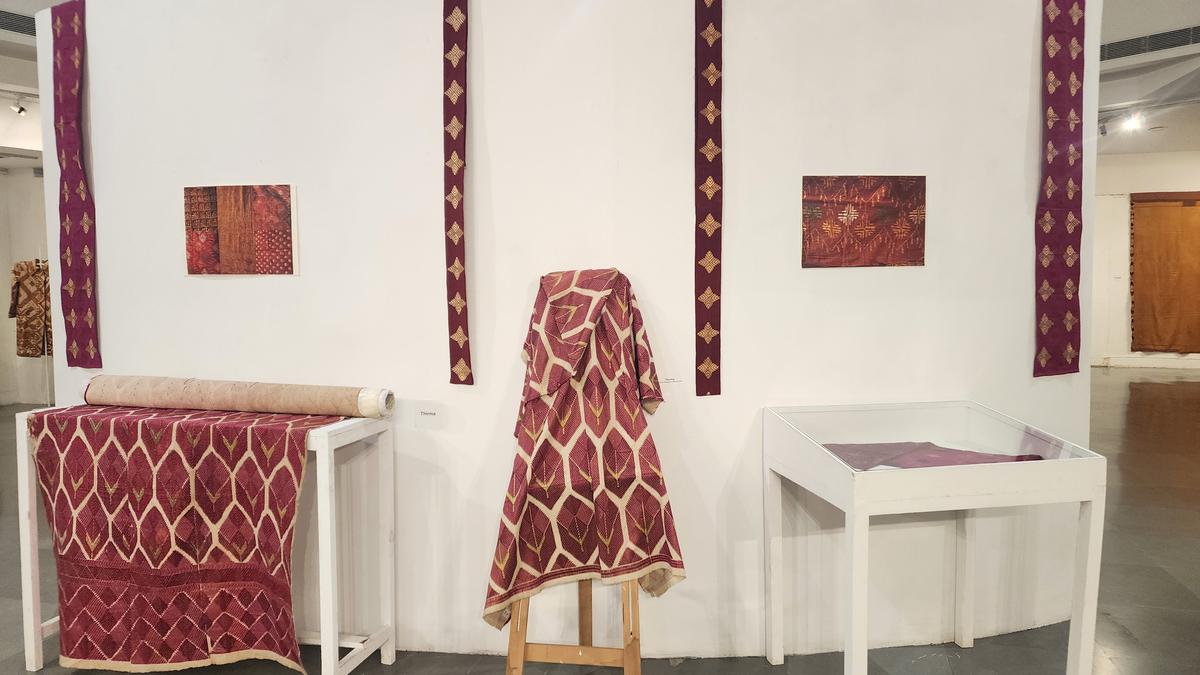
The first piece in textile designer and revivalist Sunaina Suneja’s exhibition, Phulkari: A Lingering Presence, at the India International Centre in Delhi, is displayed in reverse. It is the side that faces the viewer, exposing the stitches and loose threads usually hidden from sight. “There is a reason for it,” says Suneja. “Traditionally, phulkari was worked on like this. All the emotions were being poured on this side.”It is an apt beginning to a showcase that brings together vintage textiles from Suneja’s collection with contemporary works, and traces her long engagement with the craft.Suneja’s engagement with phulkari began in 2008, through a project in villages around Nabha intended to generate income for women. She went in assuming the women already knew how to embroider. Instead, much of the work she encountered was being made on traced or printed designs rather than through the older technique of counting threads on the fabric.Learning to lookIt took two and a half years to get the project off the ground. Thread-counting was not a matter of following a pattern; the embroiderer had to develop an eye for the weave, knowing instinctively where the needle should enter and how many threads to pick up.An elderly woman who wandered into one of the early training sessions provided an unexpected clue. She said she had embroidered in her youth and demonstrated a few stitches from the reverse. For a later project in Tarn Taran in Punjab, Suneja found herself learning the craft all over again, this time with the added task of teaching it. “My mind was also working. What are the words i was going to use? How was I going to deliver that training?”.Finding the identity of phulkariHer vintage pieces became study material. Suneja examined borders, central panels and individual motifs, comparing them across textiles. She was particularly interested in what she calls the pehchaan, or identity motif of phulkari; the visual vocabulary that allows one to recognise the craft beyond a generic floral embroidery.The absence of documentation has made the exercise one of close observation and research. Suneja compares borders, central panels and individual motifs across pieces, looking for patterns and repetitions that might reveal how the vocabulary of phulkari evolved. “When there is no documentation, you have got an open canvas,” she adds. A sainchi, for instance, led her to a book featuring a strikingly similar piece: the central panel, figures, placement and even animals corresponded. It suggested not necessarily a one-off design, but a repertoire of forms that could be repeated and adapted.That is also why Suneja resists the idea that phulkari has a fixed appearance. Chand bagh, pachranga, darshan dwāra and sona chandni reveal different arrangements of colour, geometry and motif. “Phulkari could have been any flower,” she says. “On this one, you see flowers. On another one, you see geometry.”One unfinished piece is especially revealing. It shows where the embroiderer began, how far she worked before moving on to the filling, and then stopped. For Suneja, something like this also becomes evidence of process. Elsewhere, she had women test how the thread sat on the fabric, interested in what she calls the “symbiotic relationship between the thread and the fabric”.What the textiles rememberThe textiles also carry stories of women, marriage and departure. One vari da bagh on loan was given to a friend’s grandmother when she married at 13. A chope was traditionally associated with a bride’s wedding rituals, including the bath that marked her last such ritual in her maternal home.Meanwhile, a darshan dwāra is understood as an offering connected to a temple or gurdwara, although Suneja is careful about attaching fixed meanings to such pieces. That may be what lingers in the exhibition’s title: not one definitive version of phulkari, but fragments of a language, some documented and some almost forgotten, that continues to reveal itself when someone looks closely enough.The exhibition is on till October 1, 2026 at Art Gallery, Kamaladevi Complex, India International Centre, 40, Max Mueller Marg, New Delhi. Open Monday-Sunday, 11am – 7pm
This new exhibition in Delhi revisits the many forms of phulkari
Full Article
Original Source
Read the full article at Thehindu →KhanList aggregates and links to publicly available news content. We do not host full articles from third-party sources. Always verify important information with original sources.