
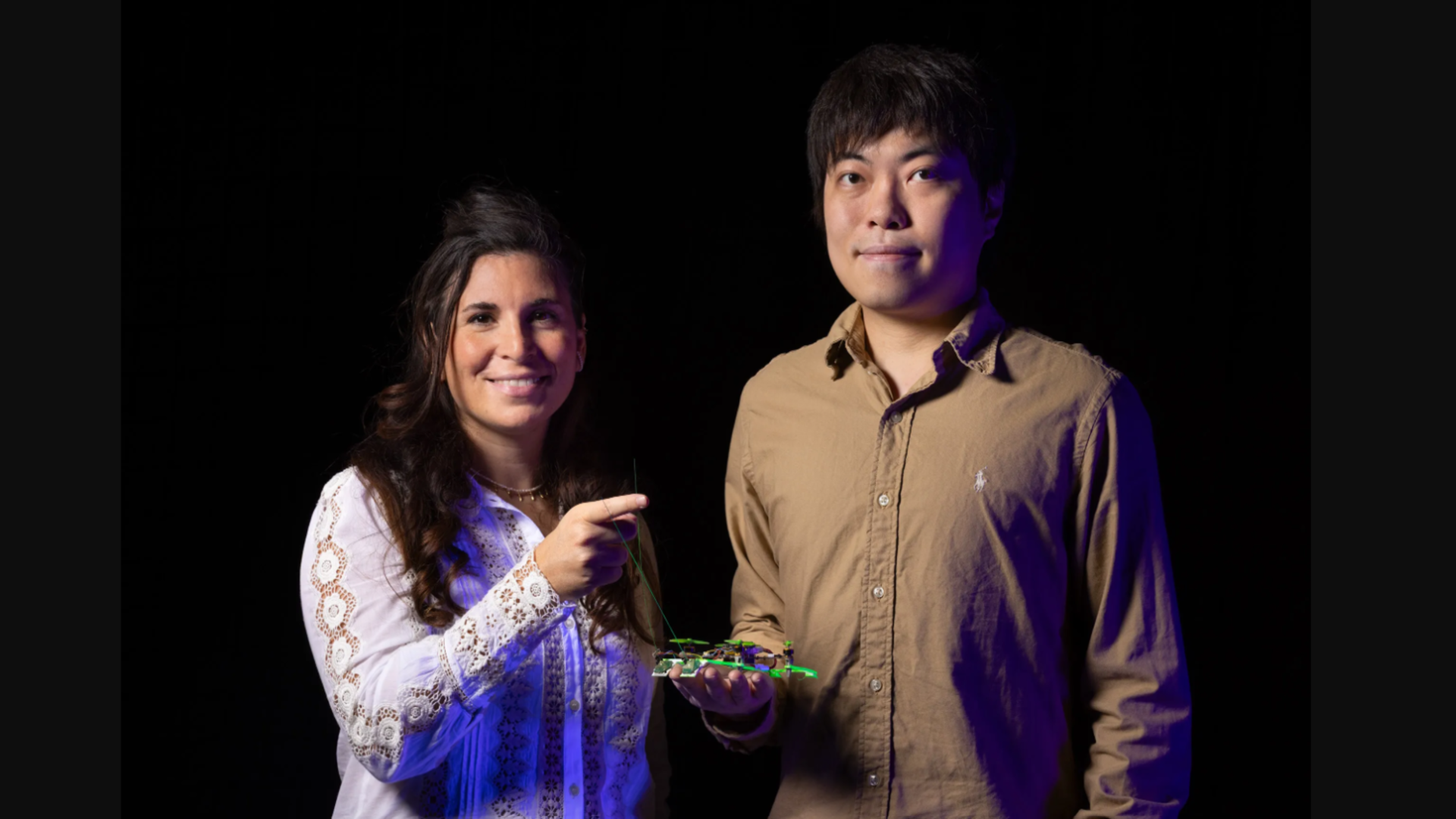
Two artificial whiskers give this tiny drone a working sense of touchPressure sensors at the whisker base detect surface contact instantlyOnboard software processes tactile data using only 34 kilobytes of memoryA research team from Delft University of Technology in the Netherlands has developed a tiny drone that uses artificial whiskers to navigate where conventional sensors struggle.The system relies on physical contact rather than cameras or satellite positioning, allowing the aircraft to detect nearby surfaces through touch.The researchers designed the technology for drones weighing below 100 grams, where adding substantial sensing equipment can quickly consume available capacity.Tiny whiskers give the drone another way to sense surroundingsThe device carries two slender filaments near its nose, angled upward and connected to miniature pressure sensors underneath.When either filament touches an object, pressure changes provide information that helps the aircraft estimate its position relative to nearby surfaces.That information allows the drone to move around obstacles, maintain contact with structures, and construct a basic representation of surrounding spaces.The approach takes inspiration from rodents and other mammals, which use facial hairs to move through confined environments with limited visibility.Sign up to the TechRadar Pro newsletter to get all the top news, opinion, features and guidance your business needs to succeed!“Here, we aim to equip drones with rich tactile sensing — not for manipulation in the air, but for a novel concept of tactile navigation,” said Salua Hamaza, Associate Professor of Aerial Physical Interaction and Embodied Intelligence.The system needed to be lightweight, process rapidly, and consume limited energy before tactile navigation could become practical aboard small aircraft.The sensing system runs on only 34KBA major hurdle was airflow, since passing wind can easily disturb whisker readings and confuse the pressure sensors beneath them.To solve this, the researchers wrote a lightweight processing program that separates turbulence from genuine surface contact in real time with millimetric precision.The complete onboard software occupies just 34 kilobytes of memory, keeping the computational requirements unusually low for an autonomous sensing system.Traditional navigation software built for larger drones typically demands considerably more computing power than this compact whisker-processing system requires today“We wanted to show that touch does not have to come at the cost of size or computational power,” said Chaoxiang Ye, a PhD candidate and researcher at Deft.The small size allows the drone to interpret environmental information without depending on external processing.The approach will not suit the fastest drones, but for small rescue units, sensing through touch may prove genuinely valuable.This device is especially useful for environments where smoke, dust, darkness, or damaged infrastructure could interfere with cameras and other optical equipment.One potential application of this drone is in collapsed buildings where rescue operations can prove to be difficult because of instability and tight spaces, and regular aerial sensing may be unreliableSmall drones could enter restricted spaces ahead of human responders, using physical contact to gather information about nearby structures and possible pathways.The system could also provide another sensing method when GPS signals are unavailable or visual information becomes difficult to interpret.Via TomsHardware Follow TechRadar on Google News and add us as a preferred source to get our expert news, reviews, and opinion in your feeds.
This new drone comes with 'whiskers' to help it navigate in the dark or smoky and dusty areas like battlefields — and it weighs less than 100g
Full Article
Original Source
Read the full article at Techradar →KhanList aggregates and links to publicly available news content. We do not host full articles from third-party sources. Always verify important information with original sources.