
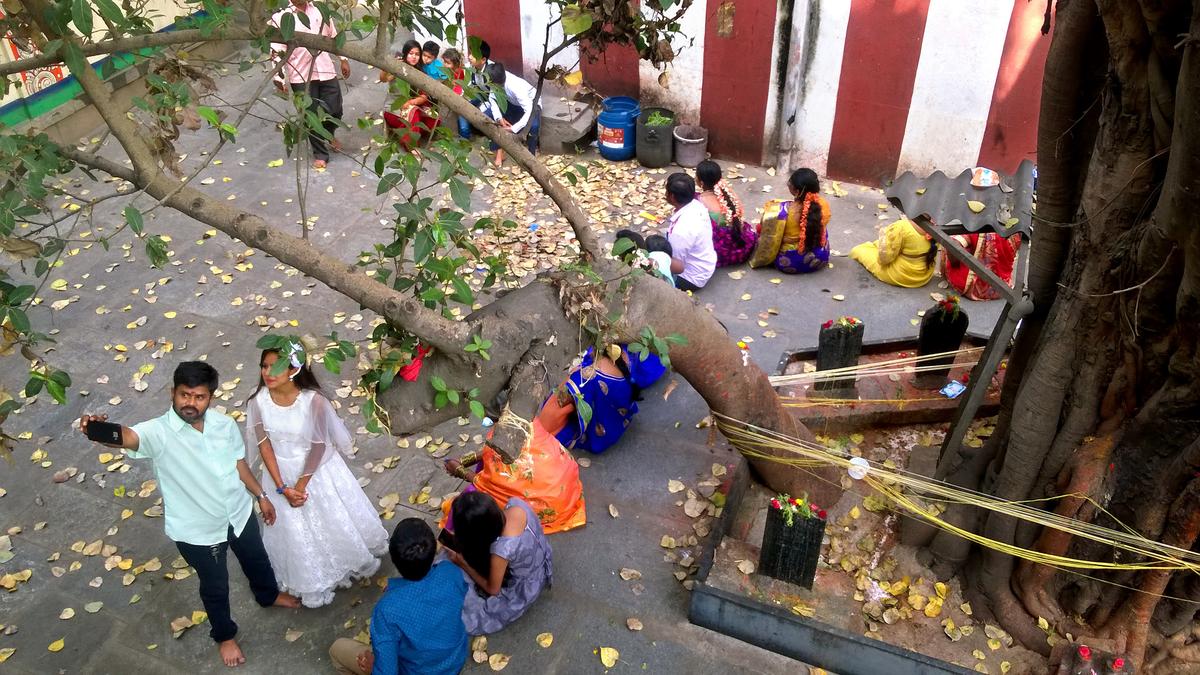
The genesis of The City Beneath the Tree: How Design and Social Interactions Shape Small Public Spaces in Bengaluru, a new book published by Permanent Black delving into the ashwath kattes of Bengaluru, goes back over a decade. “Somewhere in 2015, I went to a volunteer meeting for the Bangalore Tree Festival, where I heard the term ‘ashwath katte’ for the first time,” recalls Bengaluru-based architect and urban designer Kiran Keswani, who has co-authored the book with Suresh Bhagavatula, Professor of Entrepreneurship at IIM Bangalore. “Once we had heard about them, we realised that they were just everywhere,” she says.They soon realised that ashwath kattes were not only traditional places of worship, but were also active social spaces used by people across generations, including the elderly, office-goers, and mothers with their young children. As someone who works on networks and how they play a role in creating possibilities for people, Suresh also noticed that when people visit kattes to interact , connections leading to trust and reciprocity are created. “Who we spend time with has a great role to play in what we become in life. So, I began thinking about how spaces like this could influence the networks of those who visited the space,” he says. Kiran Keswani | Photo Credit: Special Arrangement To explore these spaces further, Suresh and Kiran wrote a joint proposal for the Azim Premji University External Research Grant under the theme ‘Urban Sustainability and Governance ’, which came through for 2018-19. “We began delving deeper into the networks of the people who visited these kattes,” says Suresh.Using citizen science, they mapped around 100 kattes around Bengaluru, choosing 20 for in-depth research. From an urban design perspective, Kiran says, the study evaluated parameters like spatial organisation, accessibility and walkability. They also used a “name-generator” technique to understand social networks at these spaces better, says Suresh. “Asking people who they interacted with over the last six months helped us analyse the networks at each of these kattes.”One of the things that these kattes hint at is how much Bengaluru, as a city, has expanded, with the urban centre taking over many villages at the peripheries. “While on one front, Bengaluru is modern with lots of glass and steel, there is also a part where people are hanging on to some of these older traditions of what the neighbourhood was,” says Suresh. For instance, some of these kattes, including the one at Mavalli, serve as sites for the ooru habba, a traditional village festival celebration. “While the village itself is integrated into the urban fabric with its physical boundaries now not visible, the processional path of the once-in-three-years ooru habba still traces the boundary of the village,” says Kiran. During the course of their research, they made yet another discovery: many of the kattes are located near Mariamman temples. “Since these kattes do have rural origins, and in the past, it was believed that the peepal tree or ashwatha was the embodiment of the deity, the tree was at every corner of the village, meant to protect it from natural disasters or calamities,” she explains. A kind of urban commons | Photo Credit: Special Arrangement One more insight that came out of this study was that while there is indeed a religious angle to these kattes, these spaces can be considered a kind of urban commons. “Everybody comes together here, so the “commoning” is the religious, social and economic practices through which people co-manage these spaces,” says Kiran, comparing these spaces to parks, which can also be thought of as commons, but are controlled by the local government. “In that sense, a katte is more a commons than a park, since here the ownership is with the community,” she says.The book, which they began working on around two-and-a-half years ago, also touches upon the relevance of kattes in Bengaluru’s urban design and planning. “We feel that they are a fantastic model of “shared spaces”, given the interdependencies between the religious, social and economic activities, with footfalls from one bringing footfalls to the other,” says Kiran. “We don’t have the resources that the West has, so creating a public space model that is suited to what we have, and our culture makes more sense.” Suresh Bhagavatula | Photo Credit: Special Arrangement She, therefore, hopes that this book manages to reach many Bengalureans and people working on urban design, she says. “We need to have an Indian idiom of urban design, and the kattes are a great example.”
This new book explores the ashwath kattes of Bengaluru
Full Article
Original Source
Read the full article at Thehindu →KhanList aggregates and links to publicly available news content. We do not host full articles from third-party sources. Always verify important information with original sources.