
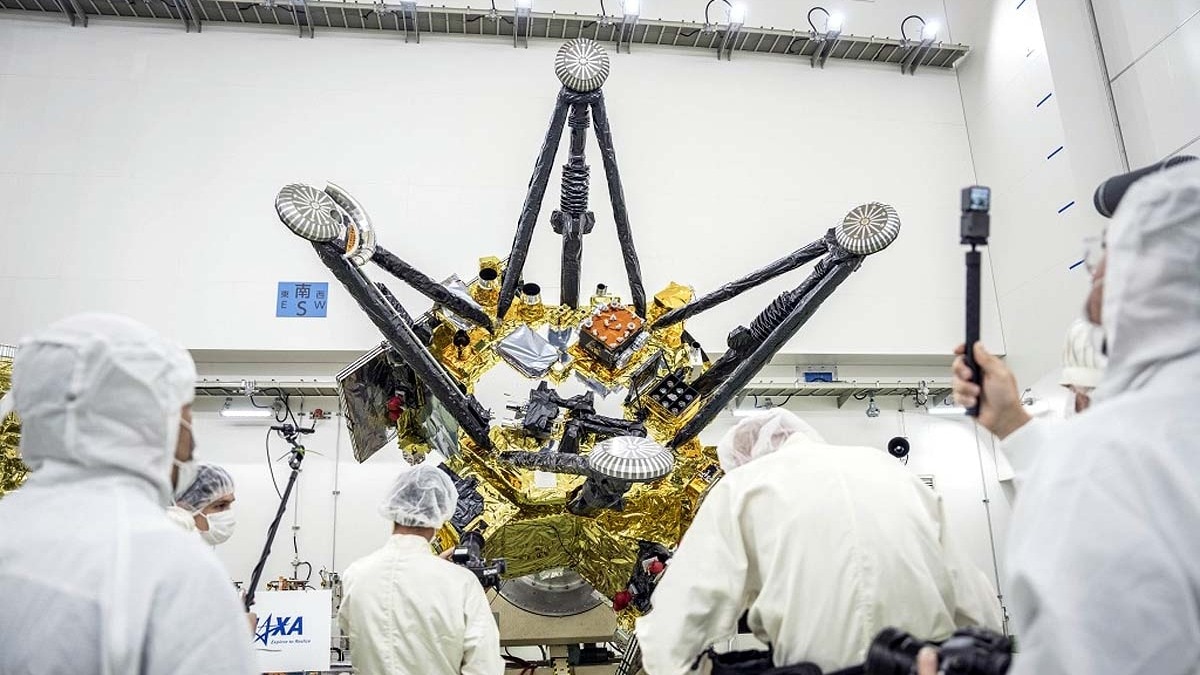
JAXA is set to launch MMX towards Phobos with 13 instruments and the IDEFIX rover. The mission seeks Martian moon samples and evidence about the origins of Mars' satellites.The Martian Moons eXploration (MMX) mission aims to return at least 10 grams of material from Phobos to Earth by 2031. (Photo: Jaxa)New Delhi,Oct 19, 2026 11:18 ISTJapan's ambitious mission to Mars' mysterious moon Phobos is scheduled to begin its journey in the early hours of October 20, with the spacecraft carrying a suite of scientific instruments and a rover designed to investigate the moon and bring extraterrestrial material back to Earth.The Japan Aerospace Exploration Agency (JAXA) is targeting liftoff at 1:11 am IST on October 20 aboard an H3 rocket from the Tanegashima Space Center.The Martian Moons eXploration (MMX) mission aims to return at least 10 grams of material from Phobos to Earth by 2031, marking the first attempt to collect and return samples from a Martian moon.The five-year mission will investigate the origins of Phobos and Deimos, Mars' two moons, and look for clues to how the Red Planet and the wider Solar System evolved. The spacecraft consists of three modules: propulsion, exploration and sample return. (Photo: Jaxa) Scientists are trying to establish whether the moons are asteroids captured by Mars' gravity or formed from debris after a major impact on the planet.WHAT IS MMX CARRYING TO PHOBOS?MMX is equipped with 13 scientific instruments and a German-French-developed rover, IDEFIX, to study Phobos from orbit and on its surface. The spacecraft consists of three modules: propulsion, exploration and sample return.Among its key instruments is TENGOO, a high-resolution telescope camera that will map Phobos' terrain and help identify potential landing sites. OROCHI, a wide-angle camera, will examine the distribution of materials across the moon, including hydrated minerals and organic matter. Graphic: Jaxa The spacecraft also carries MIRS, a near-infrared spectrometer that will investigate the moon's mineral composition and search for water-related substances and organic compounds.MEGANE, developed with NASA's support, will use gamma rays and neutrons to determine the elemental composition of Phobos' surface. A laser altimeter, LIDAR, will measure surface elevations and help build a detailed topographic map.The IDEFIX rover, developed by France's CNES and Germany's DLR, will explore the surface before the main spacecraft attempts to land and collect samples. The mission also carries instruments to study dust around Mars, charged particles and the radiation environment during its journey.HOW WILL JAPAN BRING BACK SAMPLES?After reaching the Martian system in 2027, MMX will conduct detailed observations of Phobos and also study Deimos during its mission. It is expected to spend about three years investigating the Martian moons.Around 2030, the spacecraft is scheduled to attempt surface operations and collect at least 10 grams of regolith — loose material covering the moon's surface. Graphic: Jaxa Its sampling system includes a corer and a pneumatic sampler, allowing material to be collected using different techniques. The samples will be sealed inside a return capsule for the journey back to Earth, with recovery planned for 2031.WHY DOES PHOBOS MATTER?Phobos may contain material ejected from Mars by ancient asteroid impacts. If that material is preserved on its surface, samples could offer clues about the planet's geological history, the presence of ancient water and the chemical ingredients relevant to habitability.By studying the samples alongside observations of both moons, scientists hope to resolve a long-standing question about how the Martian system formed.More importantly, Phobos is on a collision course with Mars. It's nearing Mars at a rate of six feet every hundred years. At that rate, the moon will either crash into Mars in 50 million years or break up into a ring.Beyond the science, MMX will test technologies needed for future deep-space missions, including landing on small celestial bodies, collecting samples and maintaining reliable communication across interplanetary distances.- Ends
This Moon will crash into Mars. Japan is launching a spacecraft to land on it
Full Article
Original Source
Read the full article at Indiatoday →KhanList aggregates and links to publicly available news content. We do not host full articles from third-party sources. Always verify important information with original sources.